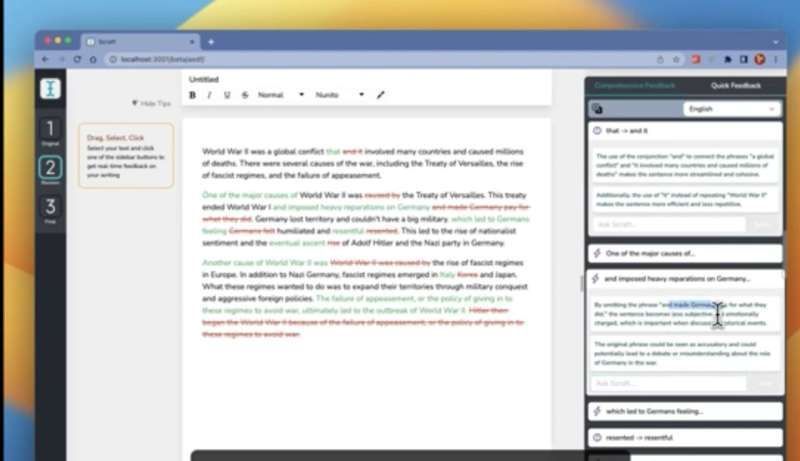
A smart education system combines traditional teaching, online tools and data analytics, so that instruction adapts to each learner and resources are available in many places and at many times. Within that system, AI-powered tools for education are not equally proven. Intelligent tutoring has raised test scores in controlled evaluations, learning analytics dashboards have no evidence of achievement gains, and privacy and equity gaps limit real-world impact. The rest of this piece sets out what the parts are, what each kind of tool has shown in controlled studies, and what a school has to get right before the data starts flowing.
What a smart education system is made of
One review of big data in higher education describes smart education as having three basic components: smart settings, smart pedagogy and smart learners. The same review gives a blunter working formula: traditional method plus online tools plus big data analytics equals smart education.
In practice, the technology layer usually sits on a learning management system (LMS). The review lists the technologies found in smart education systems: smart and virtual classrooms, e-books, learning analytics, virtual and augmented reality, cloud computing, mobile devices and social networks. Of these, it found learning analytics, e-books, mobile devices and cloud computing used most often.
Technology does not, by itself, necessarily improve educational practice, and inappropriate use can even hinder learning.
How AI-powered tools for education are used today
A systematic review of 258 studies from 2020 to 2025 on AI in elementary STEM education gives a useful snapshot of where the effort goes. Intelligent tutoring systems account for 45% of studies, learning analytics 18%, automated assessment 12%, computer vision 8%, educational robotics 7%, multimodal sensing 6% and AI-enhanced extended reality 4%, with adaptive content generation also represented.
Intelligent tutoring systems (ITS) are among the earliest uses of AI in education. They give immediate, personalised feedback, and they model each student’s knowledge so they can set tasks just above the student’s current ability. Most ITS interact at the level of individual solution steps rather than only checking final answers. That granularity is a large part of why they behave more like a tutor than a quiz.
Adaptive learning uses an individualised interface and materials that accommodate each learner. Content, pacing and difficulty adjust to the individual, which lets students work towards mastery at their own pace. The 2025 review found adaptive content delivery particularly effective for procedural skills.
Generative AI is also in use in education. It is used for personalised feedback, planning classroom activities, supporting students with special needs, administrative work and assessment. It can also produce incorrect output (hallucination) and biased output, which has led to calls for transparency about training data and for teacher training and policy. Language learning is one area where these trade-offs are already visible, and the uses and limits of generative AI in language learning are covered separately.
Automated assessment and computer vision round out the picture. Automated assessment gives real-time feedback and detects misconceptions, but it focuses on procedure and struggles with open-ended responses. Computer vision for attention and engagement monitoring is still emerging, and it carries privacy, cultural-bias and reliability problems with young children.
Does intelligent tutoring actually improve results?
On controlled evidence, intelligent tutoring raises test scores, though the size depends heavily on how it is measured and implemented.
A meta-analysis by Kulik and Fletcher covered 50 controlled evaluations of intelligent tutoring. It found a median effect of 0.66 standard deviations over conventional instruction, roughly moving a student from the 50th to the 75th percentile. A review by VanLehn compared human tutoring, computer tutoring and no tutoring. It found an effect size of 0.79 for human tutoring and 0.76 for intelligent tutoring systems, making them nearly as effective as human tutoring.
The headline number needs three qualifiers:
- Test alignment. Kulik and Fletcher found that measured gains depended a great deal on whether a locally developed test or a standardised test was used. In other words, the match between the test and the instructional objectives drives the result.
- Implementation quality. Evaluations with flawed implementations or unconventional control groups showed small effects.
- Time to work. A RAND randomised trial of Cognitive Tutor Algebra I, published in 2014, found no effect in the first year of implementation and evidence of positive effects in the second.
A randomised controlled trial compared a custom AI tutor with an in-class active learning lesson for college students. Students using the tutor learned significantly more in less time. After controlling for ceiling effects, the authors estimate an effect size of 0.73 to 1.3 standard deviations. The median time on task in the AI group was 49 minutes.
The tutor’s pedagogy was engineered into its system prompt. The platform walked students through multi-part problems in sequence, because a prompt alone could not hold that structure reliably. To limit hallucination, the prompts were supplied with full step-by-step solutions. Building the tutor platform itself took several months. The authors do not claim structured AI tutoring will always beat active learning, for example where complex synthesis and higher-order thinking are needed. They also cite earlier studies where unstructured AI use reduced reflection or lowered performance.
So the evidence supports a designed, scaffolded tutor. It does not support a general chatbot pointed at a syllabus.
The wider research base also deserves caution. The 2025 review of elementary STEM studies reports conversational AI effects of d=0.45 to 0.70 where they were reported. However, only 34% of studies reported standardised effect sizes. In the same review, 38% of studies had fewer than 50 participants, 45% ran for less than four weeks, and 52% of quasi-experimental designs had no control group. The authors judge that publication bias probably inflates apparent effectiveness. They also note that 90% of studies came from North America, East Asia and Europe. Separating that kind of evidence from announcements is its own skill, and reading AI in education news headlines against what actually ships is a reasonable companion to this section.
Evidence at a glance: AI tool types compared
| Tool type | Typical use | What controlled evidence shows | Main caveat |
|---|---|---|---|
| Intelligent tutoring systems | Step-level feedback, mastery pacing | Median 0.66 SD across 50 evaluations; 0.76 vs 0.79 for human tutoring | Gains depend on test alignment and implementation; may take more than a year |
| Structured generative-AI tutor | : | 0.73 to 1.3 SD | Depends on expert prompts, scaffolding and model choice |
| Learning analytics dashboards | Progress visualisation for students and teachers | No evidence of improved achievement across 38 studies | Participation is the exception; no well-powered randomised study |
| Predictive early warning | Flagging at-risk students | In elementary STEM, can flag struggling students within the first few sessions | Models show bias, and course-specific and generalised models differ in predictive power |
| Automated assessment | Grading, misconception detection | Moderate evidence in the 2025 review | Measures procedure and recall, not deeper understanding |
| Computer vision engagement monitoring | Attention and pose detection | Emerging evidence | Privacy, cultural bias, reliability with young children |
Can learning analytics help teachers assess students?
Learning analytics can help teachers spot students who are struggling. On current evidence, learning analytics dashboards have not been shown to raise achievement, and analytics never gives a complete picture of an individual’s learning.
One review describes analytics in three layers. Descriptive analytics examines enrolment patterns and monitors academic progress. Predictive analytics forecasts attrition and course performance. Prescriptive analytics proposes learning paths and early interventions. Early warning systems built on clickstream data, time on task and response patterns can flag struggling students within the first few sessions.
The weaknesses are just as concrete. A 2023 systematic review of 38 studies found no evidence that learning analytics dashboards have improved academic achievement, and most studies reported negligible or small effects. Participation was the exception: several studies found medium to large effects on engagement in online settings. Many studies simply compared users with non-users, which mixes up the dashboard’s effect with how engaged the students already were. The review found no well-powered, properly randomised controlled study at all.
Prediction has its own failure modes. Researchers studied nine undergraduate blended-learning courses with 4,134 students. They found that course-specific and generalised predictive models differed in both predictive power and in which predictors mattered. Merging LMS logs across courses without accounting for how each course uses the LMS can overestimate or underestimate the effect of its features. In elementary STEM, early-warning models often perform poorly for students whose learning patterns differ from the training data, particularly affecting under-represented students.
One of the most referenced cautionary cases is Purdue University’s Course Signals. It used a green-yellow-red scheme to flag students at risk of dropping out, withdrawing or failing. Purdue claimed that taking Course Signals courses improved retention. A 2013 analysis by Mike Caulfield argued that the data may suffer from reverse causality. Students who dropped out mid-year took fewer Signals courses simply because they took fewer courses overall. Caulfield argued that, absent controls for reverse causality, the retention impact was likely positive but well below Purdue’s claimed 21%.
The 2025 review notes that classroom sensing models degrade through concept drift and need monitoring and periodic retraining.
The UK’s Jisc code of practice for learning analytics sets out institutions’ responsibilities. Analytics should serve students, be used for formative rather than summative purposes, and be understood as never giving a complete picture of an individual’s learning. It also asks institutions to make sure that labelling students does not bias how staff treat them. On the interface side, the 2025 review recommends interpretable, teacher-facing indicators over opaque algorithmic scores.
What privacy risks come with smart education technology, and how should schools handle them?
The risk is not hypothetical. Human Rights Watch reported on 163 EdTech products endorsed by 49 governments during the pandemic. It found that 145 of them (89%) appeared to engage in data practices that risked or infringed children’s rights, often monitoring children secretly and without consent. Those products sent or gave access to children’s data to close to 200 third-party companies, mostly in advertising technology. As of November 2021, none of the governments reviewed had carried out a technical privacy evaluation of the products they recommended. Nor is the problem limited to advertising. In December 2025 the US Federal Trade Commission took action against Illuminate Education over a breach exposing the data of more than 10 million students, and it alleged that the company waited nearly two years to notify some school districts.
The Electronic Frontier Foundation has reported that school devices often collect far more data than necessary and store it indefinitely, including browsing history, location and behavioural information. In 2018 the FBI warned that student data such as browsing history, academic progress, medical information and biometrics created privacy and safety threats if it was compromised.
The Council of Europe, as quoted by Human Rights Watch, observed that because education is compulsory, children are not in a position to consent freely.
Handling falls into two parts: contracts and governance, and system design.
On governance, US guidance from the Department of Education’s Privacy Technical Assistance Center (2014) explains that FERPA protects personally identifiable information in education records. Under the school official exception, a provider may use that data only for the purpose it was shared for and may not re-disclose or sell it. The guidance treats FERPA as a minimum. It recommends contracts that define permitted uses, re-disclosure limits, and data destruction at the end of the contract. It also recommends telling parents and students what is collected, even where the law does not require it, and considering consent case by case even where FERPA does not demand it. Jisc makes the same point from the UK side: complete transparency about purposes, data and processes is essential.
On design, the 2025 review makes concrete recommendations. Collect only the data streams that teaching needs, pseudonymise and aggregate, obtain informed parental consent, and design outputs as teaching tools rather than monitoring systems. For classroom sensing, choose the least-identifying sensor that still works. Process data on an edge node in the classroom, so that only aggregated or de-identified features leave the room. Teacher dashboards should show class- and zone-level aggregates unless consent and clear pedagogical need justify finer detail. In the review’s minimal-risk configuration, raw streams kept for debugging are held for minutes to hours, then purged automatically. The review treats edge-centric processing as an essential architectural principle for privacy-preserving classroom systems.
Checklist before adopting an AI tool in a school
- Is there a written agreement naming permitted data uses, re-disclosure limits and destruction at contract end?
- Has anyone run a technical check of what the product actually transmits, rather than relying on its privacy policy?
- Does the product collect anything not strictly necessary for teaching, such as precise location or advertising identifiers?
- Are breach notification timelines stated, and are they realistic?
- Does the evidence for the tool come from tests aligned with your own objectives, and from more than a pilot of a few weeks?
- Are analytics outputs used formatively, with a human reviewing any flag before action?
- Has the plan allowed for effects that may only appear in the second year?
Equity and the teacher’s role
AI tools can widen the gaps they are sold to close. The 2025 review warns that AI concentrates in well-resourced schools, while language barriers, biased training data and assumptions about home access create obstacles for marginalised communities. Infrastructure is part of the barrier: advanced AI’s demands for high-speed internet, modern devices and technical support are insurmountable for many elementary schools.
Teachers are often positioned as passive recipients of algorithmic decisions. The same review describes black-box recommendations, dashboards full of data but short on actionable insight, and training that covers tool operation rather than teaching integration. There is also a social cost. Adaptive materials can push students to work alone rather than together, and AI cannot provide emotional intelligence or genuine peer collaboration.
The authors of the AI tutor trial propose a division of labour. AI teaches introductory material before class, freeing class time for higher-order problem solving and group work. The AI tutor complements in-person teaching rather than replacing it. That framing matches the 2025 review’s call for teacher-centred implementations that enhance rather than replace human expertise.
What a school still has to decide
In controlled evaluations, well-designed tutoring raised test scores. Analytics flags risk earlier, but dashboards have not, on present evidence, improved achievement. And most government-endorsed EdTech products studied put children’s data rights at risk.
That leaves a school with an open question: which tool, measured against its own curriculum and assessments, earns the data it needs to collect. Earlier waves of educational technology, from broadcast radio to television, arrived with promises of transformation and never kept much of a foothold in everyday formal teaching. Avoiding that outcome comes down to running the evaluation, the contract review and the privacy design before the rollout, not after.