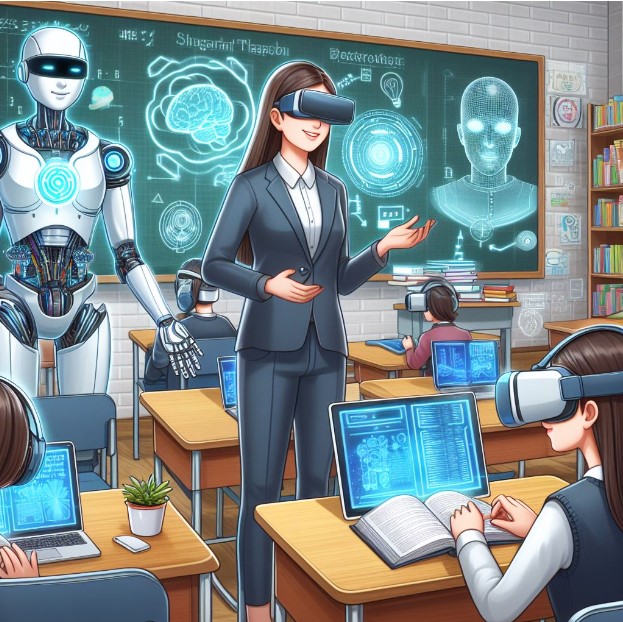
Schools have long treated learners as if they all converge on the same path at the same pace. Anyone who has sat through a class knows the assumption breaks the moment two students with different prior knowledge open the same textbook. What changes now is that the toolkit for handling that variance has matured: natural language processing can read a thousand essays without fatigue, generative models can produce targeted practice on demand, and immersive interfaces can put a learner inside a Roman forum for the cost of a headset and a few minutes of class time.
That shift is not theoretical. The market for generative AI in education was sized at USD 299.8 million in 2023 and is projected to reach USD 7,701.9 million by 2033, a compound annual growth rate of 39.5% between 2024 and 2033 according to MarketResearch.biz — a directional industry-scale figure, not an operational benchmark, but useful as a signal of where procurement budgets are heading. We see this pattern in our conversations with EdTech teams: the question is no longer whether to integrate AI, but which layer of the stack to start with.
What does AI actually change in a classroom?
Education gains from AI cluster around personalization engines, assessment automation, and operations reduction—three domains, measurable returns. It changes how individual learning paths are constructed, how abstract material is rendered, and how teacher time is spent. Each of those depends on a different technical substrate.
Personalised paths through NLP and generative models
NLP is the diagnostic layer. By processing student writing — essays, short answers, discussion-board posts — a language model can identify recurring gaps in reasoning, common misconceptions, and the framing a particular student responds to. The output is not a grade; it is a profile of where a learner is along several conceptual axes.
That profile feeds a generative layer, which produces material calibrated to it. If a student keeps confusing correlation with causation, the system can generate fresh practice problems built around that specific confusion rather than reusing whatever happens to be next in the textbook. Our generative AI work has consistently shown that this kind of targeted, on-demand content production is where transformer-based models earn their keep — they are well suited to producing many variants of a problem class, much less suited to replacing human judgement about what to teach next.
The boundary matters. NLP plus a generative model can produce a personalised path; it cannot decide what a student should learn this year. That decision still belongs to the curriculum and the teacher.
Immersive learning with AR/VR/XR and computer vision
The second substrate is immersion. A VR headset lets a learner walk through ancient Rome or rotate a 3D model of a cell. The educational point is not the novelty — it is that some concepts are spatial, and spatial concepts taught through 2D diagrams force a translation step that loses learners.
Computer vision sits underneath the experience. Eye-tracking and gesture data tell the platform what a student looked at, for how long, and when their attention drifted. That feedback loop allows the experience to adapt mid-session: a learner who lingers on a Colosseum arch can be offered more detail; one whose gaze keeps wandering may be signalling that the pacing is wrong.
The Global VR market in education is projected to grow from USD 25.85B in 2024 to USD 67.02B in 2029 at a CAGR of 21% (Mordor Intelligence, 2024) — again, a market-direction figure, not a measurement of pedagogical effectiveness. The harder question, and the one we spend more time on with clients, is which subjects actually benefit from immersion and which are better served by a well-designed diagram.
Adaptive platforms, GPU acceleration, and edge compute
The third substrate is the platform that ties personalisation and immersion together. Adaptive learning platforms run inference continuously: every answer a student gives updates a model of their current state, and that update changes what comes next. At scale, this becomes a GPU workload — PyTorch and CUDA on the training side, often TensorRT or ONNX Runtime for low-latency inference at serve time.
Resource-constrained settings change the calculus. A rural school with intermittent connectivity cannot rely on a cloud round-trip per question. The pragmatic answer is edge compute: distil or quantise the inference model, deploy it to a tablet or classroom server, and synchronise progress when bandwidth allows. NVIDIA Jetson-class hardware and ONNX runtimes on commodity Android tablets have made this far more tractable than it was two years ago.
How should personalised learning be deployed?
A short rubric we use in early conversations with EdTech partners:
| Decision point | What to consider | Typical answer |
|---|---|---|
| Where does inference run? | Bandwidth, latency, privacy posture | Cloud for low-stakes content generation; edge for in-session adaptation |
| What data leaves the device? | Regulatory regime (FERPA, GDPR), parental consent | Aggregated learning signals, not raw student writing, by default |
| What does the teacher see? | Cognitive load, classroom workflow | A small dashboard of flags, not a continuous stream |
| What is the model allowed to decide? | Curriculum authority | Sequencing within a unit; never unit selection |
| How is bias monitored? | Demographic representation in training data | Periodic audits against held-out evaluation sets |
The rubric is deliberately conservative. The failure mode we see most often is platforms that try to automate decisions which belong to humans — choosing which student needs extra attention, deciding when to escalate to a parent — and end up generating mistrust that takes longer to repair than the time saved.
The teacher’s role does not shrink
Characterizing educational AI as workforce automation misses the point entirely. It is not. The repetitive parts of teaching — grading multiple-choice quizzes, summarising student progress, generating practice variations — compress well. The parts that actually take judgement — noticing that a quiet student has gone quieter, deciding whether a struggling learner needs different content or different support — do not.
What changes is where the teacher’s attention lands. With grading and content generation partially offloaded, the time freed up tends to flow toward one-on-one conversation and small-group work, which is exactly where the evidence base for learning gains is strongest. In our experience working with education technology teams, the projects that succeed are the ones that explicitly design for this shift; the ones that fail are the ones that pitch AI as a way to reduce headcount.
What are the ethical considerations of AI in education?
Data protection, algorithm transparency, and inclusion remain mandatory regardless of competitive pressure. First, data privacy: student data is regulated under FERPA in the United States, GDPR in the EU, and equivalent regimes elsewhere, and the design constraint is that minors cannot meaningfully consent to data collection in the way adults can. The default should be aggregated signals at the platform level, with raw artefacts stored only where strictly necessary and only with explicit consent.
Second, bias. A model trained on essays from one demographic will mark differently for a different one. This is not a hypothetical — it shows up in every audit of automated essay-scoring systems we have seen. The mitigation is held-out evaluation sets that explicitly cover the populations the system will serve, and a willingness to keep humans in the loop for high-stakes decisions.
Third, teacher training. Deploying an adaptive platform without preparing the educators who will use it produces the worst of both worlds: an underused tool and a frustrated staff. Onboarding has to be treated as a first-class part of the rollout, not an afterthought.
What TechnoLynx brings to education projects
We build alongside EdTech engineering teams rather than delivering boxed solutions. That typically means three kinds of engagements: building NLP pipelines for student-writing analysis on PyTorch and Hugging Face stacks; integrating computer vision into AR/VR experiences using OpenCV, Unity, and ONNX-converted models; and deploying inference at the edge using TensorRT and Jetson-class hardware for schools with constrained bandwidth.
The thread connecting these is that none of them is a generic AI offering. Each is shaped by the specific failure modes of education as a domain — privacy, bias, the limits of automated assessment, the irreducible role of the teacher. We pay close attention to those constraints because the projects that ignore them tend to ship and then quietly disappear.
Frequently Asked Questions
How does AI personalise learning for individual students?
NLP models read student writing to identify recurring gaps and preferred framings, producing a profile of where a learner sits along several conceptual axes. Generative models then produce practice material calibrated to that profile — fresh problems built around a specific confusion rather than the next item in the textbook. The system personalises sequencing within a unit; it does not decide what a student should learn overall.
Can AR/VR really improve classroom learning, or is it just novelty?
Immersion helps most for spatial concepts — geometry, anatomy, historical sites — where translating 3D to 2D diagrams loses learners. For abstract or text-heavy material, a well-designed diagram usually outperforms a VR scene. Computer-vision tracking of gaze and engagement inside the headset is what turns it from novelty into a feedback loop.
What infrastructure do schools need to run adaptive learning platforms?
Cloud-based inference works where bandwidth is reliable. For schools with intermittent connectivity, edge deployment on tablets or classroom servers — using quantised models and runtimes like TensorRT or ONNX Runtime — keeps the platform responsive offline and synchronises progress when the network is available.
What are the main ethical risks of using AI in classrooms?
Three: data privacy under FERPA and GDPR, model bias against under-represented demographics in the training data, and the temptation to automate decisions that belong to teachers. The defensible posture is aggregated learning signals by default, audited evaluation sets covering the actual student population, and a clear line around which decisions the model is allowed to make.
Does AI replace teachers?
No. It compresses the repetitive parts of teaching — grading, summarisation, generating practice variations — and frees time for the parts that take human judgement, which is where the evidence for learning gains is strongest. Projects that pitch AI as headcount reduction tend to fail; projects that design for the shift in attention tend to succeed.
References
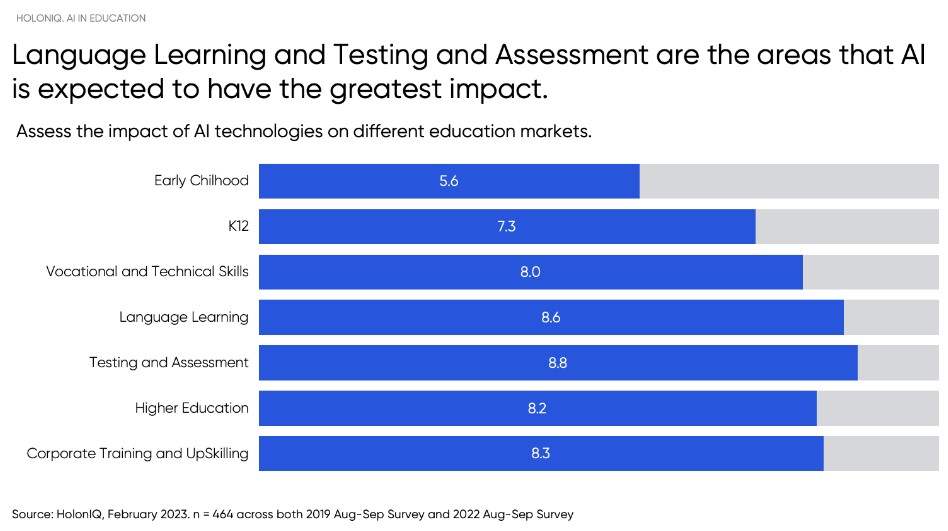
- HolonIQ. “Artificial Intelligence in Education. 2023 Survey Insights.” HolonIQ, 27 February 2023.
- MarketResearch.biz. “Generative AI in Education Market Size, Share — CAGR of 39.5%.” 2024.
- Mordor Intelligence. “Virtual Reality (VR) in the Education Market — Size, Share & Industry Analysis.” 2024.