

What AI is actually changing in insurance
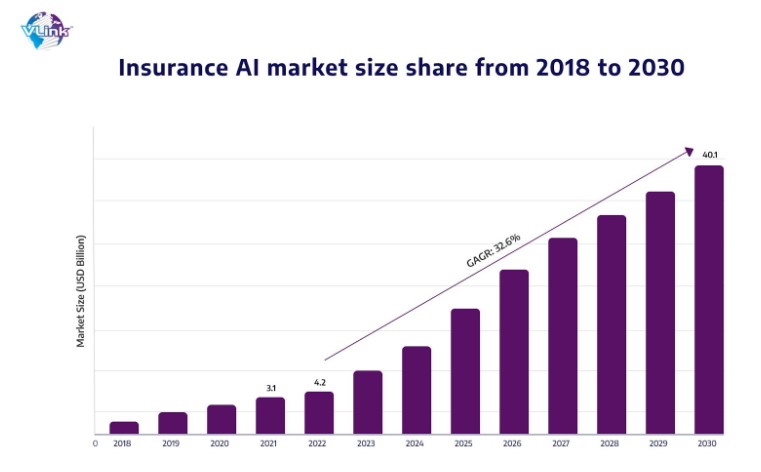
Carriers exist to measure uncertainty, resolve disputes, and prevent exploitation. Each of those three jobs has a well-defined data problem at its core, and each is being reshaped — not replaced — by machine learning systems that read documents, score risk, and flag anomalies faster than the legacy workflows they sit alongside. The market reflects this shift: AI in insurance is projected to grow from roughly USD 4.2 billion in 2022 to USD 40.1 billion by 2030, a 32.6% CAGR according to Market Research Future (a market-direction estimate from a published analyst forecast, not an operational benchmark).
That headline number is useful framing, but it hides the more interesting question for practitioners. Where in the insurance value chain does AI carry its weight, and where does it create new failure modes that have to be engineered around? This article walks through five concrete surfaces — underwriting, claims, fraud detection, risk management, and customer experience — and ends on the constraints insurers still have to solve before any of it is production-grade.
Where AI Actually Earns Its Keep
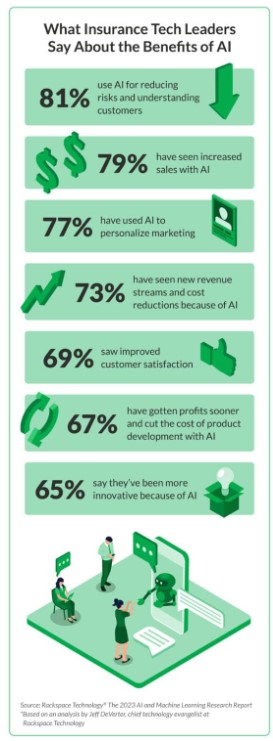
Most vendor pitches emphasize velocity, insight, and individualization without technical substance. The structural picture is narrower and more honest. AI compresses turnaround time on tasks that previously required a human to read a document or look at an image. It improves consistency on tasks where human judgement drifts. And it surfaces correlations in claims data that no single adjuster would see across their personal caseload.
| Surface | What AI changes | Underlying technology |
|---|---|---|
| Underwriting | Compresses document review and risk scoring from days to minutes | Computer vision, NLP, gradient-boosted risk models |
| Claims | Triages and extracts structured data from unstructured filings | OCR, NLP, image-based damage assessment |
| Fraud detection | Surfaces cross-claim patterns invisible to single adjusters | Anomaly detection, graph models, behavioural analytics |
| Risk management | Continuous risk updates from sensor and environmental data | IoT telemetry, satellite imagery, CV |
| Customer service | Routes routine queries away from human agents | Conversational AI, retrieval-augmented generation |
Two patterns are worth naming explicitly. First, none of these surfaces are AI-only — they all sit inside human review loops, because the regulatory and reputational cost of a wrong automated decision is asymmetric. Second, the performance ceiling on every one of them is set by data quality, not model architecture. Insurers with clean, structured historical loss data extract dramatically more value than those whose claims data lives in PDFs and adjuster notes.
AI-Enabled Underwriting
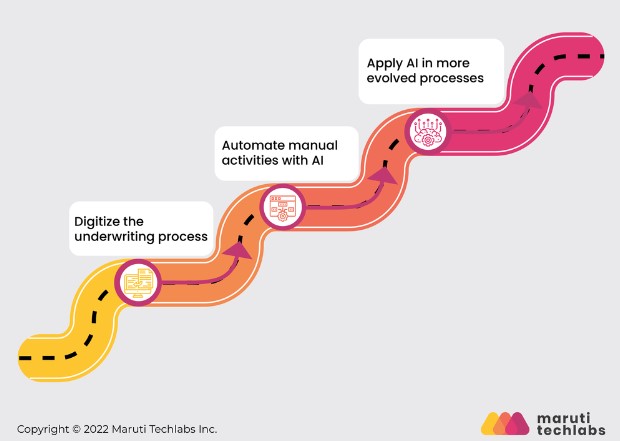
Policy evaluation is fundamentally an exercise in structured data extraction from unstructured sources. A submission arrives as a mix of structured fields, free-text notes, photographs, satellite imagery, and increasingly, telematics data. The legacy workflow is sequential, slow, and inconsistent across underwriters. AI-powered document processing has been reported to reduce underwriting time by up to 80% in case studies (Sahai, 2023 — a published-survey claim, not a benchmark we have independently measured).
The mechanism is mostly unsexy. Computer vision models read property photos and satellite tiles to identify flood plains, roof condition, and proximity to fire risk. NLP models extract structured fields from broker submission emails and loss-run reports. Gradient-boosted models combine the resulting features with traditional actuarial variables to produce a risk score. Generative models are starting to appear here too, drafting quote letters and policy summaries from structured inputs, though the production use cases are narrower than the headlines suggest.
The computational profile matters more than it looks. Underwriting models that touch image and satellite data run on GPU infrastructure — typically NVIDIA T4 or A10 class for inference, larger clusters for training. Latency targets are seconds, not minutes, because the underwriter is waiting at a screen. For carriers building this in-house, the platform choices (PyTorch or TensorFlow for training, ONNX Runtime or TensorRT for deployment, Triton Inference Server for serving) are the same stack you’d see in any production computer vision workload. Confirming which of those choices actually holds up under real underwriting latency budgets — rather than assuming the reference stack transfers — is the kind of question our GPU engineering practice answers before a carrier commits to a platform.
Claims Processing
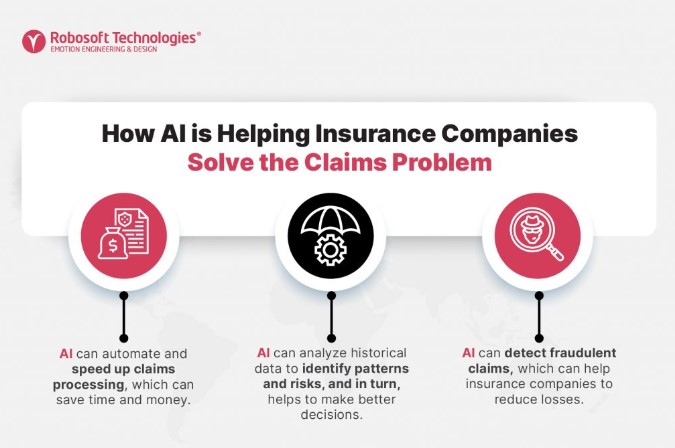
Operational leverage appears most clearly in claims, where throughput demands and task uniformity align perfectly with machine capacity. A first notice of loss arrives, an adjuster has to determine coverage, estimate severity, assign a reserve, and decide whether to investigate further. Each of those decisions can be assisted — and in narrow cases, automated — by a model trained on historical claims.
The pieces that work well in production today are:
- Image-based damage assessment for auto claims, where a CV model estimates repair cost from photographs of the damaged vehicle. Accuracy is sufficient for triage, not for final settlement.
- Document extraction from medical bills, police reports, and repair estimates using OCR plus domain-specific NLP. This removes the data-entry layer that used to consume adjuster time.
- Severity prediction from the FNOL itself, using gradient-boosted models on structured fields. Severity buckets feed reserve-setting and routing decisions.
- Sensor and telematics ingestion in commercial lines, where IoT edge devices on insured assets emit telemetry that AI systems use to validate or contest a loss narrative.
In our experience, the highest-value claims AI deployments are not the ones that try to fully automate decisions. They are the ones that reduce adjuster cycle time on the 70% of claims that are unambiguous, freeing skilled adjusters to spend their time on the 30% that genuinely need human judgement. The operational measurement that matters is not “automation rate” — it’s claims-per-adjuster-per-day on the complex tail.
Fraud Detection
Fraudulent activity drains the sector by tens of billions each year, a figure that shifts with geography and accounting conventions. The problem is structurally suited to machine learning: rare events, high signal-to-noise on the right features, and a long history of labelled examples for supervised training.
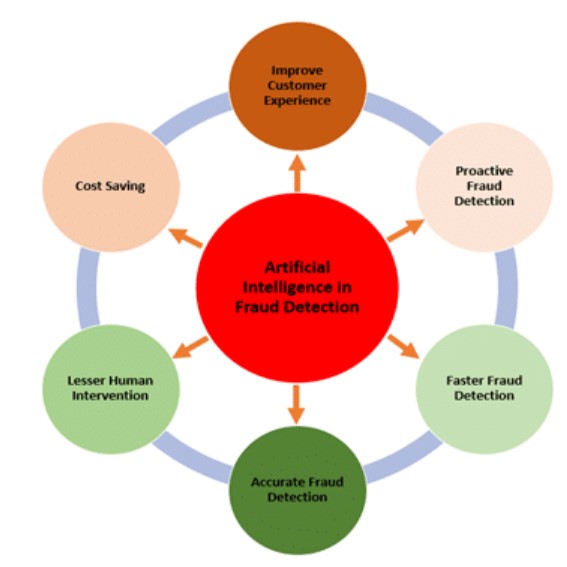
The detection stack typically combines three layers:
- Rules-based filters for known fraud patterns — these still catch a large share of obvious cases and are auditable, which matters for SIU referrals.
- Supervised anomaly detection trained on historical confirmed-fraud labels. Gradient-boosted models on tabular claims features remain the workhorse here.
- Graph-based detection for organised fraud rings, where the signal lives in the relationships between claimants, providers, and repair shops rather than in any single claim.
Generative models are increasingly used to synthesise training data for rare fraud scenarios, addressing the class-imbalance problem that limits supervised models on real labels. Behavioural anomaly detection on policyholder digital footprints — login patterns, communication cadence, claim-filing timing — adds a layer that’s hard for a fraudster to reason about.
How does AI fraud detection differ from rules-based systems?
Rules-based systems flag what you already know is suspicious. AI fraud detection surfaces patterns the rule-writers haven’t seen yet — including coordinated rings whose individual claims look unremarkable. The two are complementary, not competing: rules give you auditable coverage of known typologies, models give you adaptive coverage of novel ones.
Risk Management and Pricing
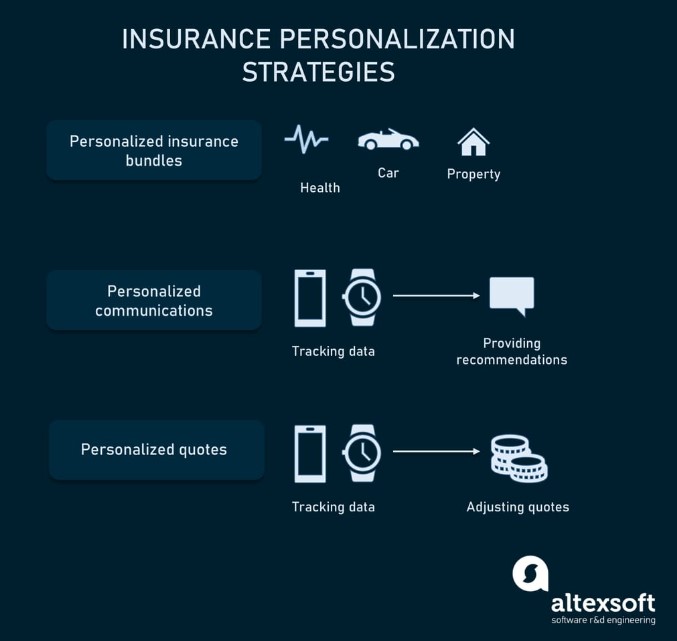
Continuous monitoring across policy lifecycles, rather than one-time assessment at issuance, represents the paradigm shift AI enables. Continuous-risk insurance — where premiums adjust based on observed behaviour — was a telematics idea before it was an AI idea, but the model layer is what makes it economically viable at scale.
The technical building blocks are:
- Satellite and drone imagery processed by CV models to update property risk in near-real-time as weather events, construction, or land-use changes occur.
- IoT edge telemetry from connected vehicles, factory equipment, and commercial property, processed at the edge to flag risky operating conditions before they become claims.
- NLP on news and regulatory feeds to surface emerging risks — supply-chain disruptions, regulatory changes, environmental events — that affect portfolio exposure.
- Blockchain-backed data sharing between insurers and reinsurers, where the value is auditable provenance of risk data, not the consensus mechanism itself.
The honest framing here is that “hyper-personalised risk pricing” is a destination, not a current state. Most carriers are still working through the data-engineering plumbing required to ingest sensor streams reliably, let alone to act on them at policy-pricing speed.
Customer Experience
Natural language interfaces have graduated from limited scripts to genuine customer service capabilities. Modern deployments use retrieval-augmented generation against the carrier’s policy documents to answer coverage questions with citations, route complex queries to human agents with context attached, and handle routine servicing tasks like address changes or premium-payment inquiries.
The interesting design question is not “can the chatbot answer” — it’s “what’s the escalation policy when the chatbot is uncertain”. Carriers that get this right treat the AI layer as a triage and assistance tool that makes human agents more effective, not as a replacement that customers learn to bypass by typing “agent” at the first opportunity.
What AI in Insurance Still Has to Solve
Above all implementations lie three persistent challenges, still without complete solutions.
Bias and fairness. Insurance pricing is regulated precisely because it can encode unfair discrimination. Models trained on historical claims data inherit historical bias; explainability tools and fairness audits are now table stakes for any production deployment in regulated lines.
Explainability. Black-box models that price policies or deny claims create regulatory and reputational risk regardless of how accurate they are. SHAP values, surrogate models, and constrained model architectures all play a role, but the underlying tension — that the most accurate models are often the least interpretable — is not going away.
Data privacy. The data appetite of these systems is large, and the data is personal. Differential privacy, federated learning, and strict access controls are part of the answer; clear customer consent for secondary uses is the other part.
What TechnoLynx Builds in This Space
TechnoLynx supports carriers and fintech platforms through core infrastructure: computer vision for documents and physical assets, GPU tuning for model-heavy operations, and sensor processing for telematics and connected property. We don’t sell underwriting platforms; we build the bespoke perception and inference components that sit inside them.
Frequently Asked Questions
How is AI used in insurance underwriting?
AI in underwriting compresses the document-review and risk-scoring steps. Computer vision reads property photos and satellite imagery, NLP extracts structured data from broker submissions, and gradient-boosted models produce a risk score. The underwriter still owns the decision; the model removes the parts that don’t need human judgement.
Can AI fully automate claims processing?
For a narrow band of low-severity, unambiguous claims — small auto glass repairs, simple travel claims — full automation is in production at several carriers. For everything else, AI sits in an assistive role: triaging, extracting structured data, predicting severity, and routing to the right adjuster. Full automation on the complex tail is not a near-term outcome.
How effective is AI at detecting insurance fraud?
AI improves fraud detection mainly by surfacing patterns rules-based systems miss — coordinated rings, novel typologies, behavioural anomalies. It does not replace SIU investigators; it gives them a better candidate list. Effectiveness depends heavily on the quality of historical labelled-fraud data the carrier has accumulated.
What are the main risks of using AI in insurance?
Three sit above the rest: algorithmic bias that can encode unfair pricing, opacity that complicates regulatory review and customer trust, and data-privacy exposure from the large personal-data footprint these systems require. None are blockers, but all need explicit engineering and governance attention.
References
- AltexSoft. (2021, June 14). Personalized Insurance: Auto and Telematics, Health, and Other Success Stories.
- Market Research Future. (2023, February 22). AI In Insurance Market to Reach USD 40.1 Billion With 32.6% CAGR from 2022 to 2030 (analyst estimate per MRFR market projection).
- Nijhawan, N. (2023, June 7). Integrating Artificial Intelligence (AI) in Insurance Apps.
- Sahai, A. (2023, October 24). Role of AI in shifting the paradigm in document processing for insurance.
- Woodburn, B. (2023, June 22). How AI is Transforming Auto Insurance.
