
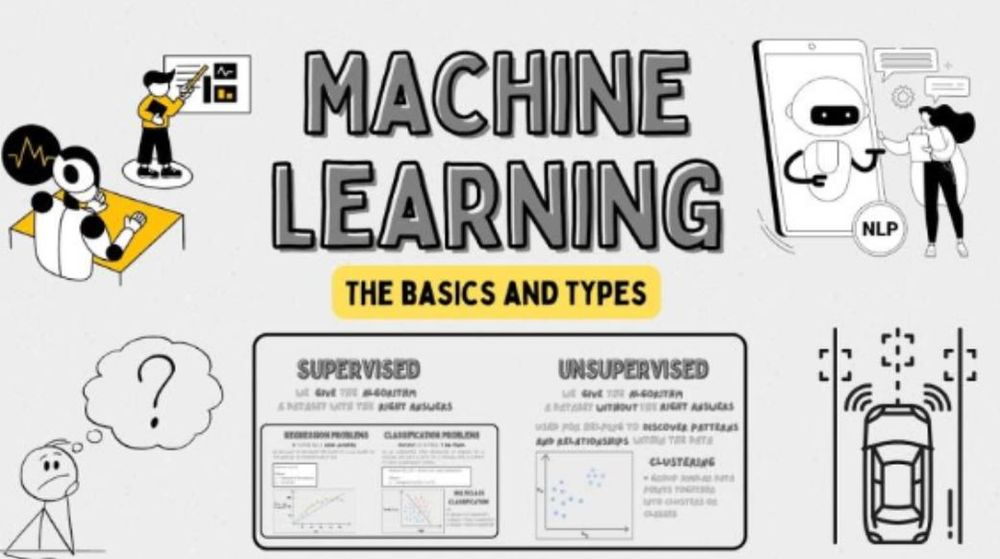
Where machine learning is used?

In today's technological landscape, machine learning has emerged as a transformative force with the power to elevate various industries...

Where machine learning is used?
Written by TechnoLynx Published on 20 Sep 2023

In today’s technological landscape, machine learning has emerged as a transformative force with the power to elevate various industries and touch every facet of our lives. Therefore, the question of “where machine learning is used?” has become one of the most frequently asked questions in this matter.

We present you this engaging video, where you will discover the remarkable breadth and depth of machine learning applications, such as in healthcare, business and finance, marketing, urban planning and many more fields!

The full video is available here.

Continue reading: MIT’s new AI model is elevating high-resolution computer vision

Pharmaceutical Supply Chain: Where AI and Computer Vision Solve Visibility Gaps

Pharmaceutical Supply Chain: Where AI and Computer Vision Solve Visibility Gaps

10/05/2026

Pharma supply chains span API sourcing to patient delivery. AI addresses the serialisation, cold chain, and counterfeit detection gaps manual tracking.

Vision Systems for Manufacturing Quality Control: Inline vs Offline, Hardware and PLC Integration

Vision Systems for Manufacturing Quality Control: Inline vs Offline, Hardware and PLC Integration

10/05/2026

Industrial vision systems for manufacturing quality control: inline vs offline inspection, line-scan vs area cameras, PLC integration, and realistic.

AI Video Surveillance for Apartment Buildings: Analytics, Privacy Zones, and False Alarm Rates

AI Video Surveillance for Apartment Buildings: Analytics, Privacy Zones, and False Alarm Rates

9/05/2026

AI video surveillance for apartment buildings: access control integration, package detection, loitering alerts, privacy zones, and false alarm rates in.

Retail Shrinkage and Computer Vision: What CV Can and Cannot Detect

Retail Shrinkage and Computer Vision: What CV Can and Cannot Detect

9/05/2026

Retail shrinkage from theft, admin error, and vendor fraud: how CV systems address each, what they miss, and realistic shrinkage reduction numbers.

Object Detection Model Selection for Production: YOLO vs Transformers, Speed/Accuracy, and Deployment

Object Detection Model Selection for Production: YOLO vs Transformers, Speed/Accuracy, and Deployment

9/05/2026

Object detection model selection for production: YOLO variants vs detection transformers, speed/accuracy tradeoffs, edge vs cloud deployment, mAP vs.

Manufacturing Safety AI: Gun Detection and Threat Monitoring with Computer Vision

Manufacturing Safety AI: Gun Detection and Threat Monitoring with Computer Vision

9/05/2026

AI gun detection in manufacturing uses CV to identify weapons in camera feeds. What the technology detects, accuracy limits, and deployment considerations.

Machine Vision Image Sensor Selection: CCD vs CMOS, Resolution, and Illumination

Machine Vision Image Sensor Selection: CCD vs CMOS, Resolution, and Illumination

9/05/2026

How to select image sensors for machine vision: CCD vs CMOS tradeoffs, resolution, frame rate, pixel size, and illumination requirements by inspection.

Facial Recognition Cameras for Commercial Deployment: Matching, Enrollment, and Legal Framework

Facial Recognition Cameras for Commercial Deployment: Matching, Enrollment, and Legal Framework

9/05/2026

Commercial facial recognition deployments: enrollment management, 1:1 vs 1:N matching, false acceptance rates, consent requirements, and hardware.

Multi-Agent Architecture for AI Systems: When Coordination Adds Value

Multi-Agent Architecture for AI Systems: When Coordination Adds Value

8/05/2026

Multi-agent AI architectures coordinate multiple LLM agents for complex tasks. When they add value, common coordination patterns, and where they break.

Facial Detection Software: Open Source vs Commercial APIs, Accuracy, and Production Integration

Facial Detection Software: Open Source vs Commercial APIs, Accuracy, and Production Integration

8/05/2026

Facial detection software options: OpenCV, dlib, DeepFace vs commercial APIs, when to build vs buy, demographic accuracy, and production pipeline.

Multi-Agent Systems: Design Principles and Production Reliability

Multi-Agent Systems: Design Principles and Production Reliability

8/05/2026

Multi-agent systems decompose complex tasks across specialized agents. Design principles, failure modes, and when multi-agent adds value vs complexity.

Face Detection Camera Systems: Resolution, Lighting, and Real-World False Positive Rates

Face Detection Camera Systems: Resolution, Lighting, and Real-World False Positive Rates

8/05/2026

Face detection camera prerequisites: resolution minimums, angle and lighting requirements, MTCNN vs RetinaFace vs MediaPipe, and real-world false positive.

LLM Types: Decoder-Only, Encoder-Decoder, and Encoder-Only Models

8/05/2026

LLM architecture type—decoder-only, encoder-decoder, encoder-only—determines what tasks each model handles well and what deployment constraints it carries.

Embedded Edge Devices for CV Deployment: Jetson vs Coral vs Hailo vs OAK-D

8/05/2026

Embedded edge devices for CV: NVIDIA Jetson vs Coral TPU vs Hailo vs OAK-D — power, inference throughput, and model optimisation requirements compared.

LLM Orchestration Frameworks: LangChain, LlamaIndex, LangGraph Compared

8/05/2026

LangChain, LlamaIndex, and LangGraph solve different problems. Choosing the wrong framework adds abstraction without value. A practical decision framework.

Driveway CCTV Cameras with AI Detection: Vehicle Classification, Night Performance, and False Alarm Reduction

8/05/2026

Driveway CCTV AI detection: vehicle vs person classification, IR vs starlight night performance, reducing animal and shadow false alarms, home automation.

Generative AI Architecture Patterns: Transformer, Diffusion, and When Each Applies

8/05/2026

Transformer vs diffusion architecture determines deployment constraints. Memory footprint, latency profile, and controllability differ substantially.

Digital Shelf Monitoring with Computer Vision: What Retail AI Actually Detects

7/05/2026

Digital shelf monitoring uses CV to detect out-of-stocks, planogram compliance, and pricing errors. What the systems actually detect and where accuracy drops.

Diffusion Models in ML Beyond Images: Audio, Protein, and Tabular Applications

7/05/2026

Diffusion extends beyond images to audio, protein structure, molecules, and tabular data. What each domain gains and loses from the diffusion approach.

Deep Learning for Image Processing in Production: Architecture Choices, Training, and Deployment

7/05/2026

Deep learning for image processing in production: CNN vs ViT tradeoffs, training data requirements, augmentation, deployment optimisation, and.

Diffusion Models Explained: The Forward and Reverse Process

7/05/2026

Diffusion models learn to reverse a noise process. The forward (adding noise) and reverse (denoising) processes, score matching, and why this produces.

AI vs Real Face: Anti-Spoofing, Liveness Detection, and When Custom CV Models Are Necessary

7/05/2026

When synthetic faces defeat pretrained detectors: anti-spoofing challenges, liveness detection requirements, and when custom models are unavoidable.

Diffusion Models Beat GANs on Image Synthesis: What Changed and What Remains

7/05/2026

Diffusion models surpassed GANs on FID scores for image synthesis. What metrics shifted, where GANs still win, and what it means for production image generation.

AI-Based CCTV Monitoring Solutions: Automation vs Human Review and What Each Handles Well

7/05/2026

AI CCTV monitoring vs human monitoring: cost comparison, coverage capability, response time tradeoffs, and what AI handles well vs where human judgment is.

The Diffusion Forward Process: How Noise Schedules Shape Generation Quality

7/05/2026

The forward process in diffusion models adds noise according to a schedule. How linear, cosine, and custom schedules affect image quality and training stability.

CCTV Face Recognition in Production: Why It Fails More Than Demos Suggest

7/05/2026

CCTV face recognition: resolution requirements, angle and lighting challenges, false positive rates, GDPR compliance, and why production performance lags.

Autonomous AI in Software Engineering: What Agents Actually Do

6/05/2026

What autonomous AI software engineering agents can actually do today: code generation quality, context limits, test generation, and where human oversight.

AI-Enabled CCTV for Building Security: Analytics, Camera Placement, and Infrastructure

6/05/2026

AI CCTV for building security: intrusion detection, people counting, loitering analytics, camera placement strategy, and storage and bandwidth.

AI Agent Design Patterns: ReAct, Plan-and-Execute, and Reflection Loops

6/05/2026

AI agent patterns—ReAct, Plan-and-Execute, Reflection—solve different failure modes. Choosing the right pattern determines reliability more than model.

Best Wired CCTV Systems for AI Video Analytics: What Matters Beyond Resolution

6/05/2026

Wired CCTV systems for AI analytics need more than high resolution. Codec support, edge processing, and integration architecture determine analytics quality.

Automated Visual Inspection in Pharma: How CV Systems Replace Manual Quality Checks

6/05/2026

Automated visual inspection in pharma uses computer vision to detect defects in vials, syringes, and tablets — faster and more consistently than human.

Agentic AI in 2025–2026: What Is Actually Shipping vs What Is Still Research

6/05/2026

Agentic AI is moving from demos to production. What's deployed today, what's still research, and how to evaluate claims about autonomous AI systems.

Automated Visual Inspection Systems: Hardware, Model Selection, and False-Reject Rates

6/05/2026

Build automated visual inspection systems that work: hardware setup, model selection (classification vs detection vs segmentation), and managing.

Aseptic Manufacturing in Pharma: Process Control, Risks, and Where AI Fits

6/05/2026

Aseptic manufacturing prevents microbial contamination during sterile drug production. AI monitoring addresses the environmental control gaps humans miss.

Agent-Based Modeling in AI: When to Use Simulation vs Reactive Agents

6/05/2026

Agent-based modeling simulates populations of interacting entities. When it's the right choice over LLM-based agents and how to combine both approaches.

4K Security Cameras and AI Analytics: When Higher Resolution Helps and When It Doesn't

6/05/2026

4K security cameras for AI analytics: bandwidth and storage costs, where higher resolution improves results, compression artifacts and AI accuracy.

Computer Vision in Pharmacy Retail: Inventory Tracking, Planogram Compliance, and Shrinkage Reduction

5/05/2026

CV in pharmacy retail addresses unique challenges: regulated product tracking, controlled substance security, and planogram compliance across thousands of SKUs.

AI Orchestration: How to Coordinate Multiple Agents and Models Without Chaos

5/05/2026

AI orchestration coordinates multiple models through defined handoff protocols. Without it, multi-agent systems produce compounding inconsistencies.

Visual Inspection Equipment for Manufacturing QC: Where AI Adds Value and Where Rules Still Win

5/05/2026

AI-enhanced visual inspection replaces rule-based defect detection with learned representations — but requires validated training data matching production variability.

Building AI Agents: A Practical Guide from Single-Tool to Multi-Step Orchestration

5/05/2026

Production agent development follows a narrow-first pattern: single tool, single goal, deterministic fallback — then widen incrementally with observability.

Enterprise AI Search: Why Retrieval Architecture Matters More Than Model Choice

5/05/2026

Enterprise AI search quality depends on chunking strategy and retrieval pipeline design more than on the LLM. Poor retrieval + powerful LLM = confident wrong answers.

Facial Recognition in Video Surveillance: Why Lab Accuracy Doesn't Transfer to CCTV

5/05/2026

Facial recognition accuracy drops 10–40% between controlled enrollment conditions and production CCTV due to angle, lighting, and resolution.

Choosing an AI Agent Development Partner: What to Evaluate Beyond Demo Quality

5/05/2026

Most AI agent demos work on curated inputs. Production viability requires error handling, fallback chains, and observability that demos never test.

Computer Vision Store Analytics: What Cameras Can Actually Measure in Retail

5/05/2026

Store analytics CV must distinguish 'detected' from 'measured with business-decision confidence.' Most deployments conflate the two.

AI in Pharmaceutical Supply Chains: Where Computer Vision and Predictive Analytics Deliver ROI

5/05/2026

Pharma supply chain AI delivers measurable ROI in three areas: serialisation verification, cold-chain anomaly prediction, and visual inspection automation.

LLM Agents Explained: What Makes an AI Agent More Than Just a Language Model

5/05/2026

An LLM agent adds tool use, memory, and planning loops to a base model. Agent reliability depends on orchestration more than model benchmark scores.

Computer Vision for Retail Loss Prevention: What Works, What Breaks, and Why Scale Matters

5/05/2026

CV-based loss prevention must handle thousands of SKUs under variable lighting. Single-model approaches produce unactionable alert volumes at scale.

Intelligent Video Analytics: How Modern CCTV Systems Detect Behaviour Instead of Motion

4/05/2026

IVA shifts surveillance alerting from pixel-change detection to behaviour understanding. But only modular pipeline architectures deliver this in practice.

Back See Blogs
arrow icon