“Futuristic AR” is a phrase that has been doing heavy lifting in marketing decks for a decade. By 2026 it finally points at something concrete: a stack where most perception runs on the headset or phone, where visual-language models answer questions about what the camera sees, and where smart glasses have crossed the line from prototype into a real consumer category. Whether the experience feels futuristic to a user has very little to do with the size of the language model behind it. It depends on whether the computer vision pipeline on the device can hold its anchors, stay inside the renderer’s latency budget, and survive a thermal envelope measured in single-digit watts.
That is the engineering question hiding under the consumer narrative. Advanced AI in AR is not a single capability you bolt onto a headset — it is a graph of perception stages, each with its own accelerator preference, scheduled against a renderer that needs a fresh pose every 11 milliseconds. We see this pattern regularly when teams move a desktop CV model onto a headset SoC: the model that ran beautifully on a workstation drops frames, drifts on anchor, and overheats the device after twenty minutes. The fix is rarely a better model. It is almost always an architecture decision the original team did not realise they were making.

What “advanced AI” Means Inside an AR Stack
Worth being concrete: which AI capabilities now ship inside AR products rather than remaining research demos? There are roughly five, and they each have different latency, memory, and accelerator profiles.
| Capability | Typical placement | Latency budget | Common accelerator |
|---|---|---|---|
| Inside-out tracking (SLAM) | On-device, frame-locked | <5 ms per frame | DSP + GPU compute |
| Hand pose estimation | On-device, free-running | 15–30 ms | NPU |
| Visual-language Q&A | On-device or cloud | 200–800 ms | NPU or remote |
| Generative 3D scene capture | Capture on-device, refine offline | seconds–minutes | GPU compute |
| Scene meshing and segmentation | On-device, asynchronous | 30–100 ms | NPU + GPU |
The interesting line is the latency budget column. Anything that has to be synchronised with the pose update — tracking, hand pose, anchor maintenance — has to land before the next renderer tick. Anything that drives content rather than presence — visual-language answers, generative content, scene understanding for context — can run on a slower, asynchronous loop without breaking the feeling of stability. Architects who collapse these into one budget tend to ship trackers that drift.
How does on-device AI change the latency budget compared with cloud-assisted AR?
A cloud round-trip from a headset to a regional inference endpoint and back is realistically 80–200 ms (as a practical estimate) once you include radio, queueing, model execution, and the return path.
This has a knock-on effect that the marketing decks tend to miss: it changes which stages need to be frame-locked. A cloud-assisted AR app naturally treats AI as an asynchronous, best-effort layer because it cannot rely on it for anything safety-critical. An on-device AR stack can pull lightweight AI outputs (intent classification, gaze prediction, gesture recognition) into the same scheduling envelope as tracking — which is where futuristic AR experiences actually start to feel different, not because the model is bigger, but because the architecture is tighter.
Where the Step-Change Actually Came From
Between 2024 and 2026, three compounding factors justified the “futuristic” label.
The first is on-device foundation models. Visual-language models that previously needed a cloud round-trip now run quantised on a phone or headset SoC, doing scene understanding and answering grounded questions about what the camera sees. Apple Visual Intelligence, Google Lens with Gemini, and Meta AI on the Ray-Ban Meta glasses are all instances of the same pattern: the inference runs close enough to the sensor that the experience feels conversational rather than asynchronous.
The second is generative 3D. Gaussian Splatting and related techniques made realistic AR scene capture cheap — a few minutes of phone footage now yields a scene representation that previously required photogrammetry rigs or LiDAR sweeps. This shifts the economics of AR content from “studio-produced asset” to “user-captured environment,” which is the precondition for AR experiences that respect the user’s actual space rather than overlaying generic content on it.
The third is smart glasses as a real category. Ray-Ban Meta crossed into the consumer mainstream during 2024–2025 with a form factor that is, importantly, not trying to be a full AR headset. It is a camera, microphones, a speaker, and an AI assistant in a wearable. That deliberate scope limitation is what made it shippable, and it has reshaped expectations about what “futuristic AR” looks like at the consumer end: not an immersive overlay on the world, but an AI that can see what you see and answer questions about it.
What Hype Still Outruns the Silicon
Parallel narratives predict all-day-wearable AR glasses replacing phones, mainstream consumer adoption of dedicated MR headsets at smartphone scale, and AR becoming the dominant consumer interface within five years. Most of this is hype. The structural constraints have not moved.
All-day AR glasses still hit a thermal wall. The optical stack — waveguides, micro-OLED projectors, eye tracking — adds power draw that has to be dissipated through a frame that sits on a human face. Battery placement is constrained by weight balance. Compute is constrained by the same thermal envelope. The published projects in this space are still bulky, short-duration prototypes, regardless of the rendering on the keynote slides.
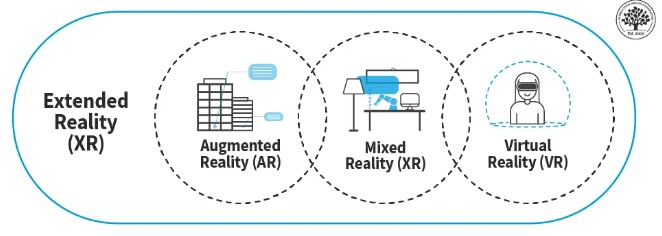
Dedicated MR headsets — Vision Pro, Quest 3, Quest Pro — are credible devices for focused-session use, but the addressable market for a $500–$3,500 headset with limited mobility is structurally smaller than the smartphone market. They will likely remain a category, not a replacement.
The hype roadmap and the engineering roadmap diverge on the question of mobility. Anything that has to be worn all day, untethered, in arbitrary environments, is a different category from anything that lives on a desk or in a studio. The first category is being approached incrementally through smart glasses with deliberately limited functionality. The second is the MR headset. Conflating the two is what makes consumer AR projections unreliable.
Where Engineering Teams Get This Wrong
Three failure modes are common when teams try to ship something they would describe as “AI-powered AR”:
Treating perception as a single pipeline. Tracking, hand pose, gaze, scene meshing, and visual-language reasoning have different latency budgets and different accelerator preferences. A pipeline that runs them all on the GPU competes with the renderer for cycles. The architectural pattern that works is to split them: SLAM and hand pose on DSP and NPU, scene understanding on the NPU asynchronously, visual-language Q&A on a lower-priority queue. That triage — deciding what shares the GPU with the renderer and what earns its own accelerator lane — is precisely the question a GPU Performance Audit is built to answer before a headset SoC hits its thermal ceiling. Our walkthrough of XR motion-tracking architectures goes into the scheduling pattern in more detail.
Designing for peak load instead of sustained load. A headset that hits its target frame rate for the first 90 seconds and degrades thereafter is failing a thermal test, not a benchmark. Sustained throughput under realistic load — not peak burst — is the operationally relevant measure for AI-accelerated XR perception on edge devices. Demos optimise for peak. Products live or die on sustained.
Assuming cloud inference is “free.” Network conditions in the environments where AR is actually used — warehouses, retail floors, hospitals, outdoor sites — are nothing like the office Wi-Fi the demo was built on. An AR experience that depends on a sub-100ms cloud round-trip will degrade gracelessly the moment it leaves the studio. The architectural question is which stages tolerate degradation and which do not, and which therefore must run on-device.
What This Means for Product Decisions
If you are scoping an AR project and the phrase “futuristic AR powered by AI” is in the brief, three questions cut through most of the noise:
Which perception stages have to be synchronised with the renderer, and which can run asynchronously? The first set defines your on-device compute budget. The second set defines what can be offloaded or batched.
What is your sustained-load thermal envelope, and have you measured it under the actual workload? Not the demo workload, the production workload, for the duration users will wear the device.
Which AI capabilities are genuinely required for the product to work, and which are there because they sound futuristic? The first set is your architecture. The second set is what kills the schedule.
Advanced AI is not what makes AR futuristic. The architecture decisions that put the right AI in the right place at the right latency are. The category has matured enough in 2026 that those decisions are now possible to make with confidence — and visible enough in failure mode when they are not.
FAQ
Which sensor stack drives inside-out tracking accuracy in current XR headsets?
A typical 2026 inside-out stack uses four to six grayscale tracking cameras (60–90 Hz), an IMU sampling at 1 kHz or higher for high-frequency pose updates between visual frames, and on some devices a depth sensor or structured-light projector for close-range hand and surface tracking. Eye tracking, where present, runs at 60–120 Hz and contributes to foveated rendering rather than world tracking directly. Accuracy is set less by sensor count than by the fusion architecture — how IMU pre-integration is combined with visual updates, how loop closures are scheduled, and how the SLAM map is maintained across sessions.
What are the architectural trade-offs between inside-out and outside-in tracking for room-scale XR?
Outside-in tracking (external base stations or cameras tracking markers on the headset) gives lower latency and better absolute accuracy in a fixed volume — historically the choice for high-end VR. Inside-out moves the cameras onto the headset and uses SLAM to build the world model, trading some accuracy for portability, lower deployment cost, and the ability to track in arbitrary environments. By 2026, inside-out has won the consumer category outright. Outside-in survives in specialised enterprise contexts where sub-millimetre accuracy and fixed-volume operation justify the deployment overhead.
How is hand tracking integrated into XR gameplay and productivity workflows without controller fallback?
The pattern that works is to treat hand tracking as a continuous input channel rather than a controller replacement. Productivity workflows (Vision Pro, Quest 3 in passthrough) lean on pinch-based selection and gaze for targeting, which is robust to occasional tracking dropouts. Gameplay that requires haptic feedback or sub-frame precision still benefits from controllers; hand tracking is layered on top for casual interactions. Hand-only experiences work best when the interaction design assumes the system will occasionally lose a hand and provides graceful recovery rather than treating tracking as guaranteed.
Where does the CV pipeline sit between SLAM, hand pose estimation, and gesture classification on the device?
These are three distinct pipelines with shared sensor inputs and different scheduling requirements. SLAM is frame-locked, runs continuously, and is the most latency-sensitive. Hand pose runs free-running at lower frequency, typically 30–60 Hz, on the NPU. Gesture classification is a thin layer on top of hand pose, running asynchronously and consuming a smoothed pose history rather than raw frames. The architectural mistake teams make is collapsing these into one pipeline scheduled against the same budget; separating them by accelerator and by frequency is what lets all three coexist on a headset SoC under load.
References
- Grand View Research. (2024). Virtual Reality (VR) Market Size And Share Report, 2030. Grand View Research.
- Mordor Intelligence. (2024). Extended Reality Market — XR Industry — Size & Trends.
- SkyQuest Technology. (2024). Augmented Reality Market Size — Industry Forecast 2031.
- Spherical Insights. (2024). Global Mixed Reality Market Size, Share, Forecast to 2023–33. Spherical Insights.
- Tremosa, L. (2024). Beyond AR vs. VR: What is the Difference between AR vs. MR vs. VR vs. XR? Interaction Design Foundation.