How Computer Vision Powers Autonomous Vehicles
No other computer-vision domain operates under the same consequence envelope as autonomous driving. Each perception sub-system — lane detection, pedestrian tracking, traffic-sign recognition, depth estimation, sensor fusion — carries an explicit safety budget. The question for engineering leads is not whether computer vision belongs in the stack, but which sub-systems must be present, what each one costs in latency and power, and where the production constraints actually bind.
A human driver processes visual cues and acts on them. An autonomous stack does the same job using cameras, lidar, radar, and inference accelerators, and it must do so under a frame-budget measured in tens of milliseconds. The interesting engineering questions sit inside that budget, not above it.
How does computer vision work in an autonomous vehicle?
Multiple cameras ring the vehicle body, each delivering a raw sensor stream. These produce a continuous video feed that the perception stack ingests at fixed cadence — typically 30 frames per second per camera, with multi-camera rigs running six to twelve streams in parallel. Each frame passes through object detection, image classification, semantic segmentation, and temporal tracking before reaching the planner.
Convolutional neural networks remain the workhorse for per-frame detection and classification, with transformer-based detectors increasingly used for multi-object tracking across frames. The compute typically runs on a dedicated automotive SoC — NVIDIA DRIVE Orin, Qualcomm Snapdragon Ride, or Mobileye EyeQ-class silicon — with TensorRT or a comparable runtime handling graph compilation and INT8 quantisation. End-to-end perception latency from photon to detection on production ADAS stacks sits in the 50–100 ms range as an observed pattern across our automotive engagements; not a benchmarked rate, but a planning heuristic that holds across the projects we have seen.
What matters is that every one of those milliseconds is accounted for. Pre-processing, model inference, post-processing, fusion, tracking, and prediction each consume a fixed share of the budget. There is no slack to absorb a misbehaving model or an unoptimised kernel.
The ten sub-systems an AV CV stack must implement
Ten distinct capabilities form the perception layer, each requiring dedicated training pipelines, evaluation infrastructure, and failure-mode analysis. The list below is not exhaustive of every CV feature shipped in modern vehicles, but it covers the capabilities that distinguish a real AV stack from a marketing diagram.
| Sub-system | Primary sensors | Typical model class | Where it tends to fail |
|---|---|---|---|
| Lane detection | Forward camera | Segmentation CNN, LaneNet-style | Worn markings, snow cover, construction zones |
| Traffic-sign recognition | Forward camera | Detection + classification CNN | Regional sign variants, partial occlusion |
| Pedestrian tracking | Camera + radar | Detection + Kalman / DeepSORT | Crowds, child-height targets, jaywalking |
| Depth estimation | Stereo camera or mono + lidar | Stereo matching or self-supervised CNN | Reflective surfaces, low-texture scenes |
| Lidar–camera fusion | Lidar + camera | Multi-modal transformer or fusion CNN | Calibration drift, rain attenuation |
| Drowsiness monitoring | In-cabin camera (IR) | Facial landmark + classifier | Sunglasses, head-position outliers |
| Parking assist | Surround cameras + ultrasonic | Bird’s-eye-view CNN | Sloped surfaces, narrow gaps |
| Blind-spot detection | Side cameras + radar | Detection CNN | Two-wheelers at speed differential |
| Traffic-light recognition | Forward camera | Detection + state classifier | Sun glare, multiple controllers per junction |
| Road-condition assessment | Forward camera + IMU | Segmentation + texture classifier | Black ice, transient wet patches |
Each row is a separate model — or, increasingly, a separate head on a shared backbone — with its own labelled dataset, validation regime, and over-the-air update cadence. Scoping an AV CV programme means staffing and budgeting for ten of these workstreams, not one.
How do CV stacks differ between Level 2 ADAS and Level 4 autonomy?
Level 2 and Level 4 systems share the same capability list, yet the underlying engineering constraints diverge completely.
A Level 2 stack assumes a human driver remains in the loop. The perception system needs to be good enough to warn, assist, or intervene in narrow scenarios — adaptive cruise control, lane-keeping, automatic emergency braking. Failure modes that require driver attention are tolerable because the driver is, by design, paying attention.
A Level 4 stack assumes no human fallback within the operational design domain. The same ten sub-systems must now resolve scenarios the Level 2 stack would have handed back: construction zones, emergency-vehicle interactions, unprotected left turns, ambiguous gestures from traffic controllers. This is why Level 4 programmes invest disproportionately in sensor redundancy (multiple lidar units, surround-camera coverage, radar at every corner) and in long-tail dataset curation. The marginal cost of resolving the last few percent of scenarios is where most of the engineering effort actually lands.
This gap is also why “we have lane-keeping, so Level 4 is incremental” is one of the more dangerous misconceptions in automotive product planning. The architectural assumptions differ, not the headline features.
Datasets, benchmarks, and where they fall short
Standardized datasets and leaderboards define evaluation norms across the AV industry. KITTI, introduced in 2012, established stereo, optical-flow, and detection baselines on German urban driving. Waymo Open Dataset and nuScenes added scale, multi-modal sensing, and more challenging weather and lighting variation. These remain useful for component-level evaluation: a detector that fails on nuScenes night-time scenes will likely fail in production night-time scenes.
What public benchmarks cannot capture is the operational design domain of a specific deployment. A robotaxi in Phoenix faces a different distribution of corner cases than one in Pittsburgh, and neither matches the European urban-driving distribution that informs many open datasets. In our automotive engagements we treat public-benchmark scores as a sanity floor — a model that underperforms on them is unlikely to perform in production — but not as a deployment signal. The deployment signal comes from a curated evaluation set drawn from the target operational design domain, refreshed continuously as the fleet logs new edge cases.
The role of sensor fusion
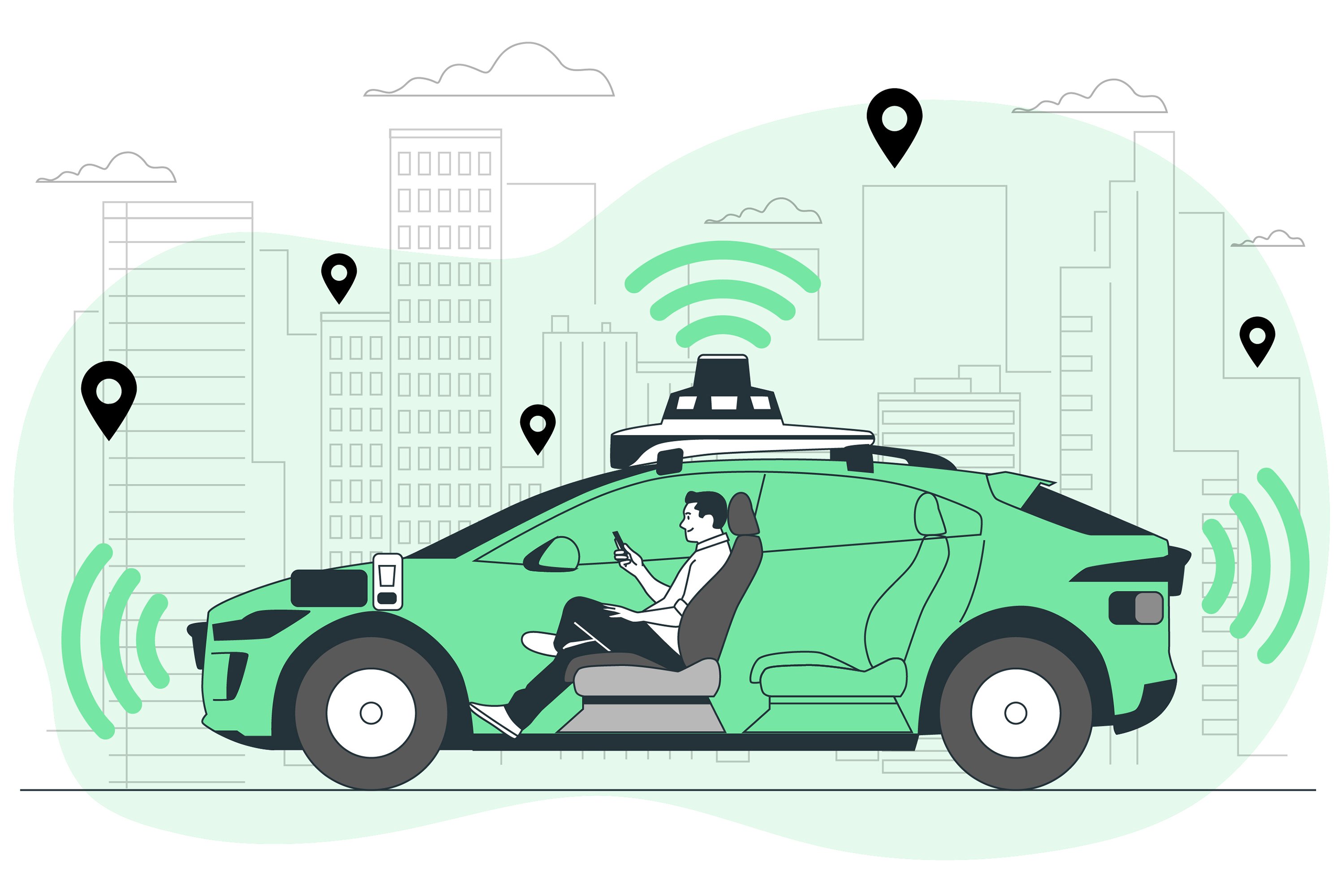
Tesla and a small cohort have shipped camera-only architectures for high-autonomy features, proving their feasibility beyond driver assistance. Most Level 4 programmes, however, combine cameras with lidar and radar, and the CV architecture changes meaningfully as a result.
In a camera-only stack, depth is inferred — either from stereo geometry or from monocular self-supervision against motion. In a fusion stack, depth is measured directly by lidar, and the camera contributes texture, colour, and semantic labels that lidar cannot. The fusion can happen at the sensor level (raw point cloud projected into image space), at the feature level (intermediate CNN activations combined), or at the object level (independent detectors merged in a tracker). Each option trades latency, calibration sensitivity, and model complexity differently.
Radar adds a third modality that is particularly resilient to rain, fog, and snow — conditions where both cameras and lidar degrade. Radar’s spatial resolution is too coarse for fine-grained classification, but its velocity measurement is direct and accurate, which complements the CV stack’s tracking estimates. The engineering effort here sits less in the models and more in the calibration, synchronisation, and time-alignment of streams arriving from sensors with different clocks and different latencies.
Where classical CV still belongs
Deep networks now dominate perception, though legacy geometric methods persist in production where they solve narrow, well-defined problems. OpenCV-style image rectification, camera-to-camera and camera-to-lidar calibration, feature-point extraction for visual odometry, and morphological operations on segmentation masks all retain their place. These operations are deterministic, fast, and well-understood, which matters when a safety case has to be argued in front of a regulator.
A common pattern is classical pre-processing feeding a learned detector, with classical post-processing applying geometric or temporal constraints to the detector’s output. The learned component carries the semantic load; the classical components anchor the pipeline to physics that the learned model cannot violate.
For a deeper architectural walkthrough of these ten sub-systems and how they compose into a production stack, see Computer Vision in Autonomous Vehicles: Ten Production-Validated Applications. For broader programme context, our Computer Vision R&D practice covers the engagement model we use for AV CV scoping work.
What remains unsolved
Three categories of failure continue to evade robust mitigation. Heavy occlusion — a pedestrian stepping out from behind a parked van, a cyclist hidden by a bus — defeats per-frame detection and requires temporal reasoning across frames that few production systems handle robustly. Adverse weather degrades all camera-based subsystems, with rain and snow being particularly disruptive to both segmentation and depth estimation. Rare-event handling, the long tail of scenarios that appear once per million miles, remains a data-curation problem rather than an architectural one; the question is not how to model the event but how to find enough examples of it to train against.
These are the questions the field is actively working on, not the questions it has solved. Any vendor claim of full autonomy that does not name these three classes specifically is worth interrogating.
Frequently asked questions
What are the production-validated CV applications in autonomous vehicles today?
The core set covers lane detection, traffic-sign recognition, pedestrian and cyclist tracking, depth estimation, lidar–camera fusion, drowsiness monitoring, parking assist, blind-spot detection, traffic-light recognition, and road-condition assessment. Each ships in production vehicles today at varying autonomy levels.
How do CV stacks differ between Level 2 ADAS and Level 4 autonomous deployments?
Level 2 assumes a human driver remains in the loop, so perception only needs to handle a narrow set of assist scenarios. Level 4 removes the human fallback within the operational design domain, which forces sensor redundancy, long-tail dataset curation, and substantially higher engineering investment per sub-system.
Which CV problems remain unsolved in 2026 AV pipelines?
Heavy occlusion, adverse-weather degradation across cameras and lidar, and rare-event handling remain the three failure classes that resist clean solutions. They are active research areas, not solved problems.
What datasets and benchmarks drive AV CV progress, and where do they fall short?
KITTI, Waymo Open Dataset, and nuScenes are the most-cited public benchmarks. They are useful as a component-level sanity floor but cannot substitute for an evaluation set drawn from the specific operational design domain of a deployment.
How does sensor fusion change the CV architecture versus camera-only stacks?
Fusion stacks measure depth directly via lidar rather than inferring it from images, and they gain weather resilience from radar. The architectural cost sits in calibration, synchronisation, and choosing the right fusion level (sensor, feature, or object) for each downstream task.
What is the role of classical OpenCV-style CV in a modern AV stack?
Classical techniques remain present for calibration, rectification, visual odometry feature extraction, and geometric post-processing. They are deterministic and well-understood, which matters when a safety case has to be argued in front of a regulator.
Safety-critical perception needs rigorous validation
Our perception modules ship to automotive OEMs with ISO 26262 certification and guaranteed behavior on distribution tails. Our involvement typically covers one or more of the ten sub-systems above — model architecture, training-data curation, latency optimisation against an automotive SoC budget, or the fusion layer that combines camera output with lidar and radar.
The engagements that go well share a common starting point: a clear-eyed view of which sub-system is on the critical path, what its current failure modes are, and what the deployment timeline can absorb. If that conversation is one you need to have, get in touch.
Image credits: Freepik