Optimising Quality Control Workflows with AI and Computer Vision

Quality control with computer vision: inspection pipeline design, defect detection architectures, and the measurement factors that determine false-reject rates in production.

Optimising Quality Control Workflows with AI and Computer Vision
Written by TechnoLynx Published on 24 Mar 2025

Introduction

Quality control is at the heart of every manufacturing process. It’s a vital part of making sure every product meets the required standards before it reaches customers. Defective products cause financial losses, recalls, and, unfortunately, reputational damage. Quality assurance is especially critical for industries like automotive, pharmaceutical, and electronics.

Traditional quality control methods rely on manual inspections, which are slow, inconsistent, and prone to human error. Even rule-based detection systems struggle with microscopic or irregular defects, reducing overall quality assurance efficiency. As production demands increase, these limitations create bottlenecks that affect both product quality and operational costs.

Artificial intelligence (AI) and computer vision, which is a branch of AI that deals with visual data, are changing quality control for the better by automating tasks like defect detection. By finding patterns in images and videos, these technologies can identify defects instantly. This makes production faster, more accurate, and consistent. Such AI systems can adapt to different product materials, lighting, and product changes, making sure only the best quality products reach distribution centres.

With industries increasingly prioritising automation, the demand for AI-enabled quality control is rapidly growing. Many companies are already using or looking into adopting AI tools for quality control and maintenance. As a result of this growing popularity, the AI quality inspection market is projected to reach $70.7 billion by 2029. This also reflects the industry’s slow and steady shift toward AI automation. In fact, 64% of the manufacturing sector now relies on Industry 4.0 technologies like AI and cloud computing for operational improvements.

In this article, we’ll explore how AI, computer vision, generative AI, AR (augmented reality), VR (virtual reality) and XR (extended reality) are improving quality control and maintenance across various industries. We’ll also discuss some real-world applications of AI and emerging trends in quality assurance using AI.

Understanding Computer Vision in Industrial Applications

When it comes to quality control, AI and computer vision systems analyse visual data to detect defects in products with precision. This is an improvement over manual inspections, which can be slow and inconsistent. In fact, Vision AI systems can process thousands of images per second. It can identify flaws, misalignments, and structural defects that might go unnoticed by human inspectors. To achieve precision with respect to defect detection, these AI solutions generally apply different computer vision techniques at various stages of the quality control pipeline.

Also, image processing is a key part of these systems. It is used to adjust parameters like the contrast, sharpness, and brightness of visual data to improve detection accuracy under different lighting conditions. Using image processing for pre-processing enables AI models to receive clean, high-quality images for analysis. After that, techniques like image segmentation can divide images into multiple sections to help AI models identify defective areas in real time with greater accuracy.

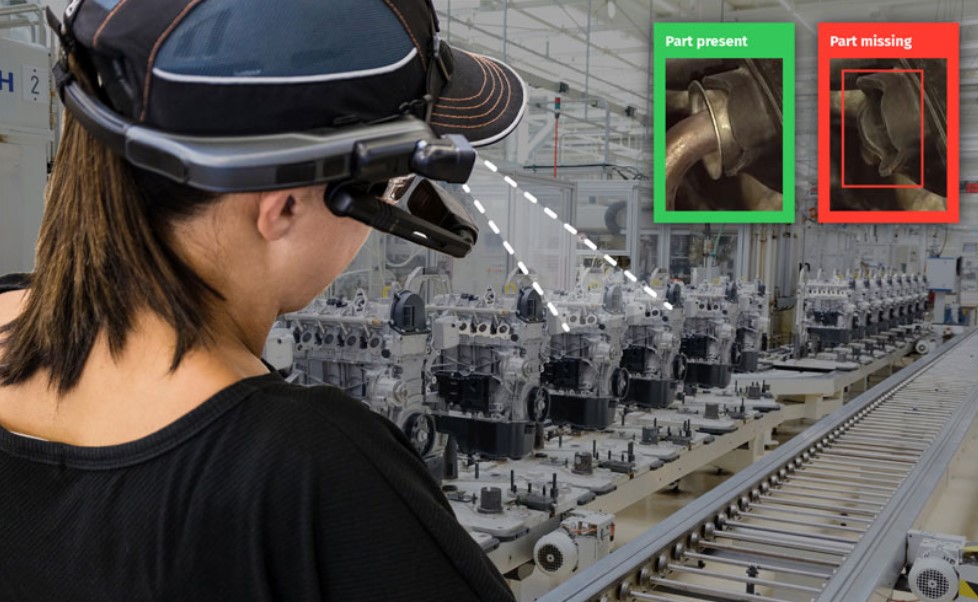
AI and Computer Vision for Defect Detection in Manufacturing. Source: JourneyApps

On top of this, object detection is used to identify missing, misaligned, or damaged components. At the core of these processes are Vision AI models like Convolutional Neural Networks (CNNs), RCNN, and YOLO. These models can extract and process visual features for accurate defect detection.

However, object detection isn’t limited to traditional CNN-based methods. Vision transformers are a newer approach that adapts transformer architectures, originally designed for processing language, to handle visual data. Instead of analysing an entire image at once, these models divide an image into smaller patches, processing them as a sequence to capture both local and global relationships.

While they can be a bit slower than conventional CNNs, their ability to extract more detailed and robust features means they could become increasingly valuable in complex tasks such as defect detection. For instance, foundation models like DINO have demonstrated strong performance in feature extraction, offering a promising alternative despite their heavier computational demands.

Real-World Use Cases of AI in Quality Assurance

Many industries using AI in quality control systems have seen an increase in defect detection, up to 90%. By using AI tools, they are also reducing waste and improving production efficiency. Let’s take a closer look at some real-world examples of industries using AI in quality control and maintenance.

AI Defect Detection in Automotive Production Lines

Many car manufacturers are already using AI to quickly detect scratches, dents, and structural deformities without slowing down production. AI-driven computer vision systems can scan car bodies in real time, spotting even minor defects that might otherwise be missed. It speeds up quality control and ensures that vehicles meet safety and design standards.

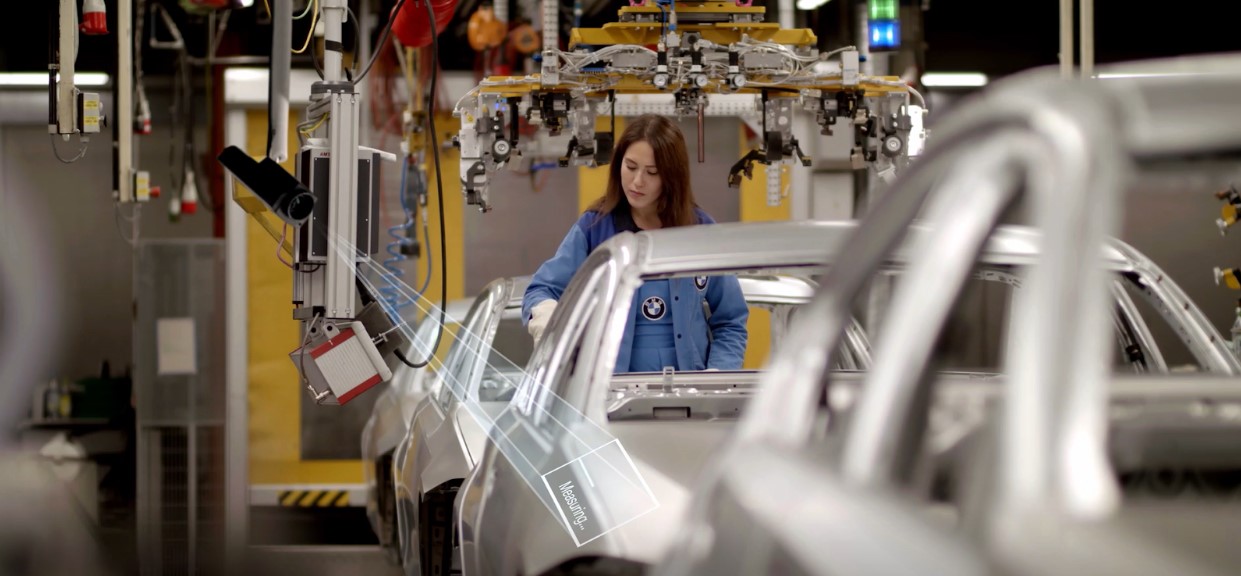
For example, leading automotive manufacturers like BMW and Audi have integrated computer vision systems into their production lines to detect surface defects on car bodies. Using Vision AI, they have managed to reduce manual inspection time by up to 50% and improve defect detection rates.

AI Defect Detection in BMW Production Lines. Source: BMW Group Press

Generative AI in Industrial Operations

Generative AI is a subfield of AI used to create or generate new data like text, images, audio, and video from scratch. In quality control and maintenance, generative AI can be used to create synthetic failure scenarios, helping industries predict and prevent equipment malfunctions before they occur. Many companies are already looking into adopting Gen AI for such predictive maintenance practices. In fact, the market for generative AI in manufacturing is projected to grow significantly, reaching $13.8 billion by 2034.

Manufacturing plants can collect vast amounts of operational data through different sensors. This data can be used by generative AI systems to create different failure possibilities. Insights from these scenarios can optimise maintenance schedules and improve system reliability. It is usually used with digital twin technology, where AI can be used to create virtual versions of machines. It helps detect problems early and improve performance before issues arise.

For example, let’s say there’s a robotic arm on an assembly line. Sensors can continuously monitor its temperature, vibration, and motor currents. Generative AI systems can use this real-time data to simulate potential failure scenarios, such as overheating or mechanical wear under different operating conditions. By testing these scenarios on a digital twin of the robotic arm, engineers can detect early signs of potential issues, adjust maintenance schedules accordingly, and implement timely repairs.

Using XR for Remote Quality Inspections

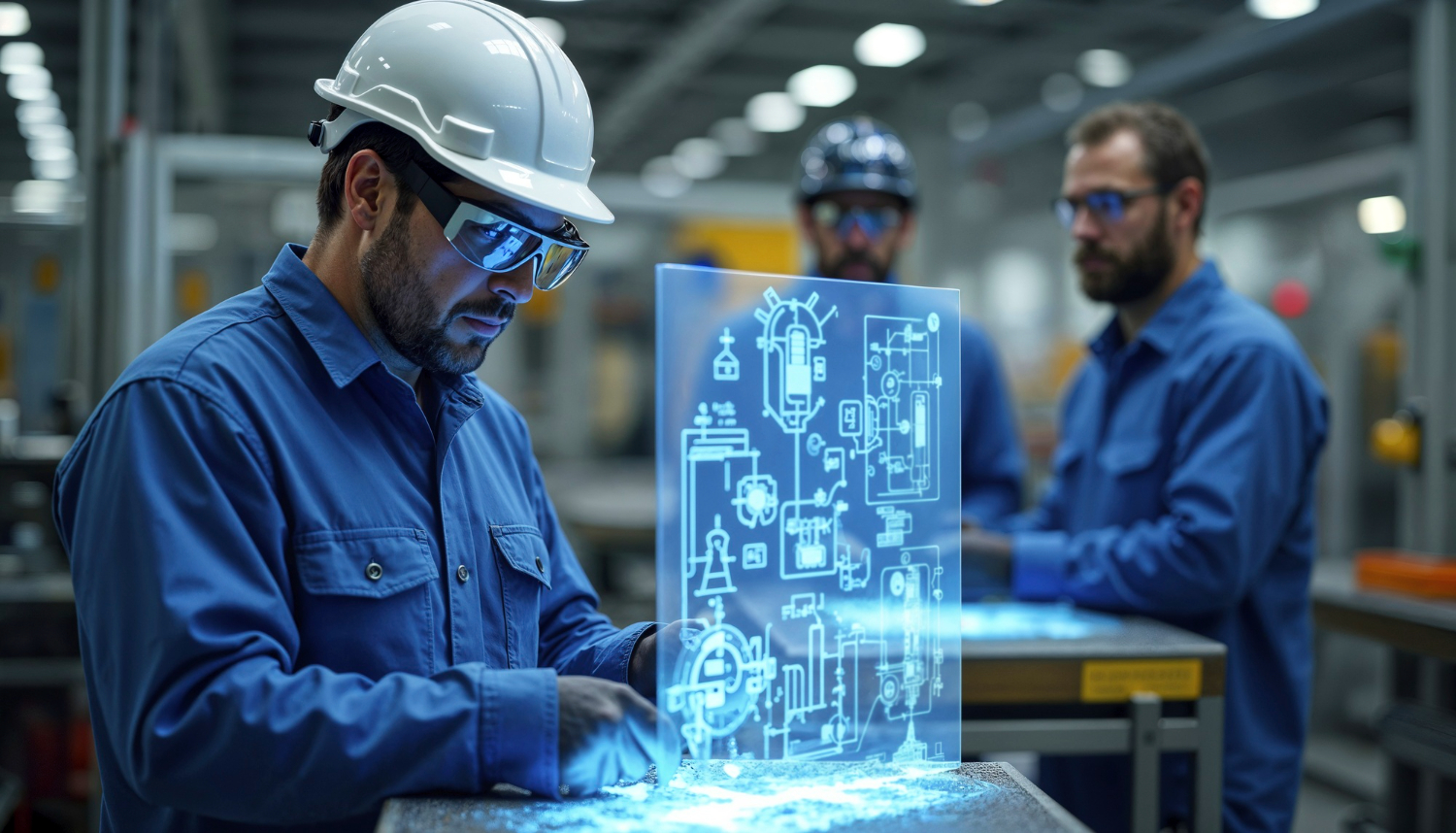
Extended reality is a technology that combines both augmented reality and virtual reality VR. XR can be used to monitor quality control operations remotely from anywhere. Using XR for remote quality inspections removes the need for extensive physical testing. Doing so reduces operational costs and improves workflow efficiency. As industries continue adopting AI and computer vision, XR-based inspections are set to become a standard in aerospace, manufacturing, and other high-precision industries.

Using AI, XR can add digital details to real-world objects, helping inspectors spot defects, structural issues, and inconsistencies more accurately than before. Today, 88% of XR companies use AI, showing a move toward smarter and more automated systems.

These systems use high-resolution cameras and AI-based image analysis to detect even the smallest anomalies. This combination increases the speed of performing inspections, reduces human errors, and maintains consistent quality standards across industries.

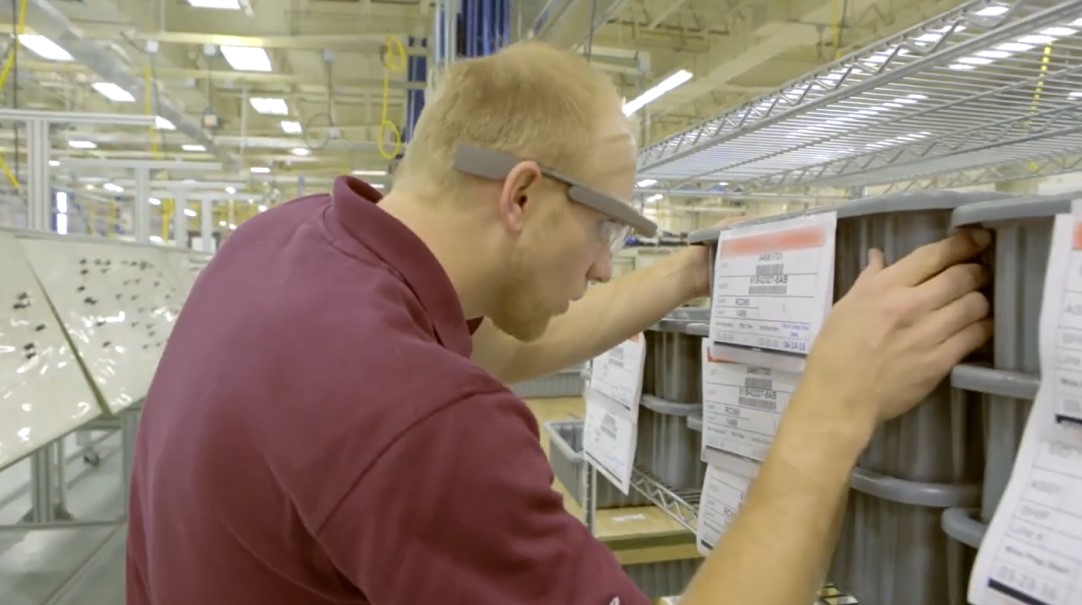
For example, Boeing has implemented AR for aircraft maintenance. AR helps technicians to view digital schematics overlaid on aircraft components, reducing inspection time by 40%.

AR-based Aircraft Production and Maintenance at Boeing. Source: Upskill

AI and OCR for Label and Packaging Verification

Optical Character Recognition (OCR) is an AI technique used to read and understand text or codes from physical documents. It can also be used for quality control by reading and verifying labels and serial numbers from product packages. By creating a system that automates the process, companies can better follow packaging compliance and regulations.

Using deep learning methods, OCR systems accurately interpret diverse fonts, sizes, and orientations on labels. For instance, it can be used to detect products that have expired, making sure only fresh products reach the shelves.

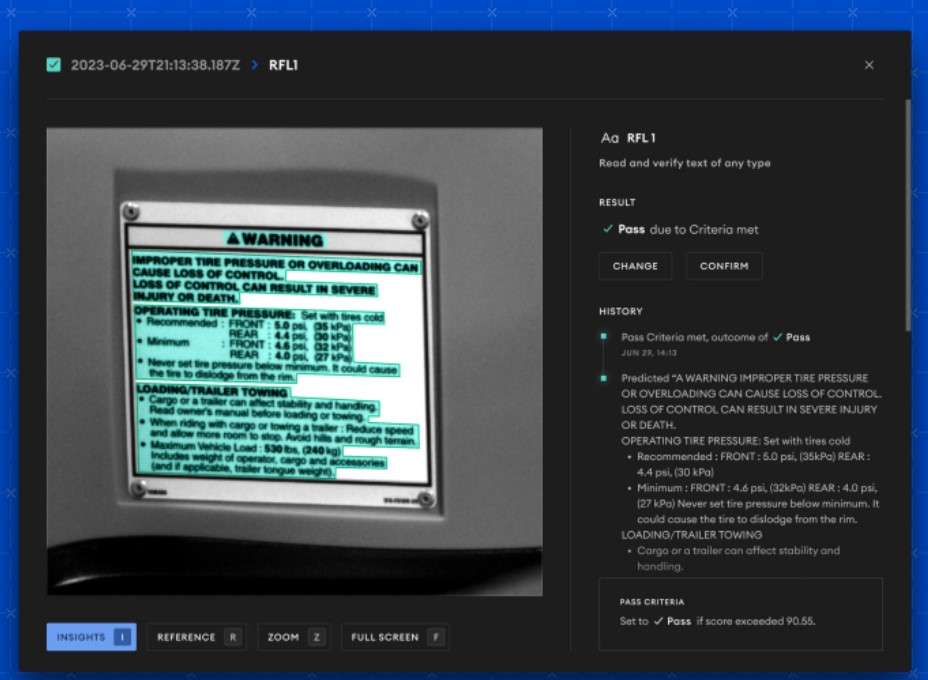
In car manufacturing, warning labels are crucial for letting consumers know about the safety features and potential hazards associated with the vehicle. AI and OCR can automate the process of checking such labels. Yamaha Motors implemented an AI-powered vision solution to automate the inspection of warning labels on their all-terrain vehicles (ATVs) and recreational off-highway vehicles (ROVs). Before using OCR, Yamaha checked labels manually, which took a lot of time. With AI, they were able to instantly verify label placement and content, making inspections faster and more accurate.

OCR for Label Inspection at Yamaha Motors. Source: Elementary

Structural Inspections for Safety Monitoring Using AI

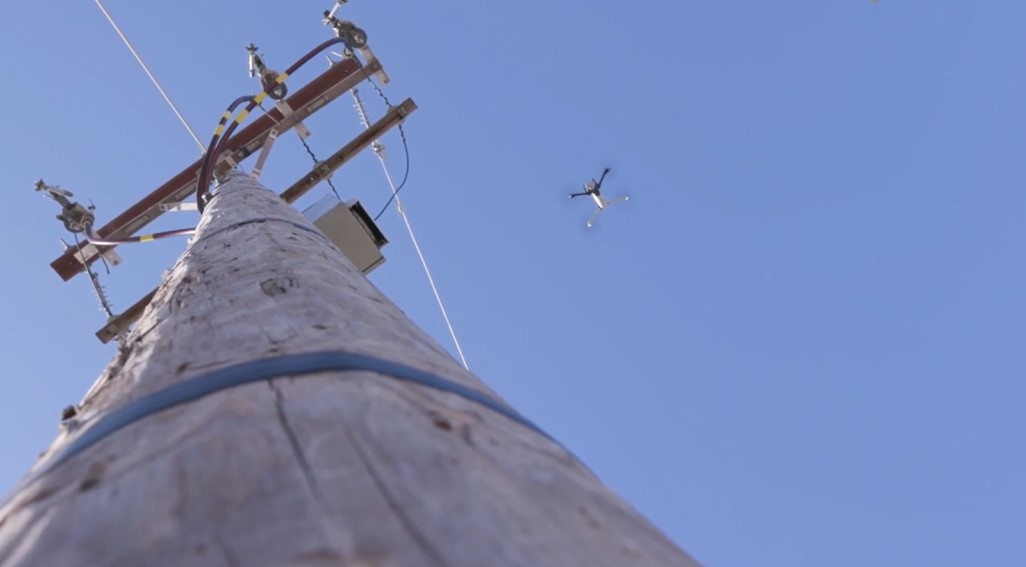
Aerial drones that are integrated with AI and computer vision can be used to make infrastructure inspections faster and safer. They provide accurate assessments of buildings and bridges. Performing these tasks manually can be hazardous for human inspectors. These AI drones provide a much safer option. They can easily analyse structural integrity, identifying potential risks before they become critical.

Drones can be integrated with models that support advanced image classification and segmentation techniques to detect cracks, material degradation, and other structural weaknesses that might have been difficult to spot. By capturing high-resolution images and processing them through AI algorithms, they provide detailed defect analysis with a level of accuracy that would’ve been difficult with traditional methods. Such a level of accuracy is vital for many applications, especially in areas like power grid maintenance.

AI Drone Inspections for Grid Management. Source: ComEd

For example, a leading U.S. energy provider, ComEd, integrated AI drone inspections into its grid management and maintenance system. ComEd’s drones capture high-resolution images of power poles and critical infrastructure. Then, AI algorithms analyse these images and identify potential defects with over 95% accuracy. This automation has made grid inspections more reliable and reduced safety risks for workers. Using AI for inspections has also helped ComEd boost its net revenue, proving how cost-effective AI can be for monitoring structures and predicting maintenance needs.

It is likely that in the future, AI and the Internet of Things (IoT) - a network of interconnected sensors and devices - will drive quality control. Factories are already using AI-powered analytics and sensor data to detect defects, predict failures, and adjust operations in real-time. Right now, 54% of businesses use AI, and 51% use IoT, showing a growing shift toward automated and self-improving production systems.

For example, instead of using a traditional camera that records images for later review, factories are using IoT cameras that stream high-resolution images continuously. While a cloud camera also offers real-time monitoring by sending data to remote servers for processing, it relies on a stable internet connection. In contrast, an IoT camera typically processes data locally, which makes faster decision-making possible.

What We Can Offer as Technolynx

At Technolynx, we develop customised AI solutions for various applications like quality control and maintenance that help industries achieve higher accuracy, efficiency, and reliability. Our expertise surrounds creating applications using cutting-edge technologies like computer vision, generative AI, and XR.

We believe in developing ethical AI solutions that make your industrial processes more efficient. If you’re looking to enhance your quality assurance strategy with AI, we’re here to help. Reach out today!

Conclusion

AI and computer vision make quality control and maintenance faster and more accurate. They help spot defects quickly and reduce mistakes by automating inspections with innovative models. In particular, these solutions can cut waste and improve production efficiency.

AI can also be used to predict equipment issues before they happen, preventing breakdowns and reducing downtime. Technologies like generative AI and XR-based inspections help businesses maintain high quality while saving money.

As industries automate, using AI for quality control isn’t just an option; it’s crucial for staying competitive and ensuring long-term success.

Sources for the Images

BMW Group Press, 2019. Fast, efficient, reliable: Artificial intelligence in BMW Group Production. BMW Group

ComEd, 2024. ComEd UAS (Drone) Demo with Skydio. YouTube

Elementary, 2023. BMD-44_elementary_x_Yamaha_Case_Study. Elementary

Freepik. n.d. Futuristic technology concept. Generated by AI

JourneyApps, 2022. 8 Computer Vision Use Cases in Manufacturing. JourneyApps.

Upskill, 2019. Boeing works with Upskill to Cut Production Time by 25%. YouTube

References

Airbus, 2016. Airbus Group Unit Testia to Supply Augmented Reality System to Spirit AeroSystems. 11 April.

Automotive Manufacturing Solutions, 2025. Audi is Advancing Vehicle Production with AI-Powered Image Processing. 4 February.

BMW Group Press, 2019. Fast, Efficient, Reliable: Artificial Intelligence in BMW Group Production

Capgemini, 2018. Augmented and Virtual Reality in Operations

Elementary, 2023. AI-Powered OCR for Label Inspection at Yamaha Motors

GlobeNewswire, 2024. AI Quality Inspection Market Report 2024: Forecasts to 2029. GlobeNewswire, 18 November.

Google Cloud, 2021. Google Cloud Manufacturing Report 2021

Kaspersky, 2024. More than Half of Companies Use AI and IoT in Their Business Processes. 29 February.

Manu, 2024. XR, VR, AR, and AI Report of 2024: Innovations and Opportunities for Businesses. Yord Studio, December.

McKinsey & Company. Smartening Up with Artificial Intelligence

Optelos, 2024. ComEd Case Study: Automating Grid Analytics Through Drone Power Line Inspection and Computer Vision AI. 11 April.

Precedence Research, 2024. Generative AI in Manufacturing Market Size, Share, and Trends 2024-2034. 14 October.
Pharmaceutical Supply Chain: Where AI and Computer Vision Solve Visibility Gaps

Pharmaceutical Supply Chain: Where AI and Computer Vision Solve Visibility Gaps

10/05/2026

Pharma supply chains span API sourcing to patient delivery. AI addresses the serialisation, cold chain, and counterfeit detection gaps manual tracking.

Vision Systems for Manufacturing Quality Control: Inline vs Offline, Hardware and PLC Integration

Vision Systems for Manufacturing Quality Control: Inline vs Offline, Hardware and PLC Integration

10/05/2026

Industrial vision systems for manufacturing quality control: inline vs offline inspection, line-scan vs area cameras, PLC integration, and realistic.

AI Video Surveillance for Apartment Buildings: Analytics, Privacy Zones, and False Alarm Rates

AI Video Surveillance for Apartment Buildings: Analytics, Privacy Zones, and False Alarm Rates

9/05/2026

AI video surveillance for apartment buildings: access control integration, package detection, loitering alerts, privacy zones, and false alarm rates in.

Retail Shrinkage and Computer Vision: What CV Can and Cannot Detect

Retail Shrinkage and Computer Vision: What CV Can and Cannot Detect

9/05/2026

Retail shrinkage from theft, admin error, and vendor fraud: how CV systems address each, what they miss, and realistic shrinkage reduction numbers.

Object Detection Model Selection for Production: YOLO vs Transformers, Speed/Accuracy, and Deployment

Object Detection Model Selection for Production: YOLO vs Transformers, Speed/Accuracy, and Deployment

9/05/2026

Object detection model selection for production: YOLO variants vs detection transformers, speed/accuracy tradeoffs, edge vs cloud deployment, mAP vs.

Manufacturing Safety AI: Gun Detection and Threat Monitoring with Computer Vision

Manufacturing Safety AI: Gun Detection and Threat Monitoring with Computer Vision

9/05/2026

AI gun detection in manufacturing uses CV to identify weapons in camera feeds. What the technology detects, accuracy limits, and deployment considerations.

Machine Vision Image Sensor Selection: CCD vs CMOS, Resolution, and Illumination

Machine Vision Image Sensor Selection: CCD vs CMOS, Resolution, and Illumination

9/05/2026

How to select image sensors for machine vision: CCD vs CMOS tradeoffs, resolution, frame rate, pixel size, and illumination requirements by inspection.

Facial Recognition Cameras for Commercial Deployment: Matching, Enrollment, and Legal Framework

Facial Recognition Cameras for Commercial Deployment: Matching, Enrollment, and Legal Framework

9/05/2026

Commercial facial recognition deployments: enrollment management, 1:1 vs 1:N matching, false acceptance rates, consent requirements, and hardware.

Facial Detection Software: Open Source vs Commercial APIs, Accuracy, and Production Integration

Facial Detection Software: Open Source vs Commercial APIs, Accuracy, and Production Integration

8/05/2026

Facial detection software options: OpenCV, dlib, DeepFace vs commercial APIs, when to build vs buy, demographic accuracy, and production pipeline.

Face Detection Camera Systems: Resolution, Lighting, and Real-World False Positive Rates

Face Detection Camera Systems: Resolution, Lighting, and Real-World False Positive Rates

8/05/2026

Face detection camera prerequisites: resolution minimums, angle and lighting requirements, MTCNN vs RetinaFace vs MediaPipe, and real-world false positive.

Embedded Edge Devices for CV Deployment: Jetson vs Coral vs Hailo vs OAK-D

Embedded Edge Devices for CV Deployment: Jetson vs Coral vs Hailo vs OAK-D

8/05/2026

Embedded edge devices for CV: NVIDIA Jetson vs Coral TPU vs Hailo vs OAK-D — power, inference throughput, and model optimisation requirements compared.

Driveway CCTV Cameras with AI Detection: Vehicle Classification, Night Performance, and False Alarm Reduction

Driveway CCTV Cameras with AI Detection: Vehicle Classification, Night Performance, and False Alarm Reduction

8/05/2026

Driveway CCTV AI detection: vehicle vs person classification, IR vs starlight night performance, reducing animal and shadow false alarms, home automation.

Digital Shelf Monitoring with Computer Vision: What Retail AI Actually Detects

7/05/2026

Digital shelf monitoring uses CV to detect out-of-stocks, planogram compliance, and pricing errors. What systems detect and where accuracy drops.

Deep Learning for Image Processing in Production: Architecture Choices, Training, and Deployment

7/05/2026

Deep learning for image processing in production: CNN vs ViT tradeoffs, training data requirements, augmentation, deployment optimisation, and.

AI vs Real Face: Anti-Spoofing, Liveness Detection, and When Custom CV Models Are Necessary

7/05/2026

When synthetic faces defeat pretrained detectors: anti-spoofing challenges, liveness detection requirements, and when custom models are unavoidable.

AI-Based CCTV Monitoring Solutions: Automation vs Human Review and What Each Handles Well

7/05/2026

AI CCTV monitoring vs human monitoring: cost comparison, coverage capability, response time tradeoffs, and what AI handles well vs where human judgment is.

CCTV Face Recognition in Production: Why It Fails More Than Demos Suggest

7/05/2026

CCTV face recognition: resolution requirements, angle and lighting challenges, false positive rates, GDPR compliance, and why production performance lags.

AI-Enabled CCTV for Building Security: Analytics, Camera Placement, and Infrastructure

6/05/2026

AI CCTV for building security: intrusion detection, people counting, loitering analytics, camera placement strategy, and storage and bandwidth.

Best Wired CCTV Systems for AI Video Analytics: What Matters Beyond Resolution

6/05/2026

Wired CCTV for AI analytics needs more than resolution. Codec support, edge processing, and integration architecture decide analytics quality.

Automated Visual Inspection in Pharma: How CV Systems Replace Manual Quality Checks

6/05/2026

Automated visual inspection in pharma uses computer vision to detect defects in vials, syringes, and tablets — faster and more consistently than human.

Automated Visual Inspection Systems: Hardware, Model Selection, and False-Reject Rates

6/05/2026

Build automated visual inspection systems that work: hardware setup, model selection (classification vs detection vs segmentation), and managing.

Aseptic Manufacturing in Pharma: Process Control, Risks, and Where AI Fits

6/05/2026

Aseptic manufacturing prevents microbial contamination during sterile drug production. AI monitoring addresses the environmental control gaps humans miss.

4K Security Cameras and AI Analytics: When Higher Resolution Helps and When It Doesn't

6/05/2026

4K security cameras for AI analytics: bandwidth and storage costs, where higher resolution improves results, compression artifacts and AI accuracy.

Computer Vision in Pharmacy Retail: Inventory Tracking, Planogram Compliance, and Shrinkage Reduction

5/05/2026

CV in pharmacy retail addresses unique challenges: regulated product tracking, controlled substance security, and planogram compliance across thousands of SKUs.

Visual Inspection Equipment for Manufacturing QC: Where AI Adds Value and Where Rules Still Win

5/05/2026

AI-enhanced visual inspection replaces rule-based defect detection with learned representations — but requires validated training data matching production variability.

AI Enables Real-Time Monitoring of Aseptic Filling Lines — Here's What's Changing

5/05/2026

New AI-driven monitoring systems detect contamination risk in aseptic filling by analysing environmental and process data continuously rather than via batch sampling.

Facial Recognition in Video Surveillance: Why Lab Accuracy Doesn't Transfer to CCTV

5/05/2026

Facial recognition accuracy drops 10–40% between controlled enrollment conditions and production CCTV due to angle, lighting, and resolution.

Computer Vision Store Analytics: What Cameras Can Actually Measure in Retail

5/05/2026

Store analytics CV must distinguish 'detected' from 'measured with business-decision confidence.' Most deployments conflate the two.

AI in Pharmaceutical Supply Chains: Where Computer Vision and Predictive Analytics Deliver ROI

5/05/2026

Pharma supply chain AI delivers measurable ROI in three areas: serialisation verification, cold-chain anomaly prediction, and visual inspection automation.

Computer Vision for Retail Loss Prevention: What Works, What Breaks, and Why Scale Matters

5/05/2026

CV-based loss prevention must handle thousands of SKUs under variable lighting. Single-model approaches produce unactionable alert volumes at scale.

Intelligent Video Analytics: How Modern CCTV Systems Detect Behaviour Instead of Motion

4/05/2026

IVA shifts surveillance alerting from pixel-change detection to behaviour understanding. But only modular pipeline architectures deliver this in practice.

Cross-Platform TTS Inference Under Real-Time Constraints: ONNX and CoreML

1/05/2026

Cross-platform TTS to iOS, Android and browser stays consistent only if compression is decided at training time — distill once, export to ONNX.

Production Anomaly Detection in Video Data Pipelines: A Generative Approach

1/05/2026

Generative models trained on normal frames detect rare video anomalies without labelled anomaly data — reconstruction error is the score.

Designing Observable CV Pipelines for CCTV: Modular Architecture for Security Operations

30/04/2026

Operators stop trusting CV alerts when the pipeline is opaque. Observable, modular CCTV pipelines decompose decisions into auditable stages.

The Unknown-Object Loop: Designing Retail CV Systems That Improve Operationally

30/04/2026

Retail CV deployments meet products outside the training catalogue. The architectural choice: silent misclassification or a designed review loop.

Why Client-Side ML Projects Miss Latency Targets Before Deployment

29/04/2026

Client-side ML misses latency targets when the device capability baseline is set after architecture selection rather than before. Sequence matters.

Building a Production SKU Recognition System That Degrades Gracefully

29/04/2026

Graceful degradation in production SKU recognition is an architectural property: predictable automation rate as the catalogue grows.

Why AI Video Surveillance Generates False Alarms — And What Pipeline Architecture Reduces Them

28/04/2026

Surveillance false alarms are an architecture problem, not a sensitivity setting. Modular pipelines reduce them; monolithic ones cannot.

Why Computer Vision Fails at Retail Scale: The Compound Failure Class

28/04/2026

CV models that pass accuracy tests at 500 SKUs fail in production above 1,000 — not from one cause but from four simultaneous failure axes.

When to Build a Custom Computer Vision Model vs Use an Off-the-Shelf Solution

26/04/2026

Custom CV models are justified when the domain is specialised and off-the-shelf accuracy is insufficient. Otherwise, customisation adds waste.

How to Deploy Computer Vision Models on Edge Devices

25/04/2026

Edge CV trades accuracy for latency and bandwidth savings. Quantisation, model selection, and hardware matching determine whether the trade-off works.

What ROI Computer Vision Actually Delivers in Retail

24/04/2026

Retail CV ROI comes from shrinkage reduction, planogram compliance, and checkout automation — not AI dashboards. Measure what changes operationally.

Data Quality Problems That Cause Computer Vision Systems to Degrade After Deployment

23/04/2026

CV system degradation after deployment is usually a data problem. Annotation inconsistency, domain shift, and data drift are the structural causes.

How Computer Vision Replaces Manual Visual Inspection in Pharmaceutical Quality Control

23/04/2026

CV-based pharma QC inspection is a production engineering problem, not a model accuracy problem. It requires data, validation, and pipeline design.

How to Architect a Modular Computer Vision Pipeline for Production Reliability

22/04/2026

A production CV pipeline is a system architecture problem, not a model accuracy problem. Modular design enables debugging and component-level maintenance.

Machine Vision vs Computer Vision: Choosing the Right Inspection Approach for Manufacturing

21/04/2026

Machine vision is deterministic and auditable. Computer vision is adaptive and generalisable. The choice depends on defect complexity, not preference.

The Real Cost of Pharmaceutical Batch Failure and How AI Prevents It

21/04/2026

Pharmaceutical batch failures cost waste, rework, and regulatory exposure. AI-based process control prevents the failure classes behind most rejections.

Why Off-the-Shelf Computer Vision Models Fail in Production

20/04/2026

Off-the-shelf CV models degrade in production due to variable conditions, class imbalance, and throughput demands that benchmarks never test.

Back See Blogs
arrow icon