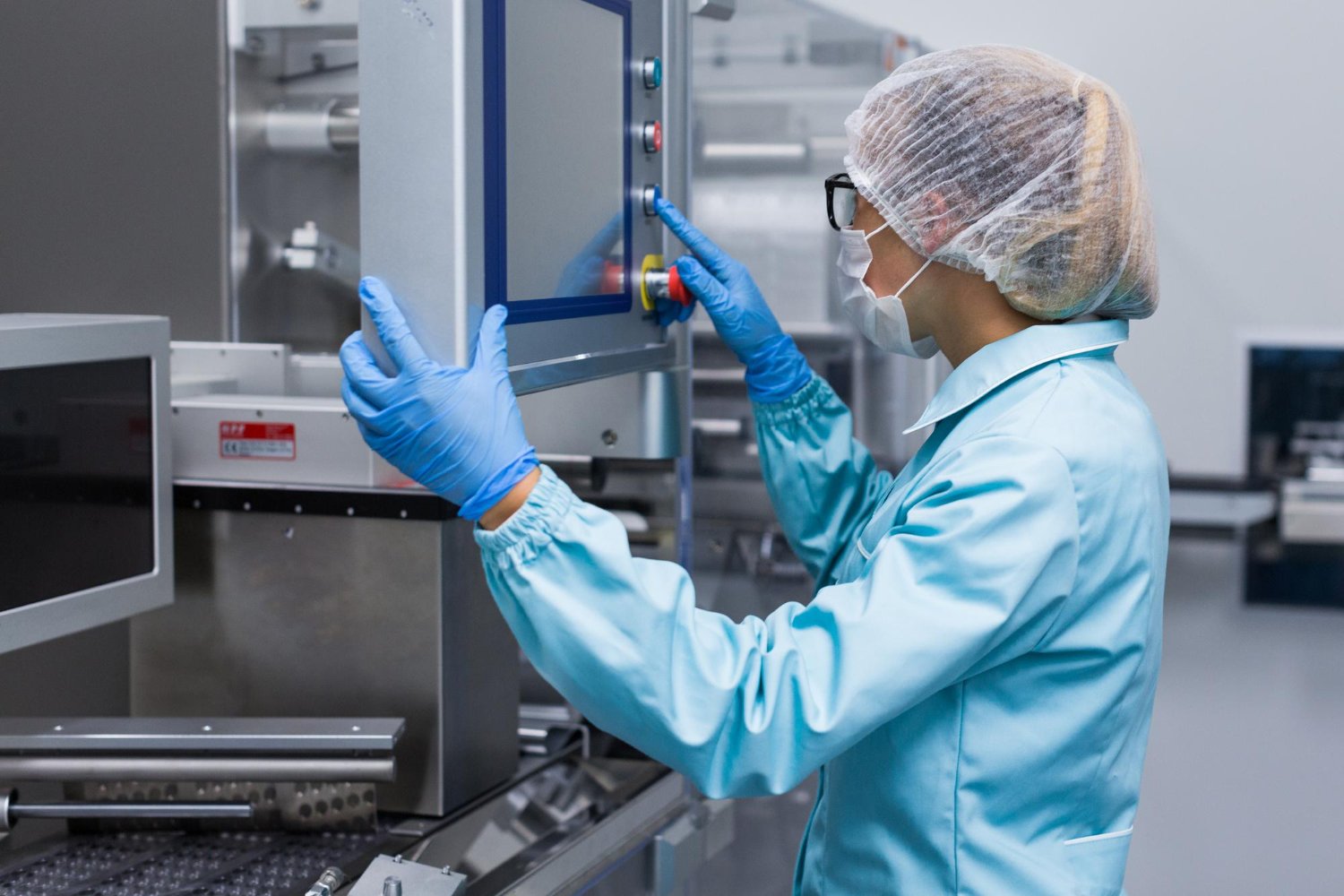
AI Visual Inspection for High-Quality Pharma Packaging
When a label is misaligned or a seal incomplete on a pharmaceutical package, patient safety is at stake. A misprinted lot code, a compromised induction seal, a missing child-resistant feature — each one is a recall vector, a regulatory finding, or a patient-safety incident waiting to surface. The manual inspection station that has historically caught these defects is also the part of the line that fatigues fastest and varies most between shifts. Computer vision is now the operationally serious answer, and the interesting question is no longer whether to automate but where the boundary between AI-based and deterministic vision actually sits.
This article walks through how AI-powered visual quality control is applied to pharmaceutical packaging specifically — what it catches, how it integrates with the line, and where it inherits the harder problems of GMP validation rather than solving them.
What Packaging Defects Does Automated Visual Inspection Actually Catch?
Defect categories amenable to automation fall into four distinct groups, each presenting unique challenges for machine vision deployment.
| Defect class | Examples | Vision approach | Difficulty |
|---|---|---|---|
| Print and labelling | Lot code legibility, barcode/QR readability, label skew, wrong artwork | OCR + deterministic template matching | Low to moderate |
| Seal integrity | Induction seal presence, foil tear, cap torque artefacts | Deterministic + lighting-engineered CV | Moderate |
| Container condition | Bottle cracks, blister-pack deformation, carton crush | CNN-based defect classification | Moderate to high |
| Child-resistant features | Push-and-turn cap alignment, blister peel-tab integrity | Combined geometric + learned features | High |
The pattern across our pharma-line work is consistent: roughly 60–70% of packaging inspection value comes from print, labelling, and barcode verification — and that work is solved well by deterministic machine vision plus OCR, no deep learning required. AI vision earns its keep on the harder 30–40%: variable container geometry, subtle deformation, and defects that look different every time. This is an observed pattern across our engagements rather than an industry benchmark; the exact split depends on product mix and packaging complexity.
When Does AI Vision Outperform Deterministic Machine Vision?
Vendors overstate the frequency with which their systems outperform human inspectors, and the cost of believing them runs high. Less frequently than sales literature implies, and over-optimistic forecasts carry steep operational costs. More frequently than sales literature admits. Deterministic vision — fixed thresholds, template matching, geometric feature extraction — has been doing serious pharma QC work for two decades. It is faster to validate, easier to explain to an auditor, and stable in ways that learned models are not. When the defect class has a deterministic visual signature under controlled lighting, the deterministic system is the correct choice.
AI vision becomes the right tool when the defect distribution is irregular: scratches that vary in length and orientation, container deformation under varying ambient conditions, contamination that doesn’t fit a fixed template, or labelling errors on artwork that changes between batches. In our experience, the deployments that work treat AI and deterministic vision as complementary rather than competing — typically a deterministic first pass handles the high-volume routine checks, and a CNN-based stage flags the ambiguous cases for either rejection or human review.
A common failure mode is to specify a deep-learning model for a problem that a well-engineered lighting setup and a template-matching algorithm would solve more reliably. Lighting is still the highest-leverage variable in pharma vision inspection. A coaxial light, the right wavelength, and a fixed inspection geometry will eliminate a class of “AI required” problems before the model is ever trained.
Real-Time Throughput and Line Integration
Blister pack, vial, and carton lines operate at throughput rates that impose strict limits on how long each inspection may take. A 600-bottle-per-minute filling line gives the vision system 100 ms per unit (by arithmetic) end to end — image acquisition, processing, decision, reject actuation. CNN-based models that are perfectly accurate offline often fail this latency budget when deployed on the line, particularly under realistic load with multiple cameras feeding the same inference node.
The architectural pattern that holds up is the production-CV stack we describe elsewhere: models that are quantised and compiled (TensorRT or equivalent) for the deployment GPU, deterministic batching policies that do not introduce variable latency, and a hard real-time path that bypasses the model entirely for the high-confidence deterministic checks. The same engineering discipline that makes a CV system work in manufacturing applies here, applied to a GMP context with auditable logs.
Reject actuation is the part teams underestimate. An inspection system that correctly identifies a defect 50 ms too late (illustrative threshold) to fire the reject mechanism is operationally equivalent to no inspection at all. The full timing budget — from photon arrival to pneumatic activation — has to be validated as a system, not just the model.
GMP Validation: Where the Difficulty Actually Lives
Deploying a computer vision inspection system for pharmaceutical packaging requires more project effort on process integration than on algorithm development. The validation work is the larger half, and it is where most pilots stall.
A CV-based inspection system for pharmaceutical packaging falls under GxP scope. The validation lifecycle looks like:
- Intended-use specification — exact defect classes the system will detect, with measurable acceptance criteria for each.
- Golden dataset construction — curated images covering the defect classes plus known-good samples, with provenance and labelling rationale documented.
- Installation Qualification (IQ) — the physical setup (cameras, lighting, conveyor integration) installed per specification.
- Operational Qualification (OQ) — the software pipeline produces the specified outputs across the defined operating range.
- Performance Qualification (PQ) — the system meets defect detection rate and false-positive rate targets on the golden dataset and on production samples.
- Ongoing monitoring — drift detection, periodic re-qualification, change-control procedure for model updates.
The two parts that catch teams out are golden-dataset construction (it takes longer than expected and the labelling decisions are not trivial) and the change-control procedure for model updates. Every time the model is retrained, the change has to flow through a controlled procedure with revalidation. Teams that don’t plan for this end up with a model frozen at deployment, unable to absorb the new defect modes that appear after six months of production.
What GxP compliance actually requires for AI software in pharmaceutical manufacturing covers the regulatory shape of this work in more depth; for the production-CV side, the methodology we apply here is the same one we use in other manufacturing CV deployments, adapted to a regulated environment.
Difficult-to-Inspect Products
Certain pharmaceutical products resist reliable visual inspection whether examined by trained operators or imaging algorithms. Suspensions where particulates are part of the product. Opaque amber vials. Lyophilised cake where the appearance of the freeze-dried product varies legitimately between units. Humans struggle with these — they tend to over-reject or under-reject, depending on shift fatigue and individual judgement.
CV systems handle these cases by changing the inspection physics rather than relying on the model alone. Different lighting (backlit, side-illuminated, polarised), different wavelengths (near-infrared often penetrates where visible light fails), and sometimes multi-angle acquisition reveal features that no single image contains. The AI model then operates on richer input than the human inspector ever had. This is the deployment pattern where CV genuinely outperforms manual inspection on a sensitivity basis — not because the model is smarter, but because the inspection system sees more.
For sterile injectables specifically, the inspection regime gets stricter and the defect classes more demanding; the production-CV engineering principles still apply but the validation bar rises.
Cost Comparison Against Manual Inspection
Finance teams ask for direct cost comparisons against manual inspection first, yet these analyses rarely withstand scrutiny. The honest answer requires naming the comparison point.
Against a fully manual line: the automated system pays back within 12–24 months in most pharma-packaging deployments we have worked on. This is an observed range across our engagements, not a benchmarked rate — the actual figure depends on labour cost, throughput, and reject economics. The dominant factors in the payback calculation are not the inspection equipment cost itself but the recall avoidance value and the throughput uplift from removing the manual inspection bottleneck.
Against a deterministic-CV baseline already in place: the marginal cost-benefit of adding AI vision is much narrower. It is worth doing for the specific defect classes that the deterministic system genuinely misses, and not worth doing as a wholesale replacement. The pilot scope should be tight: name the defect classes, quantify the current miss rate, and target those specifically.
What Pharma Buyers Should Actually Specify
When scoping an AI visual inspection deployment for packaging, the specification that survives contact with production looks like this:
- Defect classes named explicitly, each with a target detection rate and a tolerable false-positive rate.
- Throughput target stated in units per minute, with a defined inspection latency budget.
- Lighting and optical setup specified as part of the system, not assumed to be the integrator’s problem.
- Golden dataset and validation protocol agreed before development begins, not after.
- Change-control procedure for model updates documented as part of the system, not an afterthought.
- Integration boundary with the existing line — reject mechanisms, MES integration, batch record entries — defined precisely.
A specification that names these things is one a CV vendor can build against and a quality team can validate against. A specification that asks for “AI-powered inspection of packaging defects” is one that ends in a stalled pilot.
The work TechnoLynx does in this space is the bridge between production CV engineering and GMP-validated deployment: the model architecture, the latency engineering, and the golden-dataset construction sit on top of the regulatory scaffolding the buyer’s quality team owns. We tend to work best on the deployments where the buyer has already named the defect classes they care about and the throughput they need to hit — those are the projects where the engineering can actually be planned against. That named-scope discipline is consistent with how we run the rest of our life-sciences AI practice.
FAQ
How does computer vision replace manual visual inspection in pharma QC without losing defect sensitivity?
By changing the inspection physics, not just the decision-maker. CV systems use controlled lighting, multiple wavelengths, and multi-angle acquisition to capture image data richer than a human inspector ever sees, then apply deterministic or learned models to the result. Sensitivity is preserved or improved because the input is better, not because the model is necessarily smarter.
Which defect classes (particulates, cracks, fill level, labelling) can automated visual inspection reliably detect today?
Print and labelling defects (lot code, barcode, artwork) are reliably detected by deterministic CV plus OCR. Seal integrity, fill level, and container deformation are reliably detected with lighting-engineered CV plus CNN classification. Particulate detection in clear solutions is solved at production scale; particulate detection in suspensions or opaque products remains harder and requires multi-modal acquisition.
What does an automated visual inspection deployment cost compared with manual inspection at the same throughput?
In our experience, payback against a fully manual line falls in the 12–24 month range, with recall avoidance and throughput uplift dominating the equipment cost. This is an observed pattern across engagements, not a benchmarked rate. Against an existing deterministic-CV baseline, the marginal economics of adding AI vision are narrower and only justified for specific high-value defect classes.
How is a CV-based inspection system validated under GMP — golden datasets, performance qualification, ongoing monitoring?
Through the standard IQ/OQ/PQ lifecycle applied to the CV pipeline: intended-use specification, golden dataset with documented labelling rationale, performance qualification against defect detection rate and false-positive rate targets, and a documented change-control procedure for model retraining. Golden-dataset construction and ongoing change control are the parts that take longest.
When does AI-based inspection outperform deterministic machine vision, and when is the simpler approach correct?
Deterministic CV is correct when the defect has a fixed visual signature under controlled lighting — most print, labelling, and barcode work falls here. AI vision earns its place when defect appearance is irregular: variable scratches, deformation under varying conditions, or labelling errors on artwork that changes between batches. The deployments that work treat the two as complementary, not competing.
How do CV systems handle difficult-to-inspect products (suspensions, opaque vials, lyophilised cake) where humans also struggle?
By using inspection modalities the human eye cannot — near-infrared imaging, polarised lighting, multi-angle acquisition — and then training models on the richer input. The CV system outperforms manual inspection on these products not because the model is more capable than a human, but because the inspection system sees more than a human ever could.
Implementing vision systems in pharmaceutical lines
Most pharmaceutical manufacturers introducing visual inspection AI start with single-line pilots, tracking defect detection performance against manual baselines across two to three months.