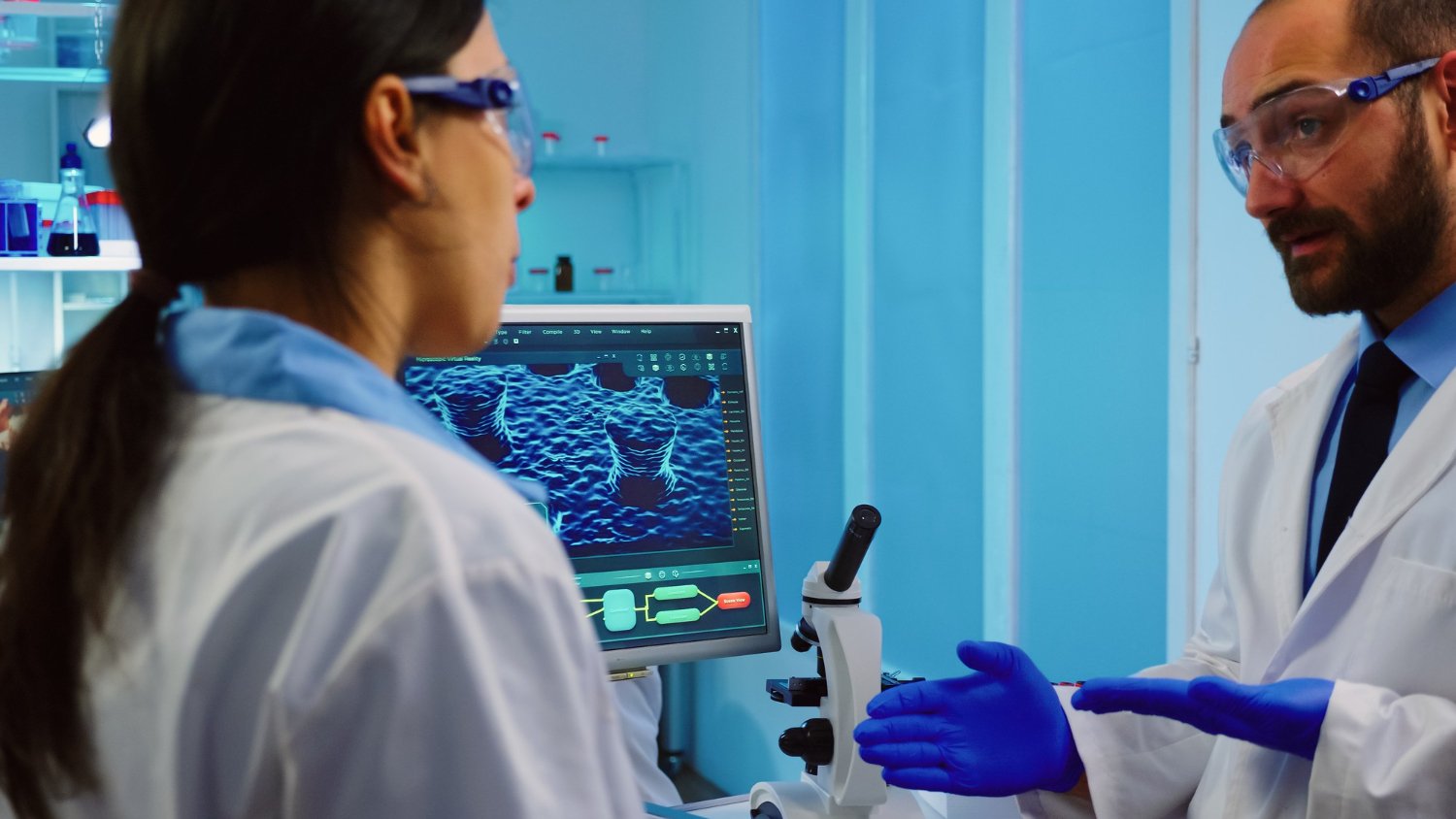
Why in-process imaging matters now in cell and gene therapy
Short timelines and fragile materials define cell and gene therapy (CGT) manufacturing. Autologous batches are lot-of-one. A minor shift in cell health or contamination risk can write off the entire run, and unlike small-molecule production, there is rarely a second chance to reprocess. Traditional checks happen at intervals — sample, transport, plate, wait — and miss what occurs between those samples.
Continuous, non-invasive insight is what closes that gap. It surfaces drift while there is still time to save a run rather than triage a failed one. Process Analytical Technology (PAT) has carried this promise for two decades, and in our experience CGT is finally the manufacturing context where the economics force the issue: a single missed contamination cue can cost six figures and a patient slot.
This is also the production-CV problem set we wrote up in Automated Visual Inspection Systems in Pharma, now applied one process step earlier — inside the bioreactor and the closed transfer, not just at fill-finish.
What is edge imaging in a CGT context?
Edge imaging places compact compute units — typically GPU-accelerated industrial PCs running TensorRT or ONNX Runtime — next to bioreactors, closed isolators, or sterile transfer points. Cameras or microscopes stream frames to these on-site nodes for real-time analysis. No raw frames leave the suite. Only structured events and compact features move upstream into the MES, EBR, or QMS.
That topology matters for three reasons at once: latency drops to the tens of milliseconds an operator can actually act on, data-residency and GxP audit trails stay clean, and the system stops accumulating PHI-adjacent video that nobody wants to govern.
Regulatory drivers that shape the approach
A documented Contamination Control Strategy (CCS) is mandated by EU GMP Annex 1 (revised, in force August 2023), which explicitly encourages technologies that prevent, detect, and control contamination risk holistically. The intent is to move beyond sporadic environmental sampling toward continuous assurance with traceable evidence.
The FDA’s Center for Biologics Evaluation and Research (CBER) draft guidance on Manufacturing Changes and Comparability for Human Cellular and Gene Therapy Products (2023) puts analytical comparability first when a process evolves. Non-clinical or clinical bridging studies follow only when the analytical package cannot demonstrate equivalence. That ordering rewards data-rich, in-process monitoring — exactly what edge imaging produces.
This is an observed pattern across the engagements we see: CGT sponsors that invested in dense in-process measurement during phase 1/2 spend materially less effort defending comparability after scale-out moves, because they can show the post-change process tracks the pre-change one feature-by-feature rather than only at release.
For the broader GxP-software framing that wraps this — URS, GAMP 5 category, audit trail expectations — see Validation-Ready AI for GxP Operations in Pharma.
What edge imaging actually measures
Unlike fixed off-line snapshots, edge imaging runs continuously and extracts features rather than archiving frames:
- Morphology and confluence. Cell size, shape, eccentricity, cluster size distribution. For adherent processes, confluence and packing density. For suspension cultures, aggregate-size histograms.
- Debris and turbidity signatures. Sub-visible debris profiles that precede many contamination events by hours.
- Motion cues. Brownian-motion-derived viability proxies and stir-induced shear indicators.
- Sub-visible particles. When paired with flow imaging microscopy, the system extends into the particle-risk regime that microbiology alone misses, which recent CGT-specific commentary has flagged as a developmental gap.
Models then raise interpretable alerts — “cluster-size distribution outside expected band”, “debris-signature rising for 12 minutes” — with a confidence score, the model version, and a link to the relevant SOP. Operators stay in control. QA keeps oversight with an audit-ready trail.
Where edge imaging fits in the Annex 1 CCS
Facility design, personnel, environment, process, and monitoring all fall within Annex 1’s CCS scope. Edge imaging primarily strengthens the monitoring and process pillars by providing continuous, context-rich evidence rather than discrete sampling points.
It sits alongside viable and non-viable particle counting, environmental monitoring, and operator gowning checks to compose the full contamination picture. The CCS document is where those links live — every imaging alert class maps to a risk in the assessment and a corresponding SOP. Industry guidance is consistent that Annex 1 represents a holistic, risk-based shift, and the CCS is the steering instrument that shows how individual measures interact. Continuous, explainable imaging fits that model only if it is wired into the CCS deliberately; bolted-on monitoring without that traceability does not.
- A golden dataset representative of the in-scope cell type, vessel, and operating range, with a documented labelling protocol and inter-annotator agreement metrics.
- Performance qualification against pre-agreed acceptance criteria per alert class — detection sensitivity, false-positive rate at a stated threshold, and decision latency.
- Ongoing monitoring of input drift and model drift, with a change-control trigger when either crosses a defined band. Each model promotion runs through a comparability pack analogous to the FDA/CBER lifecycle thinking for the underlying biological process.
A practical system blueprint
| Layer | Choice | Why |
|---|---|---|
| Optics | Bright-field or phase for adherent; in-line holographic for stirred suspension | Match the imaging modality to the physics of the vessel; sanitary-design mounts |
| Edge compute | On-premise GPU box (e.g. NVIDIA Jetson Orin or rack-mounted RTX) running TensorRT-compiled models | Sub-100 ms inference; no raw frames leave the suite |
| Event schema | Compact JSON: timestamp, alert class, confidence, model version, feature vector, optional thumbnail | Lean record; MES/EBR-friendly; signed for integrity |
| Explainability | Human-readable features and overlays surfaced to the operator HMI | Supervisors verify why an alert fired; supports validation |
| Change control | Signed build of model + config + data manifest; promotion through comparability pack | Mirrors CGT process change control; auditable |
| Security | Network segmentation, role-based access, signed artefacts, justified retention only | Continuous monitoring must not become continuous surveillance |
Most CGT edge-imaging projects under-invest in validation and change-control planning, which is where adoption stalls in our experience. Treating the imaging-and-analytics stack as a validated system from day one — URS tied to process risks, acceptance criteria per alert type, signed production build — is materially cheaper than retrofitting it before a pre-approval inspection.
Use cases that deliver quick value
Early contamination cues. Debris patterns, micro-bubbles, and subtle turbidity shifts surface before microbiology confirms the first positive signal. Inline imaging can surface these hours earlier than the next scheduled sample, giving teams time to quarantine, investigate, or redirect material.
Viability and activation insights. In autologous therapy, donor variability makes fixed set-points unreliable. Imaging-derived morphology and motion descriptors help identify when cells under- or over-activate, informing gentler agitation, media-refresh timing, or temperature adjustments specific to that donor’s biology.
Media changes and hold steps. Edge analytics can confirm stabilisation after a feed event, detect stratification in a hold vessel, and flag when oxygenation or mixing deviates from the previously characterised profile.
Sub-visible particle watch. Pairing imaging with flow imaging microscopy raises assurance in later stages and for drug-product handling — the regime where particle risk has historically been hardest to characterise for cell-based products.
These use cases apply across CAR-T, TCR-T, allogeneic NK, mesenchymal stromal cells, and regenerative-medicine workflows that use lentiviral or AAV vectors. They also extend, with different optics, to closed processing for haematopoietic stem cell products and donor allogeneic grafts.
For the inspection-side counterpart — packaging, labelling, and injectable defect detection further downstream — see AI Visual Inspection for Sterile Injectables and the Annex 1 compliance walk-through.
KPIs that matter
- Detection lead time measures the interval between the first imaging alert and the confirmed deviation it predicted.
- False-alarm rate at the deployed threshold, plus operator acceptance rate per alert class.
- Batch-to-batch comparability metrics built from imaging features, usable as part of the analytical comparability evidence when the process evolves.
- Release-cycle time and deviation rates for the monitored unit operation.
- SOP adherence time from alert raised to corrective action executed.
These are operational measurements specific to each deployment — the absolute numbers vary by cell type, vessel, and process maturity, so they are not portable benchmarks between sites. Treat them as the contract between QA and the system, not as marketing figures.
Avoiding common pitfalls
Audit friction and slow adoption follow from opaque models. Keep features interpretable and document operating ranges in the URS, not as a post-hoc artefact.
Noisy alerts fatigue operators within weeks. Combine thresholds with temporal smoothing and require human confirmation for low-confidence events; the goal is decision support, not autonomous action.
Validation left too late invites rework. Build the validation pack as you go, sprint by sprint, so the production cut-over is a signature and a build-lock rather than a six-month evidence-gathering exercise.
Privacy missteps undermine trust. Edge processing, event-first records, and selective redaction are the safer defaults under Annex 1.
How to roll out without breaking the suite
Begin with one suite and one step where imaging directly reduces a top-three CCS risk. Define a narrow URS and two or three acceptance criteria that QA and operations co-own.
Capture a small challenge set covering the known difficult cases — opaque vials, lyophilised cake, suspension stratification — and run a shadow phase where the system raises alerts but does not drive decisions. Hold weekly triage with operators and QA to adjust thresholds and explanations. When KPIs cross the agreed bar, lock the configuration, complete the validation pack, and switch to production with human-in-the-loop confirmation.
Plan how imaging events will link to the CCS, how SOPs will reference alerts, and how records will appear during inspection. Annex 1 expects a risk-based, holistic posture. Tie the imaging system into that structure from day one rather than treating compliance as the last sprint.
Where TechnoLynx fits
Edge-imaging systems for CGT suites are what we design and deliver: interpretable analytics that run on-premise, event integrations with MES, EBR and QMS, and validation artefacts that drop into existing templates. Our deployments are privacy-first and inspection-ready — event-centric logs, signed configurations, and change control that mirrors CGT comparability practice. We support autologous and allogeneic workflows, vector-based gene therapies, and combination products where cell engineering and gene delivery sit in the same process train.
The outcome is continuous, explainable visibility over cell health and contamination risk, without slowing work on the shop floor — and without the audit risk that comes from monitoring systems that nobody can fully explain when an inspector asks. That explainability bar is the same one we hold across the rest of our life-sciences AI work, not just CGT suites.
FAQ
How does computer vision replace manual visual inspection in pharma QC without losing defect sensitivity?
By running continuous, high-resolution capture against models trained on a curated golden dataset of confirmed defects, and by setting per-class detection thresholds that are validated against a manual baseline before go-live. The system inspects every unit at line speed rather than a sampled subset, which raises overall sensitivity even when per-image sensitivity is matched to human level.
Which defect classes (particulates, cracks, fill level, labelling) can automated visual inspection reliably detect today?
Sub-visible and visible particulates, glass and container cracks, fill-level deviations, stopper seating, label presence and orientation, and print-quality defects are all detectable with current methods. Difficulty rises with optical complexity — opaque vials, suspensions, and lyophilised cake — where specialised optics or hybrid deterministic-plus-learned pipelines are typically needed.
What does an automated visual inspection deployment cost compared with manual inspection at the same throughput?
The cost profile is front-loaded: capital and validation effort first, then low marginal cost per inspected unit. Manual inspection inverts that — low capital, high recurring labour, and inspector-to-inspector variability that is itself a compliance cost. The crossover depends on throughput, defect rate, and how strict the AQL is for the product class.
How is a CV-based inspection system validated under GMP — golden datasets, performance qualification, ongoing monitoring?
Three components: a representative, version-controlled golden dataset with documented labelling protocol; performance qualification against pre-agreed acceptance criteria per defect class; and ongoing monitoring of input and model drift with a defined change-control trigger. Each model version is promoted through a comparability pack rather than silently updated.
When does AI-based inspection outperform deterministic machine vision, and when is the simpler approach correct?
Deterministic machine vision is the right answer when defects have stable, well-defined visual signatures — fill level against a fiducial, label position against a template. AI-based methods are the right answer when defect appearance is variable, context-dependent, or where the class boundary is hard to specify in rules. Most production lines benefit from a hybrid: deterministic for the easy classes, learned models for the hard ones, with a shared event schema.
How do CV systems handle difficult-to-inspect products (suspensions, opaque vials, lyophilised cake) where humans also struggle?
By changing the physics, not just the model. Flow-imaging microscopy for sub-visible particles in suspensions, alternative wavelengths for opaque containers, and multi-angle capture or X-ray augmentation for lyophilised products. The model layer then operates on data the human eye cannot resolve at line speed, which is where automated inspection gains a real edge rather than only matching the manual baseline.
References
- BioPharm International (2024) Process Analytical Technologies for Manufacturing Cell and Gene Therapies.
- CASSS CGTP Roundtable Notes (2024) Developing PAT to Support Advances in Cell Therapy Manufacturing.
- Cell Manufacturing USA (2023) Roadmap to 2030.
- FDA/CBER (2023) Manufacturing Changes and Comparability for Human Cellular and Gene Therapy Products (Draft Guidance).
- European Commission (2022) EU GMP Annex 1: Manufacture of Sterile Medicinal Products.
- Fluid Imaging (2023) Flow Imaging Microscopy in Cell and Gene Therapy.
- Image credits: DC Studio via Freepik.