A dairy operator wires up collar sensors on 400 cows, feeds the data into a model that promises early lameness detection, and three months later the alerts are firing on healthy animals while the genuinely sick ones slip through. The hardware works. The vendor demo worked. The problem is that the model was trained on a different breed, a different barn layout, and a different feeding schedule — and nobody told the operator that any of those things mattered.
This is the recurring shape of applied AI in agriculture. The technology is real, the use cases are real, and the failures are almost always about the gap between a controlled demonstration and a working farm. Understanding that gap is more useful than another list of what AI “could” do for farming.
What Applied AI in Agriculture Actually Covers
“AI in agriculture” collapses three unrelated problem families, each demanding different sensors, data pipelines, and tolerances for failure.
Precision farming uses computer vision and sensor fusion to act on field variability — which patch of a field needs water, which rows show early disease, where weeds are concentrated so a sprayer can target them instead of blanketing the whole field. The dominant techniques here are image segmentation and object detection, often built on frameworks like PyTorch or TensorFlow and deployed to edge hardware mounted on tractors, drones, or fixed cameras.
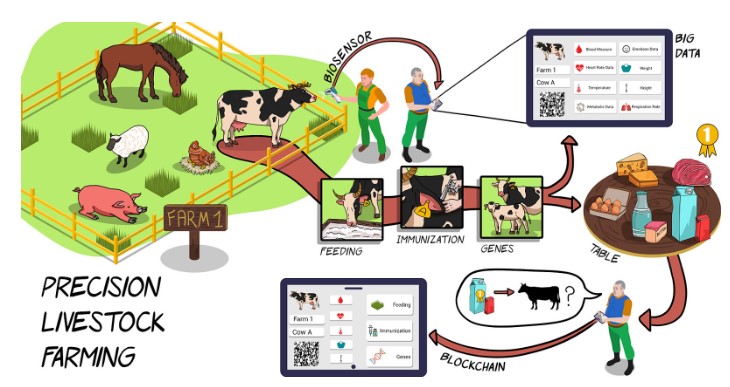
Livestock management applies similar perception techniques to animals rather than crops: monitoring individual feed intake, detecting lameness or illness from gait and posture, tracking heat cycles for breeding, and counting or identifying animals across a herd. Our overview of how AI is reshaping livestock management walks through where these systems earn their keep and where they generate noise.
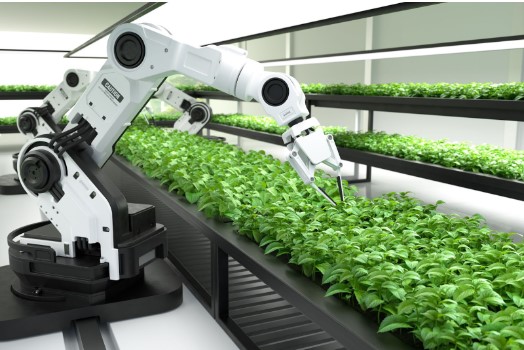
Agricultural automation is the robotics layer — autonomous harvesters, robotic weeders, automated feeding and milking systems. These combine perception with control, which means the consequences of a wrong prediction are physical, not just informational.
The common thread is that all three depend on perception models running in environments that are far messier than the datasets they were trained on. That mismatch is where most projects struggle.
How Does AI Help With Agriculture in Practice?
AI narrows decisions a person would make with partial visibility, then scales that narrowing beyond human reach. By replacing partial-information guesses with constrained inference across acreage no crew can monitor in real time. By compressing judgment calls farmers would make anyway, then applying them across hectares no human could monitor unaided.
A human can inspect a field of crops for disease, but not every plant, every day. A camera-and-model system can flag the small fraction of plants showing early stress, turning a blanket spray into a targeted one. The value isn’t that the model is smarter than the agronomist — it’s that it covers ground the agronomist physically can’t, and surfaces candidates for human judgment.
The same logic applies to livestock. A model that watches gait across a whole herd continuously will catch subtle lameness patterns earlier than a twice-daily walk-through, simply because it never stops looking. Early detection of lameness or mastitis matters because treatment cost and milk-yield loss both climb steeply once a condition is established — this is a well-documented pattern in veterinary literature, not a TechnoLynx measurement.
Where AI does not help: any decision where the cost of a false positive is high and the model hasn’t been calibrated to your specific conditions. An alert system that cries wolf gets ignored within weeks. That’s the operational reality behind most abandoned AgTech deployments.
A Decision Rubric: Is Your Agriculture Problem AI-Ready?
Model architecture predicts almost nothing about AgTech project success; five other questions do. They’re about the data and the environment.
| Question | Green (proceed) | Red (fix first) |
|---|---|---|
| Is the target observable? | The condition shows up reliably in images/sensor data (visible weeds, gait change, fruit ripeness) | The condition is mostly internal or chemical with no clear sensor proxy |
| Do you have representative data? | Data spans your breeds, crops, lighting, and seasons | Vendor model trained on a different farm/region/breed |
| What’s the cost of a false alarm? | Cheap to verify and dismiss | Triggers expensive action or erodes trust quickly |
| Is there a human in the loop? | Model surfaces candidates; person decides | Model acts autonomously on high-stakes decisions early |
| Will conditions drift? | Drift is monitored and the model is retrainable | Deploy-and-forget with no retraining path |
A project sitting mostly in the green column is worth building. A project with two or more red cells will usually fail not because the AI is weak, but because the surrounding system can’t support it.
Why Vendor Demos Mislead in Agriculture
Demo-to-field collapse accounts for more AgTech failures than any other single cause. A model evaluated on the vendor’s curated dataset reports impressive accuracy, then degrades sharply once it meets your barn, your soil, your camera angles, and your weather.
The mechanism is straightforward. Perception models learn the statistical regularities of their training data. Change the breed of cattle, the row spacing of a crop, the time of day the images are captured, or the dust on the lens, and you’ve shifted the input distribution away from what the model learned. The result is a model that’s confident and wrong — the worst combination for an operator trying to decide whether to trust it.
This is why benchmark accuracy figures quoted in a sales deck are weak evidence for any specific farm. A reported accuracy number is only meaningful relative to the conditions it was measured under, and farm conditions vary enormously. The reasoning behind why a single performance number rarely transfers across environments is something the benchmarking discipline treats as a first-class measurement problem — performance is bound to the workload and conditions it was measured against, not a portable property of the model.
The practical defense is a pilot on your data before any rollout, plus a plan for retraining as conditions drift across seasons. Treating model accuracy as a one-time property rather than something that decays is the single most expensive assumption in AgTech.
What Are the Disadvantages and Limitations of AI in Agriculture?
Three constraints dominate all others.
First, data scarcity for your specific conditions. The labeled-image datasets that make a model work are expensive to produce, and the ones that exist rarely match a given farm’s breeds, crops, and geography. This is the root cause of most accuracy disappointments.
Second, connectivity and edge constraints. Many farms have poor or no network coverage in the field, which forces inference onto edge devices with limited compute. Running a heavy segmentation model on a tractor-mounted device means making real trade-offs between model size, latency, and power — the same engineering constraints that govern any edge-deployed computer vision system.
Third, drift and seasonality. A model tuned in spring may underperform by autumn because lighting, plant maturity, and animal condition all change. Without a monitoring and retraining loop, accuracy quietly erodes — and because the erosion is gradual, operators often don’t notice until trust is already gone.
None of these is a reason to avoid AI in agriculture. They are reasons to budget for data, edge engineering, and ongoing maintenance rather than treating the model as a finished product.
Which Companies Are Building AI for Agriculture?
Large equipment manufacturers embedding perception, single-crop startups, and sensor-analytics platform providers form the three archetypes in the AgTech vendor landscape. Rather than rank specific companies — a list that dates quickly — it’s more useful to evaluate any vendor against the rubric above: ask what data their model was trained on, whether it can be retrained on yours, and what happens to accuracy when conditions drift. A vendor who can answer those questions concretely is a stronger bet than one quoting a single headline accuracy figure.
FAQ
What does applied AI in agriculture cover?
Computer vision networks now identify individual weeds, pests, and nutrient deficiencies across thousands of acres faster than any human scouting team. The market spans precision farming, livestock management, and agricultural automation, with value concentrated in narrowing decisions that would otherwise be made with incomplete information.
Which AI approach is best for agriculture?
There is no single best AI for agriculture; the right approach depends on whether your target condition is observable in sensor data, whether you have representative training data for your conditions, and the cost of a false alarm. Image segmentation and object detection dominate precision farming and livestock monitoring, but the determining factor is data fit to your specific environment, not the model architecture.
What are the newest AI technologies in agriculture?
Recent agricultural technology centers on edge-deployed computer vision for targeted spraying and disease detection, continuous livestock monitoring for early illness and breeding signals, and robotics that combine perception with physical control. The shift is less about new model architectures and more about moving inference onto edge hardware that works in field conditions with limited connectivity.
How does AI help with agriculture?
AI helps by surfacing candidates for human judgment at a scale a person can’t physically cover — flagging the small fraction of stressed plants or detecting subtle lameness across a whole herd continuously. The value comes from coverage and early detection, not from replacing the agronomist’s or vet’s decision-making.
What are the main applications of AI in livestock farming and herd health monitoring?
The main applications are individual feed-intake monitoring, lameness and illness detection from gait and posture, heat-cycle tracking for breeding, and animal counting and identification across a herd. Early detection matters because treatment cost and yield loss both climb steeply once a condition is established.
What are the disadvantages or limitations of AI in agriculture?
The three dominant limitations are data scarcity for your specific breeds, crops, and geography; connectivity and edge-compute constraints that force trade-offs between model size, latency, and power; and drift across seasons that erodes accuracy without a monitoring and retraining loop. These are reasons to budget for data and maintenance, not reasons to avoid AI.
Which companies are building AI tools for precision farming and agricultural automation?
The landscape spans large equipment manufacturers embedding perception into machinery, specialist startups focused on a single crop or condition, and platform providers offering sensor-plus-analytics packages. Rather than rank vendors, evaluate any of them on what data their model was trained on, whether it can be retrained on yours, and how accuracy holds up as conditions drift.
The most useful question to carry into any AgTech evaluation isn’t “what can this model do?” — it’s “what does this model do when it meets my farm?” The systems that survive contact with real fields and real herds are the ones built with that question in mind from the start.
Where AI Agriculture AgTech goes from here
Knowing which failure modes you can tolerate matters far more than the AI itself. That answer is workload-specific, and it is worth writing down before you build.