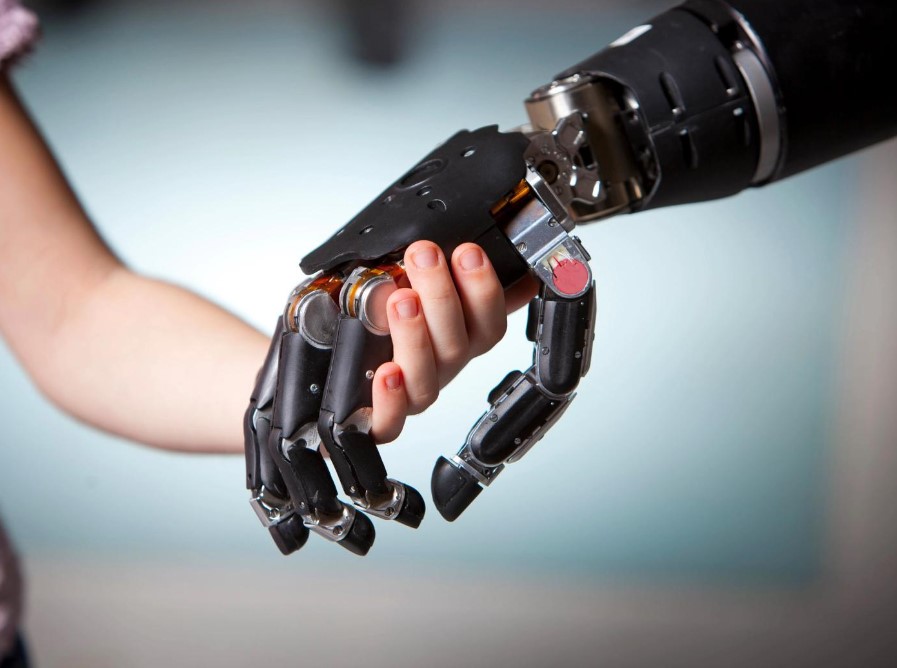
An autonomous machine is not a robot that follows a script. It is a system that perceives a changing environment, decides what to do next, and acts on that decision without a human in the loop for each step. That distinction matters more than it first appears, because most of the engineering difficulty in this field is not in the actuators or the chassis — it is in closing the loop between sensing the world and committing to an action under uncertainty.
The phrase “AI in autonomous machines” gets used loosely, often as if a single model were doing the whole job. In practice the intelligence is distributed across several layers, each with different failure characteristics. Perception turns raw sensor data into a usable picture of the surroundings. Planning turns that picture into a sequence of intended movements. Control turns intentions into motor commands. AI shows up in all three, but it does the most distinctive work in perception and planning — the two places where the machine has to reason about a world it cannot fully observe.
What Is an Autonomous Machine, Really?
An autonomous machine senses its environment, builds an internal model of what is happening, selects an action toward a goal, and executes it — repeatedly, fast enough to stay ahead of the changing world. Autonomy is a spectrum, not a binary. A robotic vacuum that bumps and re-routes sits near one end; a warehouse mobile robot that re-plans paths around moving people sits further along; a self-driving vehicle handling unprotected left turns sits near the far end.
The examples people reach for first — autonomous vehicles, delivery drones, warehouse robots, agricultural harvesters, inspection drones — share the same underlying architecture even though their physical forms differ wildly. They all run a perception-to-action loop. What separates a near-trivial autonomous system from a hard one is the diversity of situations the loop has to handle correctly. A robot operating in a fenced, mapped warehouse faces a bounded world. A vehicle on a public road faces an open one, where the long tail of rare events dominates the safety case.
How Does AI Support Autonomous Machines?
Separating the layers matters because they fail differently and are engineered with different tools.
| Layer | What it does | Where AI does the work | Dominant failure mode |
|---|---|---|---|
| Perception | Sensor data → world model (objects, free space, semantics) | Deep learning on camera, LiDAR, radar | Misclassification, missed detection in unfamiliar conditions |
| Localization & mapping | Where am I, what’s around me | SLAM, sensor fusion, learned place recognition | Drift, degeneracy in feature-poor environments |
| Planning | World model → intended trajectory | Search, optimization, increasingly learned policies | Brittle behavior in scenarios outside the training distribution |
| Control | Trajectory → actuator commands | Mostly classical control, sometimes learned | Instability under model mismatch or latency |
This table is worth reading as a map of where the hard problems live. Classical engineering still owns control and much of localization. The genuinely AI-heavy layers are perception and planning, and those are exactly where deployment surprises tend to originate.
Perception is the most visibly AI-driven layer. Modern stacks fuse multiple sensor modalities — typically camera plus LiDAR plus radar — because no single sensor is robust across all conditions. Cameras give rich semantics but degrade in low light and glare; LiDAR gives precise geometry but struggles with reflective or transparent surfaces and heavy precipitation; radar penetrates weather but is coarse. Neural networks built on architectures like convolutional backbones and, more recently, transformer-based detectors run this fusion. The same families of computer-vision models used in industrial inspection appear here, retuned for the motion and latency constraints of a moving platform.
What Role Does AI-Driven Perception Play?
Perception determines whether the autonomous machine earns or loses the right to act. If the world model is wrong, every downstream decision is wrong, no matter how good the planner is. This is why perception is held to a higher reliability bar than most other machine-learning applications: a recommendation engine that misfires costs a click, while a perception system that misses a pedestrian costs far more.
Two properties make perception hard in this setting. First, the input distribution is open-ended — the system will encounter lighting, weather, occlusion, and object combinations it never saw in training. Second, the cost of errors is asymmetric and context-dependent. A false positive that triggers an unnecessary brake is an annoyance; a false negative on an obstacle is a safety event. Tuning a detector’s operating point is therefore not a pure accuracy question but a risk-allocation decision that belongs to systems engineers, not just data scientists.
A common pattern we see is teams over-indexing on aggregate accuracy metrics — mean average precision on a benchmark dataset — while the operational failures cluster in a handful of rare, high-consequence conditions that the benchmark barely samples. This is an observed pattern across perception-heavy projects, not a benchmarked rate, but it shows up reliably enough to be worth designing against. The fix is not a better single number; it is scenario-stratified evaluation that weights the rare-but-dangerous cases properly.
How Do Planning and Decision-Making Enable Operation Without Human Intervention?
Planning answers “what should I do about it” once perception has established “what is around me” — this is where autonomy becomes visible as behavior. A planner takes the world model, the machine’s goal, and a set of constraints — physical limits, safety margins, rules of the environment — and produces a trajectory the control layer can execute.
The decision-making here spans timescales. A behavioral layer decides intent: yield, overtake, re-route, wait. A motion-planning layer turns the chosen intent into a smooth, feasible trajectory. The classical approach uses search and optimization with hand-specified cost functions, which is transparent and verifiable but brittle when the situation drifts outside what the designer anticipated. Learned policies, including reinforcement-learning and imitation-learning approaches, generalize better to messy real situations but are harder to verify and can fail unpredictably outside their training distribution. Most production systems today are hybrids: a learned component proposes, and a classical, checkable layer constrains and vetoes.
The reason planning is genuinely hard — and not a solved problem — is that it has to commit to actions under uncertainty about both the present (was that detection real?) and the future (will that pedestrian step off the curb?). A machine that waits for certainty never moves; one that ignores uncertainty is dangerous. Good planners reason explicitly about this trade-off, propagating perception confidence into decision margins rather than treating the world model as ground truth.
What Are the Main Challenges and Ethical Considerations?
Technical and ethical challenges are entangled, which is part of what makes this field difficult to reason about cleanly.
On the technical side: the long-tail problem dominates. The first 90% of scenarios (as a rule of thumb) are comparatively easy; the remaining fraction — rare, weird, safety-critical — consumes most of the engineering effort and most of the validation cost. Sim-to-real gaps mean a policy that works in simulation can degrade in the field. Sensor degradation, adversarial conditions, and the difficulty of validating systems whose behavior depends on learned components all compound the problem. Validating an autonomous system is not like testing deterministic software, because the input space is effectively infinite and the system’s behavior is emergent.
On the ethical side: responsibility allocation when an autonomous decision causes harm, the opacity of learned decision-making, bias inherited from training data, and the broader question of where a human stays in or on the loop. These are not abstract concerns — they shape architecture decisions directly. A system that must explain its decisions favors interpretable planning layers; one operating in a regulated domain inherits validation requirements that push toward checkable, classical components even at some cost to raw capability.
A Quick Diagnostic: Is This Autonomy Problem Bounded or Open?
When scoping an autonomous-machine project, the single most useful early question is whether the operating environment is bounded or open. Run through these:
- Is the environment mapped and largely static? Bounded problems (fixed warehouse, controlled facility) are dramatically more tractable than open ones (public roads, unstructured outdoor terrain).
- How heavy is the long tail? If, as a sizing estimate, 99% of situations are routine, the cost lives in the last 1% — a planning heuristic for budget validation accordingly.
- What is the cost asymmetry of perception errors? High asymmetry (safety-critical) demands scenario-stratified evaluation and conservative operating points.
- Can a human stay on the loop? Supervised autonomy with a fallback is a different — and far cheaper — engineering problem than full autonomy with no human recourse.
- Are the learned components verifiable? If regulation or safety requires explainability, hybrid architectures with checkable constraint layers are usually the right call.
If most answers point to “bounded,” the project is an engineering problem with a known shape. If they point to “open,” it is a research problem wearing an engineering deadline, and the plan should say so.
FAQ
What are autonomous AI systems?
Autonomous AI systems are machines that perceive their environment, build an internal model of what is happening, select an action toward a goal, and execute it without a human deciding each step. Autonomy is a spectrum — from a vacuum that bumps and re-routes to a vehicle handling open public roads — defined by how diverse the situations the system must handle correctly are.
What is an example of an autonomous machine?
Common examples include autonomous vehicles, delivery and inspection drones, warehouse mobile robots, and agricultural harvesters. Despite very different physical forms, they share the same perception-to-action loop; what separates an easy case (a fenced, mapped warehouse) from a hard one (a public road) is the diversity and rarity of the situations the loop must handle.
What is AI in autonomous machines?
AI in autonomous machines is the intelligence distributed across the perception, planning, and control layers of the system. It does its most distinctive work in perception (turning sensor data into a world model) and planning (turning that model into intended actions), which are the two layers where the machine must reason about a world it cannot fully observe.
How does AI support autonomous machines?
AI supports autonomous machines primarily through deep-learning perception that fuses camera, LiDAR, and radar into a usable world model, and through planning that converts that model into feasible trajectories. Classical engineering still owns most control and localization; the AI-heavy perception and planning layers are where deployment surprises most often originate.
What role does AI-driven perception play in autonomous machines?
Perception turns raw sensor data into the world model every downstream decision depends on — if it is wrong, the whole loop is wrong. It is held to a higher reliability bar than most machine learning because its input distribution is open-ended and its errors are asymmetric, where a missed obstacle is far costlier than a false alarm.
What are the main challenges and ethical considerations for autonomous AI agents?
Technically, the long-tail of rare, safety-critical scenarios dominates engineering and validation effort, alongside sim-to-real gaps and the difficulty of validating systems with learned components. Ethically, the open questions are responsibility allocation when harm occurs, the opacity of learned decisions, inherited training bias, and where a human stays in or on the loop — concerns that shape architecture directly.
How do planning and decision-making capabilities enable autonomous machines to operate without human intervention?
Planning takes the world model, the goal, and the constraints and produces a trajectory the machine can execute, deciding intent across timescales from behavioral choices to smooth motion. It enables hands-off operation by committing to actions under uncertainty about both the present and the future — good planners propagate perception confidence into decision margins rather than treating the world model as certain.
Autonomous machines blur into the systems around them. The same perception and decision techniques that let a machine act in the physical world also underpin work in predictive maintenance for industrial equipment, where the question is when a machine will fail rather than how it should move, and in movement modelling and biomechanics, where perception is turned inward on the body itself. The pipelines that train, version, and ship these models lean heavily on the practices covered in AI in cloud and DevOps. The honest framing for anyone scoping an autonomous-machine project is to decide first whether the world it operates in is bounded or open — that single distinction predicts more about cost and risk than any choice of model architecture.