Introduction
For working engineers, Turing offers operational insight rather than biographical narrative. Three of his ideas still set the boundaries inside which working AI systems are designed: the Universal Turing Machine fixes what can in principle be computed, the 1950 question “Can machines think?” gave us the evaluation frame that modern chatbot arenas inherit, and the statistical codebreaking discipline he led at Bletchley Park is a more honest ancestor of today’s machine-learning pipelines than the symbolic-AI tradition that came after. Everything else in the Turing biography genre — the schools, the dissertations, the cinema — is texture around those three threads.
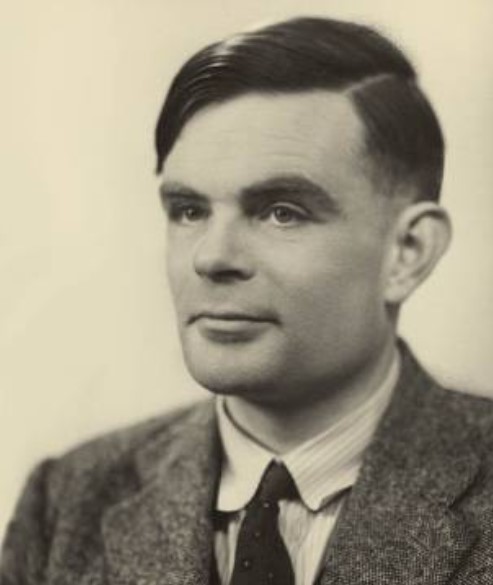
Turing was born in 1912 and died in 1954, aged 41. In that span he wrote the 1936 paper On Computable Numbers, with an Application to the Entscheidungsproblem (Turing, 1937) that defined the Universal Turing Machine (UTM) and proved that some problems cannot be decided by any algorithm. He led the wartime effort to break the German Enigma cipher at Bletchley Park. And in 1950 he published Computing Machinery and Intelligence (Turing, 1950), which posed the test that now carries his name.
The relevance of that body of work extends into computer vision, generative AI, and GPU-accelerated inference — the load-bearing systems any modern AI engineering team builds against. What follows is a practitioner’s read of what still matters, what has been displaced, and where the boundaries he drew still bind.
What did Turing actually contribute that still matters for AI engineering today?
Computability constraints, evaluation frameworks, and statistical inference roots form the recurring triad in applied work. None of them is decorative.
Computability bounds. The UTM established that one abstract machine can perform any computation expressible as an algorithm, given the right tape and instructions. That is the foundation under every general-purpose computer. The companion result — Turing’s proof that the Entscheidungsproblem has no general algorithmic solution — is the hard ceiling: there are well-formed questions no program can answer in general, regardless of compute budget or model size (History of Information, 2024). When we are scoping a GenAI feasibility audit, this is the first filter. If a customer’s desired outcome reduces to deciding an undecidable property of arbitrary inputs, no amount of parameter scaling rescues it.
The Turing test as an evaluation pattern. The test as Turing described it puts an interrogator in conversation with a hidden human and a hidden machine; if the interrogator cannot reliably tell them apart, the machine has passed. Read literally as a definition of intelligence, the test has aged poorly. Read as the lineal ancestor of preference-based evaluation — chatbot arenas, blind A/B comparisons, human-rater scoring against rubrics — it is the dominant evaluation pattern in modern conversational AI.
The Bletchley pipeline. Statistical pattern recognition over noisy, adversarial data, with a feedback loop between hypothesised model structure and decrypted output. That is the shape of modern machine-learning training and evaluation. It is closer to today’s ML practice than the symbolic-AI work of the 1950s–1980s is.
Has any production system genuinely passed the Turing test in 2025–2026?
Misunderstanding this distinction carries real cost. The honest answer is: no system has passed an adversarial, well-controlled Turing test under conditions Turing himself described — long-form conversation, motivated interrogators, no time limit, no domain constraint. What modern systems have done is reach human-indistinguishability under specific, constrained conditions: short conversations, casual topics, non-expert interrogators. That is a different claim, and it is the claim the popular press tends to garble.
The practitioner’s read of this is to stop using “passing the Turing test” as a milestone at all. The useful question now is “under what conditions does this system produce outputs a real user accepts in a real workflow?” That is what the chatbot arena format actually measures, and it is the question that maps onto deployment decisions. Evaluating a customer-support assistant against blind preference scoring on real tickets tells you something operational. Evaluating it against a free-form imitation game does not.
How does the Turing test compare with modern AI benchmarks?
Modern AI benchmarks — HELM, MMLU, SWE-bench, BIG-bench, and the various code-execution suites — sit on a different axis from the Turing test. The test measures behavioural indistinguishability in open conversation. The benchmarks measure task accuracy against a known answer key.
| Evaluation | What it measures | What it misses |
|---|---|---|
| Turing test (original) | Indistinguishability from a human in open dialogue | Task correctness, factuality, safety |
| Chatbot arena (blind A/B) | Human preference between two model outputs in context | Absolute quality; whether either output is correct |
| MMLU / HELM | Knowledge and reasoning accuracy on closed-form questions | Conversational fitness, user acceptance |
| SWE-bench | End-to-end success on real software-engineering issues | Generalisation outside the benchmark distribution |
| Operational eval on production traffic | What the system actually does for the user | External comparability across vendors |
A serious evaluation stack uses several of these in combination. The Turing test lineage is most visible in the preference-arena column; the others are descendants of a more recent psychometric tradition, not of Turing.
Bletchley Park: what Turing actually did during the war
In 1939, Turing began his cryptanalysis work at Bletchley Park. The German Enigma machine produced roughly 159 quintillion possible daily settings (Imperial War Museums, n.d.), which made brute-force manual codebreaking infeasible. The Bombe — the electromechanical device Turing designed, building on earlier Polish work — simulated multiple Enigmas in parallel to test candidate rotor settings against known plaintext fragments (“cribs”), reducing decryption from days to minutes (Britannica, 2024). In 1942 Turing travelled to the United States to share the methods with US military intelligence.
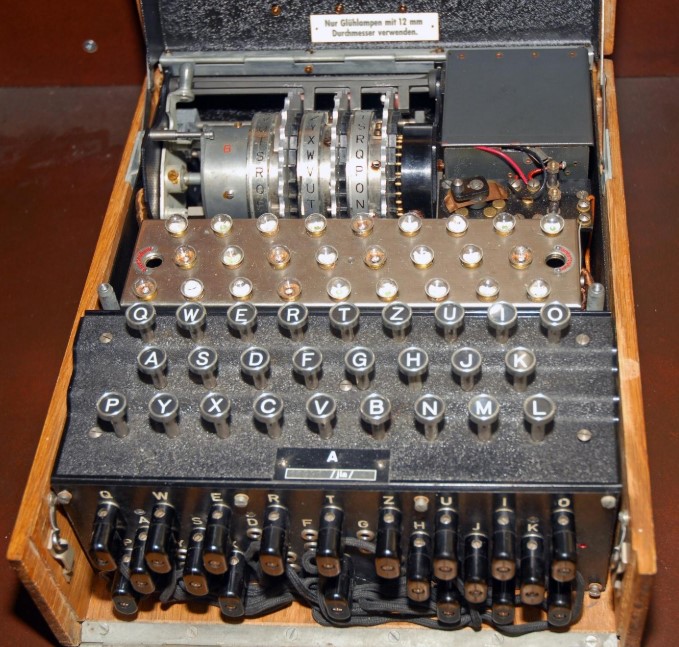
We bring this up not for the cinema but for the pipeline shape. Bletchley combined statistical inference, hypothesis search over a large discrete space, exploitation of structural weaknesses in the data-generating process, and tight feedback between model and decoded output. That is the ancestor of how we set up a modern ML training and evaluation loop — far more so than the rule-based expert systems that dominated AI research in the decades immediately after.
Which early-AI lessons repeat in the current LLM cycle?
Dartmouth 1956 marks the conventional birth of AI as an organized research field. It also originated the first overpromise: that human-level intelligence was a few decades away. The two AI winters that followed — the late 1970s and the late 1980s — were each preceded by a hype peak and a funding correction. The pattern we see in our practice:
- Capability claims outrun deployment reality. Demos work; production stalls on data, latency, integration, and evaluation.
- The most impressive results come from narrow tasks with abundant supervision. General-capability claims are harder to substantiate operationally.
- Tooling and infrastructure mature on a slower curve than model capability. GPU economics, edge deployment constraints, inference cost per request, and pipeline reliability remain the rate-limiting factors well after the model itself is “good enough.”
The current LLM cycle has the same shape, and the practitioner’s job is to scope engagements against the durable capability — not against the demo. That is where the Turing computability frame earns its keep: it tells you what is structurally out of reach, before the project starts.
Who counts as the father of AI?
Reframe the problem, reshape the solution space. The honest list:
- Turing, for the computability foundation and the evaluation frame (1936, 1950).
- John McCarthy, who coined “artificial intelligence” and organised the 1956 Dartmouth workshop that named the field.
- Marvin Minsky, for symbolic AI, the perceptron critique, and decades of theoretical and institutional work at MIT.
- Claude Shannon, for information theory, which is load-bearing under every modern statistical learning system.
- Frank Rosenblatt, for the perceptron — the direct ancestor of modern neural networks.
- John von Neumann, for stored-program computer architecture and early connections between computation and brain-like processes.
If the question is “whose ideas still constrain what AI systems can do?” Turing’s answer is the most durable. If the question is “who organised AI as a research discipline?” McCarthy’s claim is stronger. Both are defensible; only one is computational.
What did “Computing Machinery and Intelligence” anticipate, and what did it miss?
Three of Turing’s insights proved durable: shifting the question from machine thought to behavioral equivalence, recognizing that evidence criteria would determine outcomes, and prioritizing learning architectures over explicit rule systems. That last point is striking. It points more directly at modern machine learning than the symbolic-AI work that followed in the next two decades.
What Turing missed is what every honest read of the paper has to acknowledge. He did not anticipate the scale of compute and data that would be required, nor the discovery that statistical learning on raw signal could outperform structured representations for most perceptual and linguistic tasks. He underestimated the brittleness of imitation when generalisation is required outside the training distribution. And he treated the question of consciousness and the question of behavioural competence as more cleanly separable than the modern debate has shown them to be.
Limitations that remained
Extracting value from Turing now requires distinguishing between still-active principles and historical artifacts. Three threads carry forward — the Turing test as a UX-evaluation pattern, computability bounds on what a model can be asked to do, and the codebreaking-to-machine-learning pipeline lineage. What has not carried forward as cleanly is the strong-AI / general-intelligence framing that dominated the 1950s–1980s; modern systems are powerful within narrow scopes and remain brittle outside them, and the engineering job is to build for that reality rather than for the general-intelligence ambition. Similarly, the symbolic-AI inheritance has been mostly displaced by statistical and learned approaches, although hybrid neuro-symbolic systems are reopening some of those questions in a more disciplined form.
The value of reading Turing alongside today’s working systems is not nostalgia. It is that the vocabulary, the testing frame, and the computability constraints are still load-bearing in any honest discussion of what an AI system can and cannot do. The engineering decisions get made inside the boundaries Turing drew — even when the models doing the work look nothing like the ones he imagined.
In our work scoping AI engagements, we keep returning to the same checklist Turing implicitly handed us: is the desired behaviour computable at all; is there a sound evaluation frame that maps to user acceptance; and is the data-generating process amenable to statistical pattern recognition with feedback. When the answer to any of those is no, the right move is to reshape the engagement before any model is trained.
FAQ
Why is Alan Turing called the father of artificial intelligence?
Turing laid down the conceptual foundations that the discipline still rests on — the Universal Turing Machine in 1936 defined what it means for a problem to be computable at all, and his 1950 paper “Computing Machinery and Intelligence” posed the question “Can machines think?” and proposed an operational test for answering it. Modern AI work continues to inherit both that computability frame and that evaluation frame.
Has any production system genuinely passed the Turing test in 2025–2026, and what does that imply?
No system has passed an adversarial, well-controlled Turing test under the conditions Turing originally described — long-form conversation, motivated interrogators, no domain constraint. Modern systems reach human-indistinguishability under constrained conditions (short conversations, non-expert interrogators), which is a much weaker claim. The practical implication is to retire “passing the Turing test” as a milestone and replace it with operational evaluation: under what conditions does the system produce outputs a real user accepts in a real workflow.
How does the Turing test compare with modern AI benchmarks such as HELM, MMLU, and SWE-bench?
The Turing test measures behavioural indistinguishability in open dialogue. HELM, MMLU, and SWE-bench measure task accuracy against known answer keys. They sit on different axes, and a serious evaluation stack uses several in combination. The Turing-test lineage is most visible in the chatbot-arena preference format; the closed-form benchmarks descend from a more recent psychometric tradition, not from Turing.
Which lessons from the early history of AI (Dartmouth, the AI winters) repeat in the current LLM cycle?
Capability claims outrun deployment reality; the most impressive results come from narrow tasks with abundant supervision; tooling and infrastructure mature more slowly than headline capability. Each AI winter was preceded by a hype peak and a funding correction. The current LLM cycle has the same shape, and the practitioner’s job is to scope engagements against durable capability rather than against the demo.
Who counts as the father of AI by different framings — Turing, McCarthy, Minsky, others?
Turing for the computability foundation and the evaluation frame; McCarthy for naming the field and organising the 1956 Dartmouth workshop; Minsky for symbolic AI and decades of institutional work; Shannon for information theory; Rosenblatt for the perceptron; von Neumann for stored-program architecture. If the question is whose ideas still constrain what AI systems can do, Turing’s answer is the most durable. If the question is who organised AI as a research discipline, McCarthy’s claim is stronger.
What did Turing’s “Computing Machinery and Intelligence” anticipate, and what did it miss about the current LLM era?
It anticipated the shift from “can machines think?” to behavioural indistinguishability, and pointed at learning machines that acquire capability through training rather than hand-coded rules — a remarkably accurate prefiguration of modern ML. It missed the scale of compute and data required, the dominance of statistical learning over symbolic representation for perceptual and linguistic tasks, the brittleness of imitation outside the training distribution, and the difficulty of separating behavioural competence from questions about consciousness.
References
- Britannica (2024) – Alan Turing — Biography, Facts, Computer, Machine, Education, & Death.
- Britannica (2024) – Bombe — Code Breaking, History, Design, & Facts.
- History of Information (2024) – Alan Turing Publishes ‘On Computable Numbers’.
- Imperial War Museums (n.d.) – How Alan Turing Cracked the Enigma Code.
- The National Museum of Computing (n.d.) – The Enigma Machine.
- The Turing Digital Archive (n.d.) – About Alan Turing.
- Turing, A.M. (1937) ‘On Computable Numbers, with an Application to the Entscheidungsproblem’, Proceedings of the London Mathematical Society, s2-42(1), pp. 230–265.
- Turing, A.M. (1950) ‘Computing Machinery and Intelligence’, Mind, LIX(236), pp. 433–460.