A perpetual-inventory system says a SKU is in stock. The shelf is empty. Both statements are true at the same time, and classic inventory control techniques are built in a way that cannot tell you that.
That gap is the whole problem. Inventory control, as most retail operations teams practise it, is a discipline for keeping the book honest — reconciling receipts, sales, shrink, and transfers so that the number in the system tracks the number you actually own. It is good at that. What it was never designed to do is tell you whether the product the book says you own is sitting where a customer can pick it up. A unit can be counted, paid for by the chain, and present in the building, yet still be in the backroom, mis-shelved two aisles over, or stranded behind a planogram break. To the system it is available. To the shopper it does not exist.
How Inventory Control Techniques Actually Work, and What They Mean in Practice
Managing stock flow and quantity against demand involves a suite of distinct control methods. In a modern retail chain that usually means a perpetual-inventory system: every receipt increments the count, every point-of-sale scan decrements it, and periodic cycle counts or full physical counts correct the accumulated error. Layered on top are reorder logic (economic order quantity, min/max thresholds, demand forecasting) and exception reports for negative-on-hand or stale SKUs.
These techniques share one assumption: that the system count is a faithful proxy for what the customer can buy. For warehousing and replenishment decisions, it largely is — you reorder against the book, and the book drives the truck. The assumption quietly breaks at the last three metres, between the backroom door and the shelf face, because nothing in a perpetual-inventory system observes the shelf. The count tells you what entered the store and what left through the till. It says nothing about the journey in between.
This is the divergence point worth naming clearly: inventory control techniques that only reconcile system counts cannot see on-shelf availability loss, because the data they reconcile never includes the state of the shelf.
Book Inventory vs On-Shelf Availability: Why the Gap Matters
One SKU generates two inventory figures that rarely match.
Book inventory (or system stock-on-hand) is what the perpetual-inventory system believes you hold in a given store. On-shelf availability is the share of stocked SKUs actually present and findable at the shelf at a given moment. The difference between them is the availability loss — the products the system counts as sellable that a customer would walk away from because they could not find them.
The gap is structural, not occasional. Across grocery and general-merchandise retail, on-shelf availability for stocked items is widely cited in published industry studies as sitting in the low-to-mid 90s percent on average and dropping further on promoted lines (published-survey; figures vary by category and study). That means a meaningful share of “in stock” SKUs are, at any moment, not where the shopper expects. Each one is a silent lost sale that no inventory report flags, because the book says everything is fine. We see this pattern regularly: the store with clean inventory reconciliation and a stubborn, invisible availability problem.
There are only a few ways a counted unit goes missing from the shelf, and each one is invisible to the count:
- It is in the backroom, received but never replenished to the floor.
- It is mis-shelved — physically present, wrong location, undiscoverable.
- It sits behind a planogram break, where the layout the store runs no longer matches the layout the count assumes.
- It is on a shelf with a wrong or missing price tag, so it scans incorrectly or not at all.
Closing this gap is what shelf-execution AI that catches stock-outs and planogram drift is for. It does not replace inventory control. It reads the one variable inventory control was never instrumented to capture.
Which Inventory Control Techniques Does Shelf-Execution AI Complement Rather Than Replace?
Because shelf execution addresses a visibility layer beneath traditional control methods, it complements rather than competes with them. Classic techniques manage quantity over time; shelf-execution observes state in space. They are complements, not competitors, and conflating them produces bad procurement decisions.
| Inventory control technique | What it manages | What it cannot see | What shelf-execution adds |
|---|---|---|---|
| Perpetual inventory (POS-driven count) | System stock-on-hand per SKU | Whether counted stock is on the shelf | On-shelf-present vs book gap |
| Cycle / physical counts | Count accuracy over time | Shelf state between counts | Continuous shelf reads |
| Reorder logic (min/max, EOQ) | When and how much to reorder | Whether reordered stock reaches the face | Restock-trigger from shelf, not just book |
| Planogram authoring | The intended shelf layout | Whether the store complies with it | Planogram compliance rate |
| Price/promo management | What a SKU should cost | Whether the tag on the shelf matches | Price-tag and promo-tag verification |
Read the table by column three: every technique has a blind spot at the shelf face, and every blind spot is the same kind — a divergence between the system of record and physical reality. Shelf-execution AI is the layer that reconciles the two. The boundary worth respecting is that this article — and this discipline — scopes strictly to shelf-execution facets: on-shelf availability, planogram compliance, and price-and-promo-tag checks. It does not extend into footfall, dwell time, or any customer-behaviour analytics. Reading shelves is not watching shoppers.
How Reading the Actual Shelf State Catches Losses Counts Miss
Observing shelf conditions directly—rather than deriving them from system records—forms the basis of the approach. A model trained on shelf imagery — from fixed cameras, associate mobile devices, or robot-mounted sensors — reads the shelf face and answers questions the count cannot: Is this facing empty? Does the product present match the planogram slot? Does the tag say the right price?
Under the hood this is a computer-vision problem with retail-specific failure modes, which is exactly why generic models struggle with it — the reasons that off-the-shelf CV breaks at retail scale apply directly here. A typical pipeline runs object detection and fine-grained SKU classification (often built in PyTorch, exported to ONNX or TensorRT for inference on edge devices), with the recognised shelf state compared against the planogram and the price file. The output is not “how many do we own” — that is the book’s job — but “what is the shelf showing right now.”
That difference is the entire value. A perpetual-inventory system learns a SKU is gone only when the last unit sells. Shelf-execution detects an empty facing while the book still shows positive stock — the precise signature of a backroom or mis-shelve loss. The detection arrives hours, sometimes days, before a count would surface it, and well before a periodic store-staff walk would happen to notice. For the full detection mechanism, the stockout explained walkthrough of what an out-of-stock is and how shelf-execution AI detects it goes deeper than the scope here allows.
What On-Shelf-Availability and Time-to-Restock Metrics Should You Track?
Tracking only system inventory masks the core problem: products recorded as available but unreachable by customers. The metrics that connect classic inventory control to shelf execution are three:
- On-shelf availability (OSA) rate — the share of stocked SKUs physically present and findable at the shelf. This is the direct counterpart to book inventory and the number most retail operations dashboards do not have.
- Planogram compliance rate — the share of shelf slots whose actual product placement matches the authored layout. Low compliance is a leading indicator of mis-shelve-driven availability loss.
- Time-to-restock from out-of-stock detection — the elapsed time from an empty facing being detected to the facing being replenished. This is where the recovered-availability ROI lives: closing the loop faster than periodic counts shrinks the lost-sale window.
The measurable outcome to anchor on is recovered availability — the share of “system says in stock” SKUs that were actually missing and got corrected because the shelf was read. In our experience the first thing this surfaces is not a stocking failure but a measurement gap: teams discover their real OSA was several points below what they assumed, simply because nothing had ever measured it (observed pattern across retail engagements; not a benchmarked rate). The inventory control example of how shelf-execution AI closes the out-of-stock loop shows these metrics moving end to end on a single SKU.
Can Shelf-Execution AI Extend Inventory Control Without a Camera-Hardware Procurement Cycle?
Deployment typically relies on portable capture devices instead of permanent camera arrays, a distinction that unblocks otherwise stalled initiatives.
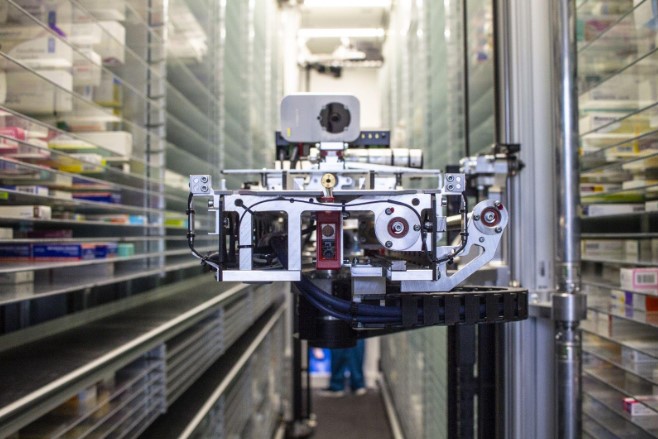
Most retail estates already carry a usable sensor footprint: existing CCTV, associate handheld scanners and phones, and in some chains shelf-scanning robots. The constraint is rarely whether imagery exists; it is whether the existing devices can run inference at acceptable latency and accuracy without a forklift upgrade. That is an engineering question with a measurable answer, and it is the reason a GPU performance audit of the current camera and mobile-device footprint is the sensible first step — it sizes what the existing hardware can actually carry so the shelf-execution layer extends inventory control without opening a procurement cycle. The pattern of porting models to run on the hardware you already own, rather than the hardware a vendor would prefer to sell you, is the same discipline that lets shelf-execution AI catch stock-outs and planogram drift without hardware replacement.
Reconciling a model’s output against physical reality rather than a system of record is not unique to retail. It is the same hardening problem manufacturing teams face when CV defect-detection models move from pilot to the production line — the model is only as trustworthy as its agreement with the physical line, not with the upstream record.
Where Does the Shelf-Reading Model Still Fail?
Honest evaluation includes the ways these systems fail, not just the features they promise. Shelf-execution models degrade under conditions that have nothing to do with inventory logic and everything to do with vision.
Lighting variance across a store — glare on a chiller door, deep shadow on a bottom shelf — moves detection confidence around and can produce both missed empties and false out-of-stock alerts. Packaging redesigns are the slower, more insidious failure: when a supplier refreshes a SKU’s artwork, a classifier trained on the old packaging may stop recognising it until retrained, quietly misreading a full facing as the wrong product or as empty. Dense, visually similar SKUs (private-label variants, flavour ranges) are the hardest fine-grained classification case and the most common source of confusion.
The discipline this imposes is treating the shelf model’s output as a measured signal with a known error rate, reconciled against book inventory and human spot-checks — not as ground truth. When the two disagree, that disagreement is itself information: it points at either a shelf problem or a model problem, and both are worth knowing. This is why the comparison between what inventory control software does versus what shelf-execution AI does on the shelf is worth getting right before committing — the two answer different questions, and neither is a substitute for the other.
Anyone running these systems at scale should start from the retail computer-vision practice and the underlying computer-vision engineering work that makes shelf reading hold up under real store conditions, because the gap between a demo and a deployed shelf model is exactly the lighting, packaging, and SKU-similarity failure modes named above.
FAQ
How does inventory control techniques work, and what does it mean in practice?
Perpetual counts, cycle counts, reorder logic, and planogram authoring represent distinct techniques retailers use to synchronize system records with physical stock and respond to demand patterns. In practice it manages quantity and flow against the book. It does not observe the shelf face, so it tracks what you own, not what a customer can find.
What is the difference between book inventory (system stock-on-hand) and on-shelf availability, and why does the gap matter?
Book inventory is what the perpetual-inventory system believes you hold; on-shelf availability is the share of stocked SKUs actually present and findable at the shelf. The gap between them is availability loss — products counted as sellable that a shopper would walk away from. It matters because each missing-but-counted unit is a silent lost sale that no inventory report flags.
Which inventory control techniques does shelf-execution AI complement rather than replace?
Nearly all of them, because shelf-execution sits on a different axis: classic techniques manage quantity over time, shelf-execution observes state in space. It complements perpetual counts, reorder logic, planogram authoring, and price management by reading the shelf face each of them is blind to. It is a reconciliation layer, not a replacement.
How does reading actual shelf state catch availability losses that perpetual-inventory counts miss?
A perpetual-inventory system only learns a SKU is gone when the last unit sells, and it never sees backroom, mis-shelve, or planogram-break losses at all. A vision model reading the shelf detects an empty facing while the book still shows positive stock — the signature of those losses. The detection arrives hours or days before a count or a staff walk would surface it.
What on-shelf-availability and time-to-restock metrics should I track to measure inventory control effectiveness?
Track on-shelf availability rate (shelf-present vs book), planogram compliance rate (actual placement vs authored layout), and time-to-restock from out-of-stock detection (the lost-sale window). The outcome to anchor on is recovered availability — the share of “system says in stock” SKUs that were actually missing and got corrected because the shelf was read.
Can shelf-execution AI extend my inventory control without a camera-hardware procurement cycle?
Usually yes. Most retail estates already carry usable imagery from existing CCTV, associate handhelds, and shelf-scanning robots; the real question is whether those devices can run inference at acceptable latency and accuracy. A GPU performance audit sizes the existing footprint so the shelf-execution layer extends inventory control without opening a hardware procurement cycle.
Where does the shelf-reading model still fail (lighting, packaging redesigns), and how does that affect inventory accuracy?
Lighting variance produces missed empties and false out-of-stock alerts; packaging redesigns can make a classifier misread a full facing until it is retrained; visually similar SKUs are the hardest fine-grained case. The discipline is to treat the model’s output as a measured signal with a known error rate, reconciled against book inventory and human spot-checks rather than trusted as ground truth.
A useful test before committing to any of this: ask your team what your store’s on-shelf availability rate is this week. If the only answer available is the book inventory number, you have just located the gap this entire discipline exists to close.
Deployment milestones worth tracking
Fund what reduces time from detection to correction; precision metrics alone won’t convince operations leaders to sign off. Everything else is detail.