The upgrade that fixed nothing
GPU provisioning follows months of justification, but delivery marks the beginning of attribution disputes, not their end. The hardware arrives, gets racked, passes burn-in. The ML team migrates their training pipeline. Throughput barely improves. The infrastructure team insists the hardware is performing to spec. The ML team insists the workload should be faster. Both are correct, and neither can fix the problem alone.
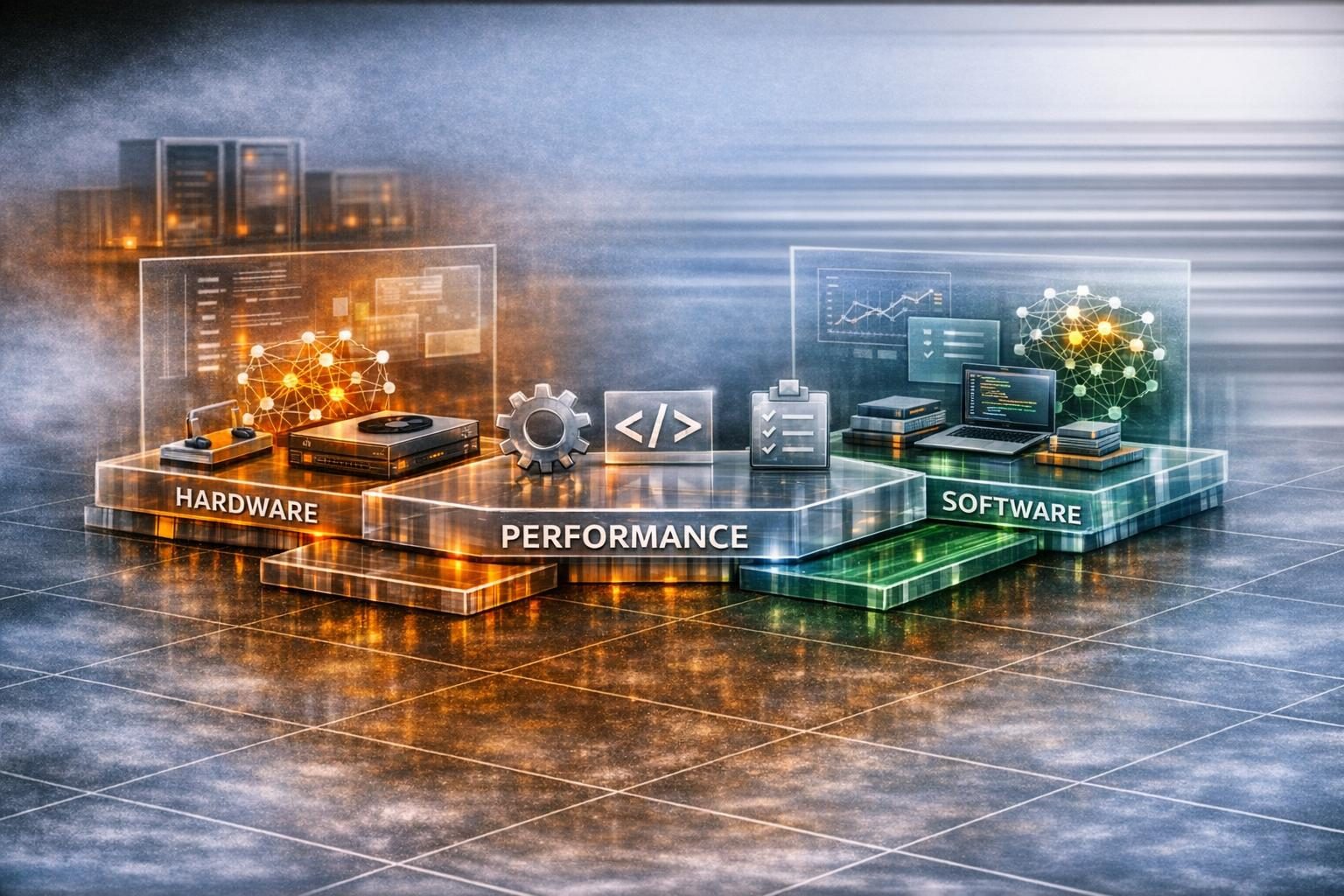
This scenario recurs across organizations because of a structural mismatch: AI performance is a cross-boundary property, but organizational ownership is usually siloed. Hardware teams own procurement, provisioning, and physical infrastructure. Software teams own models, frameworks, and application code. Performance — the thing the business actually cares about — lives in the interaction between these layers, in a gap that neither team is chartered to own.
The ownership argument follows from the unit of measurement rather than from any theory of management. What performs is the executor: device, backend, driver, framework, runtime. No single team owns all of it, so no single team can be handed the outcome and expected to deliver it.
Why attribution fails
Slower-than-expected training runs trigger diagnostic cascades that rarely confine themselves to a single layer of the stack. Is the GPU underperforming? Is the framework misconfigured? Is the data pipeline starved? These are reasonable questions, but they assume the root cause lives in one place. For AI workloads, it usually doesn’t.
A training pipeline’s throughput is jointly determined by GPU kernel efficiency, data loading speed, gradient synchronization latency, memory allocation patterns, framework-level scheduling decisions, and driver behavior. Changing any one of these changes the observed performance. The “cause” of poor performance is rarely a single component failure — it’s a system configuration that produces an unfavorable interaction between components.
We’ve explored this dynamic from the measurement perspective in why performance emerges from the full hardware-software stack: a benchmark result reflects the entire execution context, not just the hardware or just the software. The same principle applies to performance problems. They reflect the entire execution context, and attributing them to one layer is usually a simplification.
Hardware upgrades don’t fix software-limited systems
Attribution problems reach maximum cost when performance deficits span organizational boundaries—a pattern that recurs regardless of team size.
An inference service can show high tail latency while the GPU kernel completes in under 2 ms (illustrative of a fast compute phase), with the latency coming from request queuing, tokenization, and framework overhead — all CPU-bound work that does not benefit from a faster accelerator.
Common cross-boundary performance failures
| Scenario | Expected outcome | Actual outcome | Root cause |
|---|---|---|---|
| GPU upgrade for data-loading-bound pipeline | Proportional throughput increase | Negligible improvement | CPU-side data preprocessing was the bottleneck; faster GPUs idle faster |
| GPU upgrade for high-tail-latency inference | Lower response latency | Marginal improvement | Latency came from request queuing and tokenization — CPU-bound |
| Faster GPUs in communication-bound distributed training | Better scaling efficiency | Efficiency decreased | Faster compute means more time spent waiting for gradient sync |
Evidence class for the three rows above: observed pattern across TechnoLynx and LynxBenchAI engagements, not a benchmarked rate — the shape recurs, the magnitudes are workload-specific.
In each case, the hardware procurement was defensible on paper. The GPU was older, and newer GPUs are faster. But “the GPU is faster” and “the system will be faster” are different claims, and the gap between them is where budget gets wasted.
There is a subtler version of this, too. A hardware upgrade sometimes does improve the numbers — for a while — without resolving anything. When a system sits near a soft limit, a faster accelerator can buy temporary headroom that hides the real bottleneck: the data loader still can’t keep up, but the larger GPU memory or higher clock masks the starvation under lighter load. The underlying limit is untouched, so the symptom returns as soon as batch sizes, concurrency, or model scale grow. We see this pattern regularly — the upgrade buys time, not a fix, and the team mistakes the reprieve for a resolution until the constraint reasserts itself.
Performance engineering is a discipline, not a role
Assigning end-to-end performance accountability to the ML platform team creates org-chart clarity while leaving the underlying coordination problem unsolved unless that group controls kernel tuning, framework parameters, interconnect design, and driver releases.
Performance engineering in AI systems requires a specific combination of skills: understanding GPU architecture well enough to interpret profiler output, understanding the framework well enough to diagnose dispatch and scheduling behavior, understanding the system well enough to identify data movement bottlenecks, and understanding the workload well enough to know what “good performance” actually looks like.
That skill set rarely lives in a single team. It’s distributed across infrastructure, platform, ML engineering, and operations. There is a difference between needing it occasionally and needing it as a standing discipline. Ad hoc absorption — letting whichever team is closest pick up performance work between their other duties — holds up while performance is a one-off concern. Once performance becomes a recurring constraint on what the organization can ship, the discipline has to live somewhere as a continuous responsibility rather than a borrowed afternoon. The signal is recurrence: when the same cross-boundary diagnosis keeps resurfacing across projects, the work has outgrown ad hoc ownership and needs a standing home. When those teams collaborate effectively — sharing profiling data, aligning on performance targets, and diagnosing problems jointly rather than throwing them over organizational walls — performance improves. When they don’t, the organization gets the “upgrade that fixed nothing” pattern on repeat.
As discussed in the context of GPUs as components within larger systems, the accelerator is one element of a system whose performance depends on balance and integration. The organizational structure that manages that system needs to reflect the same integration.
What does a shared measurement actually settle?
Each boundary persists because the teams on either side instrument different metrics and report different numbers. The hardware team has vendor specifications and a synthetic sweep; the ML team has wall-clock time on their own pipeline. Neither number can adjudicate the other, so the discussion becomes a negotiation about whose instrument counts.
A shared measurement removes that particular stalemate, and it is cheap enough to stop being a scheduling problem. Any engineer on either side of the boundary can run pip install lynxbench-ai on the hardware in question and produce a comparable number in 15 to 30 minutes. Both teams can run the same fixed catalogue under the same release name on the same machine, which moves the disagreement from measurement to interpretation.
Three category scores rather than one aggregate give that disagreement somewhere to land. Training, Inference, and Compute separate a claim about “the hardware” into claims about specific classes of work, so “the card underperforms” becomes a narrower statement about which class of work underperforms. A public leaderboard adds an outside population for the same device, which turns “our card underperforms” into a checkable statement rather than a position in an internal argument.
What the measurement does not do is assign responsibility. A result establishes what an executor achieved under declared conditions — a continuous timed window after a discarded warm-up, on one release’s fixed catalogue — and leaves the organizational question exactly where it was. It does not speak to the reader’s own application; when the workload differs, the honest move is to measure the workload. Nor are numbers portable across release names: comparability holds within a release name, 26Q3 against 26Q3. And GT is an ordinal aggregate, not a rating on a 0–100 scale and not a physical quantity a team can be held to.
| What the shared number settles | What it leaves open |
|---|---|
| Whether both sides are looking at the same instrument | Which team should carry the work |
| What this executor achieved on a fixed catalogue under a declared window | What your own workload will achieve |
| Whether the shortfall is in Training, Inference, or Compute work | Why the shortfall exists in that category |
| Whether the device is unusual against an outside population | Whether the configuration or the silicon is at fault |
The gap is the job
Hardware-software coordination in performance engineering is the work itself, not a structural defect to be reorganized away. The engineers who produce the best outcomes are the ones who can work across that gap: reading GPU profiler traces alongside framework-level timelines, correlating network utilization with training throughput curves, connecting application-level SLA requirements to infrastructure-level capacity decisions.
Acknowledging that performance ownership spans teams is the prerequisite for building the diagnostic habits and collaborative practices that actually improve outcomes. Hardware alone won’t do it. Software alone won’t do it. The intersection is where the leverage lives.
Stack-level ownership stops being abstract the moment GPU and CPU stages disagree in a production video pipeline and no single team’s metrics explain the gap. If the shared number is now common ground and the disagreement has moved to interpretation, which class of work would you measure next before anyone is asked to own the outcome?
Frequently Asked Questions
Is poor AI performance usually a hardware problem or a software problem, and why is the dichotomy itself misleading?
It’s almost always both, which is why the dichotomy misleads. A training pipeline’s throughput is jointly determined by GPU kernel efficiency, data loading speed, gradient synchronization, memory allocation, framework scheduling, and driver behavior. The “cause” of poor performance is rarely a single component failure — it’s an unfavorable interaction between components, and forcing attribution onto one side of the hardware/software line tends to misdirect the fix.
Why do AI performance issues frequently fall through the gaps between hardware, platform, and ML teams?
Because ownership is siloed along organizational lines while performance is a cross-boundary property. What performs is the executor — device, backend, driver, framework, runtime — and no single team owns all of it. When something underperforms, each team can correctly say their layer is meeting spec while the system as a whole still misses its target.
When does buying more powerful hardware fail to fix a software-limited system?
Whenever the constraint is host-side or communication-bound. A pipeline bottlenecked on CPU-side data preprocessing just idles faster GPUs more efficiently, and an inference service whose tail latency comes from request queuing and tokenization sees only marginal gains from a faster accelerator. In distributed training that already saturates the interconnect, faster compute makes scaling efficiency worse, because GPUs spend a larger fraction of wall-clock time waiting for gradient synchronization.
Why is performance engineering a discipline that has to live somewhere, even when no single role carries the title?
Because the work requires reading GPU profiler output, diagnosing framework dispatch and scheduling, identifying data movement bottlenecks, and judging what “good” looks like for a specific workload — a skill set that rarely sits inside one team. Ad hoc absorption holds up while performance is a one-off concern; the threshold is recurrence. Once the same cross-boundary diagnosis keeps resurfacing, the work needs a standing home with the authority to intervene across the full stack.
How can a team tell whether a performance problem is a hardware or a software issue in practice, and what does a shared measurement on the same machine actually settle?
In practice the tell is that each layer measures fine in isolation while the system still misses its target, and that hardware upgrades produce negligible improvement. A shared measurement helps by removing the instrument dispute: both sides can run the same fixed catalogue under the same release name on the same machine — roughly 15 to 30 minutes after pip install lynxbench-ai — and disagree about interpretation rather than about measurement. It establishes what the executor achieved under declared conditions; it does not assign responsibility, and it does not speak to your own application.
Why does splitting a benchmark result into Training, Inference, and Compute categories change the shape of a hardware-versus-software disagreement between teams?
Because a single aggregate gives the argument nowhere to land — “the hardware is fine” and “the hardware is slow” are both unfalsifiable at that resolution. Three category scores separate a claim about “the hardware” into claims about specific classes of work, so the discussion narrows to which class underperforms. A public leaderboard adds an outside population for the same device, which turns an internal position into a checkable statement.
LynxBenchAI benchmarks the complete hardware-and-software stack as an integrated system, reporting sustained performance per precision under bounded optimisation, so results reflect the actual intersection rather than either layer in isolation. The related discussion of whose problem slow AI is covers the procurement side of the same boundary.
Who fixes slowdowns that span driver, firmware, and scheduler
Vendor boundaries amplify the diffusion: a single regression may require simultaneous firmware patches, kernel module updates, and runtime configuration changes across proprietary and open-source components. If any of those differ, are you still looking at a comparison, or two unrelated observations?