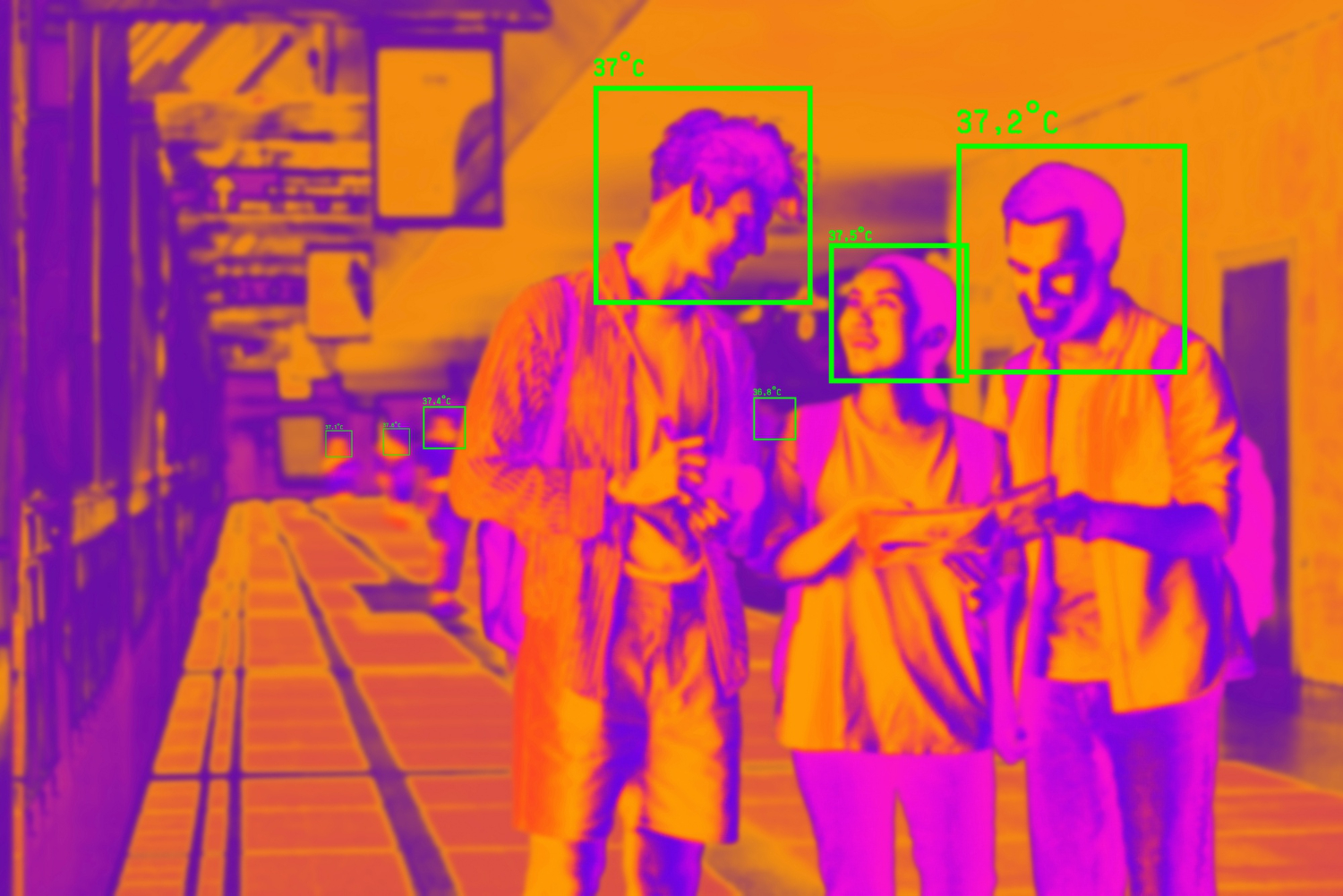
A pretrained pose model draws a clean skeleton on your assembly station in the first demo, and everyone in the room reads that skeleton as ground truth. It isn’t. A keypoint is a prediction with a confidence attached, and on a live line that confidence quietly stops meaning what it meant in the lab.
That gap — between the framed, well-lit demo scene and the actual station with occlusion, unfamiliar part geometries, and an edge throughput budget — is where pose estimation for quality control goes wrong. Not with an error message. With a confident keypoint placed on an object the model has never seen, inherited by a downstream assembly-verification or safety check that has no way of knowing the number underneath it was a guess.
This article explains how pose estimation actually works when it is doing manufacturing QC, why the pretrained-demo intuition breaks on the line, and what a production-ready pose stage looks like when you treat its output as a signal with a confidence and coverage contract rather than a picture of the truth.
How does pose estimation work, and what does it mean on a line?
Pose estimation predicts the location of a fixed set of keypoints on an object or person — the corners of a bracket, the joints of an operator’s arm, the mounting holes on a housing — and, in most models, the connectivity between them. The output is a set of (x, y, confidence) triples per keypoint, optionally lifted to (x, y, z) for 3D models. The skeleton you see on screen is just those triples connected by lines.
The important word is confidence. Every keypoint carries a scalar the model emits alongside the coordinate, and that scalar is the only thing that separates a real detection from a hallucinated one. When practitioners treat pose as solved, what they are really doing is discarding that scalar — reading the drawn skeleton as fact and ignoring the per-keypoint confidence that the model went to the trouble of producing.
In a manufacturing QC context, pose feeds two broad jobs. The first is assembly verification: are the parts in the geometric relationship the spec requires? Keypoints on a connector and its socket, plus the angle between them, become a pass/fail rule. The second is ergonomic and safety-event detection: is an operator’s posture or hand position entering a hazard envelope? Both jobs consume keypoints as if they were measurements. Neither is robust to a keypoint that is confidently wrong.
Top-down vs bottom-up, 2D vs 3D: which fits which QC job?
Model topology dictates failure patterns: heatmap regressors degrade gracefully under noise, while coordinate predictors snap to wrong keypoints. Two axes matter.
Top-down vs bottom-up describes the pipeline order. A top-down model (the pattern behind HRNet-style keypoint heads) first detects each object with a bounding box, then estimates keypoints inside each crop. It is accurate when detections are clean but its cost scales with the number of objects, and it inherits every detection miss — no box, no pose. A bottom-up model (the OpenPose lineage) finds all keypoints in the frame first, then groups them into instances. Its cost is roughly constant regardless of object count, which matters when many parts or several operators share the frame, but grouping errors appear when instances overlap.
2D vs 3D describes what the keypoint means. A 2D model places keypoints in the image plane. A 3D model estimates depth, either from a depth sensor or by lifting 2D predictions, which is what an assembly-angle check often needs — a 2D angle between two keypoints is ambiguous under perspective. 3D adds calibration burden and a new failure surface: depth error compounds into angle error.
| Pose model type | Cost behaviour | Fits when | Primary failure on the line |
|---|---|---|---|
| Top-down 2D | Scales with object count | One or few parts per frame, clean detection | Missed detection drops the whole pose |
| Bottom-up 2D | ~Constant per frame | Many parts / multiple operators | Instance grouping errors under overlap |
| Top-down 3D | Scales with object count + depth | Assembly-angle checks needing real geometry | Depth error compounds into angle error |
| Bottom-up 3D | ~Constant + depth | Crowded scenes needing 3D posture | Grouping and depth error stack |
(Evidence class: observed-pattern — these are the trade-offs we weigh when scoping a pose stage, not a benchmarked ranking. The right choice depends on frame composition and the geometric tolerance the QC rule needs.)
The point of the table is not to pick a winner. It is that the failure mode you will spend your time observing is determined by this choice before you write a line of pipeline code, and the same modularity discipline governs the instance segmentation models used elsewhere in manufacturing inspection.
Why do pretrained pose models place confident, wrong keypoints?
Here is the mechanism most demos hide. A pretrained keypoint model was trained on a distribution — COCO-style human poses, or a specific object set — and its confidence calibration is only meaningful inside that distribution. Point it at a bracket geometry it has never seen, and it does not return low confidence and abstain. It returns the nearest thing in its learned manifold, with a confidence that reflects internal certainty, not correctness.
This is the same distribution-shift failure that degrades defect classifiers, and it is worth stating plainly: a pretrained model’s confidence is a statement about familiarity, not about truth. When the input drifts away from training data, the two decouple, and the model can be most confident exactly where it is most wrong.
On a live line three drivers push the input off-distribution constantly:
- Occlusion. An operator’s hand, a fixture, or another part covers a keypoint. The model still emits a coordinate — it interpolates from the visible structure — and often does so with unremarkable confidence.
- Unfamiliar geometry. Your parts are not in COCO. A keypoint head trained on human joints or a generic object set will still fire on the visually-nearest analogue.
- Motion blur and lighting. A part moving through frame under mixed factory lighting is a harder image than any curated training example, and blur degrades keypoint localization silently.
None of these throws an error. That is the trap. The naive pipeline treats the drawn skeleton as truth and passes it downstream, where an assembly-correctness check inherits the error with no signal that anything was uncertain. The correct framing is to treat every keypoint’s confidence — and the coverage, how many expected keypoints were actually found — as first-class pipeline signals, the same reliability discipline that governs how an image detection model works in industrial inspection.
How do edge throughput limits degrade pose, and how do you see it?
A factory-floor deployment does not have a datacenter GPU per camera. It has an edge budget — a Jetson-class device, a shared accelerator, a fixed frame-rate target. Pose estimation is not cheap: top-down cost scales with object count, and 3D adds depth work on top. When the budget is tight, something gives, and there are only two levers.
The first lever is resolution. Downscaling the input to hit the latency target shrinks small keypoints below the model’s effective localization floor. A mounting hole that was 20 pixels across at full resolution becomes 8 pixels after downscale, and the keypoint on it degrades from a measurement to noise — with confidence that barely moves, because the model still sees something there.
The second lever is frame-rate. Under load, frames get dropped. This is the quietest failure of all: a dropped frame produces no output at all, so a pipeline that only logs the poses it did produce has no record that a defect passed the station unexamined. The inference that would have caught it simply never ran.
You observe both by instrumenting the pipeline, not the model. Log per-frame keypoint confidence distributions and per-frame coverage (expected keypoints vs found). Log the arrival rate of frames against the processed rate — the gap is your drop rate. Watch confidence-distribution drift over a shift; a slow slide toward lower mean confidence is the early warning that lighting, wear, or a new part variant is pushing input off-distribution. This is the same throughput-observability instinct behind real-time object detection on the production line, applied to keypoints instead of boxes.
Quick answer: what to log on a production pose stage
- Per-keypoint confidence — not just the drawn skeleton, the scalar under each point.
- Per-frame coverage — expected keypoints vs actually found; a partial pose is a different event from a full one.
- Frame arrival rate vs processed rate — the gap is your silent drop rate.
- Confidence-distribution drift over a shift — the leading indicator of off-distribution input.
- Input resolution actually fed to the model — after any latency-driven downscale, not the camera’s native resolution.
How should the pipeline handle the unknown-pose case?
The single most important design decision is what happens when the model is not sure. The naive default is to emit the best guess and move on. The production default should be the opposite: a low-confidence or low-coverage pose is not a pose — it is an “unknown” event that the pipeline routes explicitly.
Concretely, that means confidence and coverage thresholds gate the pose before it reaches any QC rule. Below threshold, the frame is not silently passed as a good pose and it is not silently dropped either — it is flagged for review, re-inspection, or a fallback path. A part whose pose came back as “unknown” is a part the line knows it did not verify, which is a completely different operational state from a part that was verified and passed. Treating those two as the same is the core error.
This also constrains where thresholds live. They belong in the pipeline, observable and tunable per station, not baked as a hidden constant inside a monolithic model wrapper. When the threshold is a pipeline parameter you can see the effect of moving it: raise it and the unknown-rate climbs but false verifications fall; lower it and you accept more silent guesses. That is a decision a QC owner should get to make with numbers in front of them.
How does bad pose propagate into the defect-catch rate?
Pose is rarely the last stage. It feeds assembly-verification and safety-event logic, and errors propagate with amplification. A confidently-wrong keypoint feeds a correct angle computation on a wrong coordinate, producing a wrong pass/fail with full downstream confidence. The QC rule did its job perfectly on garbage input.
The measurable consequence is a defect-catch rate that looks fine in aggregate while missing a specific failure class — the parts whose geometry sits off-distribution, or the frames that got dropped under peak-hour load. Because the misses correlate with conditions (a part variant, a busy shift), they do not average out; they cluster exactly where you cannot afford them. Making false-keypoint and dropped-frame rates observable is what converts this from an invisible tail risk into a tracked number you can act on, the same way multi-object tracking on an inspection line makes cross-frame identity a tracked property rather than an assumption.
The reliability lens here is not specific to pose — it is the computer vision engineering practice that treats every model in a pipeline as a component with a stated confidence and coverage contract, and it is why we scope pose as one stage among many rather than a self-contained oracle.
Production-ready pose vs a monolithic pretrained model
Put the two postures side by side.
| Dimension | Monolithic pretrained model | Modular, observable pose stage |
|---|---|---|
| Output treated as | Drawn skeleton = truth | Keypoints = signal with confidence + coverage |
| Unknown input | Silent best guess | Explicit “unknown” event, routed |
| Thresholds | Hidden internal constant | Pipeline parameter, per-station, observable |
| Throughput degradation | Invisible (drops unlogged) | Arrival-vs-processed gap tracked |
| Distribution drift | Discovered as missed defects | Confidence-distribution drift alarmed |
| Downstream trust | Inherited blindly | Gated on confidence + coverage contract |
(Evidence class: observed-pattern — this is the architecture distinction we assess when reviewing a pose deployment, not a scored benchmark of two products.)
FAQ
What does working with pose estimation models involve in practice?
Pose estimation predicts a fixed set of keypoints on an object or person as (x, y, confidence) triples — optionally with depth for 3D — and connects them into a skeleton. In practice the confidence scalar under each keypoint is the signal that separates a real detection from a hallucinated one, and the drawn skeleton is a prediction, not a measurement.
What are the main types of pose estimation models and when does each fit a manufacturing-line use case?
Top-down models detect each object first then estimate keypoints inside the crop — accurate with clean detection but costly per object and blind to missed detections. Bottom-up models find all keypoints then group them, staying roughly constant in cost for crowded frames but risking grouping errors under overlap. 2D suits image-plane checks; 3D is needed when an assembly-angle rule requires real geometry, at the cost of calibration burden and compounding depth error.
Why do pretrained pose estimation models that work in a demo place confident but wrong keypoints on unfamiliar parts or occluded objects?
A pretrained model’s confidence is calibrated only inside its training distribution, so it reflects familiarity rather than correctness. On an unfamiliar part geometry or an occluded object, the model returns the nearest thing in its learned manifold with unremarkable confidence instead of abstaining, which means it can be most confident exactly where it is most wrong.
How do edge throughput constraints force resolution or frame-rate trade-offs that degrade pose accuracy, and how do you observe that degradation?
A tight edge budget forces either downscaling — which shrinks small keypoints below the localization floor — or frame-dropping, which produces no output at all for the missed frames. You observe both at the pipeline level: log per-frame confidence distributions and coverage, and track frame arrival rate against processed rate so the silent drop gap is visible.
How should a pose pipeline handle the unknown-pose or low-confidence case instead of emitting a silent best-guess keypoint?
Treat a low-confidence or low-coverage pose as an explicit “unknown” event rather than a pose. Confidence and coverage thresholds gate the output before any QC rule consumes it, routing uncertain frames to review or a fallback path so a part the line did not actually verify is never recorded as verified-and-passed.
How does unreliable pose output propagate into downstream assembly-verification or safety-event checks and affect the defect-catch rate?
Downstream logic computes correct results on wrong coordinates, producing confident wrong pass/fail decisions. Because the misses correlate with specific conditions — a part variant or a peak-load shift — they cluster rather than averaging out, so the defect-catch rate looks fine in aggregate while missing a specific failure class until false-keypoint and dropped-frame rates are made observable.
What does a production-ready pose estimation stage look like in a modular, observable CV pipeline versus a monolithic pretrained model?
A monolithic model treats its skeleton as truth, hides its thresholds, and drops frames silently. A production-ready stage treats keypoints as a signal with a confidence and coverage contract, exposes thresholds as observable per-station parameters, routes unknown inputs explicitly, and tracks throughput degradation and distribution drift as first-class metrics.
Where the honest uncertainty sits
The part nobody can promise you at the demo is how far your specific parts sit from a pretrained model’s training distribution — and that distance is what determines whether pose is a measurement or a guess on your line. Before a pose stage is trusted to gate assembly or safety decisions, that unknown-input behaviour and the edge-throughput headroom are exactly what a Production CV Readiness Assessment stress-tests, because a confidently-wrong keypoint is a failure class that only shows itself once the line is running.