Computer vision in agricultural machinery earns its keep wherever a perception result drives a physical actuator — spraying a nozzle, steering a row, or triggering a harvesting arm — rather than merely populating a dashboard. That coupling between “what the camera sees” and “what the machine does next” is the whole reason CV displaces cheaper sensors here, and it also dictates every hard engineering constraint that follows.
Which vision tasks actually justify the hardware?
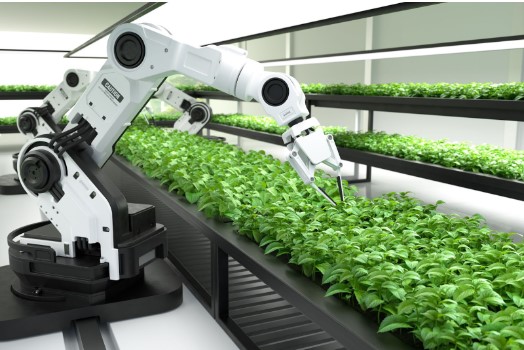
The highest-value roles are perception tasks bound tightly to an implement. Crop-versus-weed discrimination that drives targeted spraying, row-following that feeds guidance and steering, and fruit or plant detection that gates a selective harvester are the three that repeatedly clear the cost hurdle. In each, the vision output is a control signal, not a report.
Contrast that with monitoring-only deployments — yield estimation, stand counts, generic “field health” imagery. Those have real value, but they tolerate latency, they tolerate a human in the loop, and they often run just as well from a drone pass or a satellite tile. The moment a nozzle bank has to fire on a specific 20 cm patch as the boom moves over it, you are in a different engineering regime entirely. The broader taxonomy of these use cases sits in our overview of AI in agriculture and agtech; this piece narrows in on the machinery-mounted, actuator-coupled subset.
A useful filter: if removing the vision system means falling back to blanket action (spray the whole field, hand-pick every row), the CV is doing load-bearing work. If removing it just means losing a chart, the economics are much weaker.
Why is the field the hard part, not the model?
Field CV runs in one of the most hostile deployment environments in the discipline. You are contending with variable outdoor lighting across a single pass, airborne dust coating lenses, chassis vibration blurring frames, connectivity that drops to nothing mid-field, and a hard real-time budget because the machine does not stop moving. The consequence is blunt: the constraint is almost never lab accuracy and almost always robustness plus edge-inference latency under those conditions.
This inverts the usual model-development instinct. A weed classifier that hits, say, high-90s accuracy on a curated validation set can still be unusable if it degrades badly under low sun angle, or if its inference time on the on-board compute pushes total latency past the window the sprayer needs to actuate at working speed. The failure modes that matter are the ones that only appear at 5 a.m., at 15 km/h, with a dusty lens.
Here is the layered way to think about the deployment budget:
1. Sensing layer. Lighting and optics dominate. Global-shutter cameras to survive vibration and motion, controlled illumination or exposure logic to fight sun-angle swings, and lens protection/cleaning because dust is not an edge case in the field — it’s the baseline. Get this wrong and no model recovers it.
2. Inference layer. The model runs on embedded edge compute (an on-board GPU or an accelerator module), not in a datacentre — connectivity is intermittent by assumption. The budget you defend is end-to-end latency: capture → inference → actuator command. A model that is accurate but too slow for the machine’s ground speed is a failed deployment, full stop.
3. Actuation layer. The vision result must arrive in time and in the right coordinate frame to fire the correct nozzle, adjust steering, or position an arm. Spatial and temporal alignment between “where the target was seen” and “where the implement is now” is a real-time problem in its own right, independent of detection quality.
In practice, we spend far more time hardening the sensing and inference layers against field conditions than chasing the last points of validation accuracy — because that is where deployments actually break. The general engineering discipline behind that work is what our computer vision practice is organised around, and the agricultural case is a demanding instance of it rather than a special one.
How do you set the latency budget on a moving machine?
Work backwards from ground speed and implement geometry. If the machine covers a given distance per second and the actuator sits a fixed distance behind the camera’s field of view, the total pipeline latency must be shorter than the time it takes the machine to travel that gap — otherwise the command lands on the wrong patch of ground. This is a physical deadline, not a soft target.
That deadline is what forces edge inference, model quantisation, and often a smaller architecture than you’d choose in a lab. It is also why “just use a bigger model” rarely helps: added accuracy that costs latency can push you past the deadline and make the system worse at its actual job. As commonly reported across embedded-vision work, quantisation and pruning to fit an accelerator’s real-time envelope are routine here, not exotic — the trade is accuracy points for a latency guarantee you can actually meet.
What should you validate before field trials?
Validate under degradation, not under best case. Build test sets that include low sun angle, backlight, motion blur, partial lens occlusion from dust, and the specific crop-growth stages you’ll face — because a model trained on clean mid-day imagery will surprise you at dawn. Then profile inference latency on the exact edge hardware you intend to ship, not on a workstation GPU, since that number is the one your latency budget depends on.
Treat the actuator loop as part of the system under test. A perception model evaluated in isolation tells you little about whether the right nozzle fires at the right moment; the meaningful metric is end-to-end hit rate against ground truth targets at working speed, which folds in detection quality, latency, and spatial alignment together.
Frequently Asked Questions
Does agricultural computer vision need cloud connectivity?
Generally no, and designing for it is a mistake. Field connectivity is intermittent by assumption, and actuator-coupled tasks have real-time deadlines that a round trip to the cloud cannot meet. Inference runs on on-board edge compute; cloud links, when present, are for logging, updates, and non-time-critical analytics.
Why not just use GPS guidance instead of vision?
GPS handles absolute positioning and pre-planned paths well, but it does not perceive what is actually in front of the machine. Row-following in a real crop, distinguishing a weed from a seedling, or locating ripe fruit are perception problems that positioning alone cannot solve. The two are complementary — GPS for where the machine is, vision for what it should act on.
Is model accuracy the main challenge in field CV?
Rarely. In most machinery deployments the binding constraints are robustness to variable lighting, dust, and vibration, plus meeting edge-inference latency on a moving platform. A model with excellent lab accuracy can still fail if it degrades under field conditions or runs too slowly for the machine’s ground speed.
What makes a CV use case worth the hardware cost in agriculture?
The strongest case is when vision output directly controls an implement and the alternative is blanket action — spraying an entire field instead of just the weeds, or hand-picking every row. If the vision only produces a chart or report, cheaper sensors or occasional drone imagery often suffice, and the economics weaken considerably.
ROI calculations that matter to farm equipment buyers
Vision-guided implements justify their price premium when they reduce herbicide spend by 60–80% (as a payback threshold, a rule of thumb for investment planning) or cut labor hours enough to pay back the investment within two growing seasons.