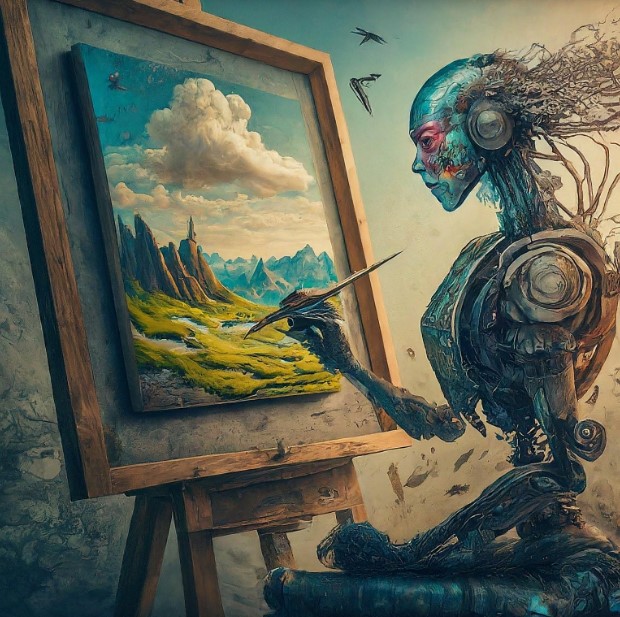
AI in Digital Visual Arts: Exploring Creative Frontiers

Traverse the fusion of AI and digital visual arts. Discover cutting-edge techniques and increase your creativity with AI-powered tools. Embrace the future of artistry today!

AI in Digital Visual Arts: Exploring Creative Frontiers
Written by TechnoLynx Published on 22 Apr 2024

The synergy of AI & 3D modelling has skyrocketed the world of digital visual arts to unprecedented heights. Artists and designers use machine learning algorithms and computer vision, together with AR/VR, to advance art exponentially. By bringing 2D models to life to intrigue audiences inside virtual reality, AI has revolutionised how we perceive, create and interact with visual content. In 2023, the global AI in entertainment market was valued at USD 19.52 billion and is estimated to grow at a CAGR of 26.1% during the forecast period.

Also, AI-generative technologies contribute to the cinematography, photography and video games for realistic graphics, adaptive storytelling and alluring gameplay experiences. Anna Ridler, an artist, harnesses AI-powered algorithms to create digital art and uses the intersection of nature and technology themes. As we navigate through the intricate interplay of pixels and algorithms, the following sections will unfold the multifaceted impact of AI on 3D printing, cinema, photography, and digital art creation.

How This Artist Uses AI & Data to Teach Us About the World | Source: Vocal Media

Use Cases

AI-generated 3D Modelling for Virtual Reality

AI acts as a digital artist, crafting 3D objects to create VR environments that blur the line between the virtual and real. These models are not just static replicas but dynamic, lifelike spaces that captivate our senses. This use case unravels some high-tech tools such as computer vision, which is the equivalent of AI’s eyes, generative AI for its creative brain and GPU acceleration – an engine that makes everything run smoother.

Virtual Reality – Creating and Immersing Ourselves in New Worlds | Source: Vecteezy

Computer Vision in VR Creation

Imagine putting a VR headset on and thinking that you are actually in a real-world simulation. AI, using computer vision, makes this possible. It crunches data from cameras to recreate spaces in a way that’s almost indistinguishable from reality. For instance, Google Earth VR utilises AI-enhanced 3D modelling to accurately recreate real-world environments. This has led to an increase in user engagement by 50% since the introduction of AI-enhanced features.

It also uses Computer Vision to look at 3D models and make them super accurate. This helps create these awesome, lifelike places in the virtual world. This visual data analysis ensures that the virtual environments crafted are realistic and exhibit a level of detail that meets the highest artistic standards.

Generative AI & GPU Acceleration’s Creative Assistance

Also, AI uses Generative AI. It not only polishes up existing 3D art but also comes up with new and interesting things to add. It’s like a creative assistant helping artists make their virtual creations even more exciting. To make sure everything happens in a snap, AI uses GPU Acceleration. This is like giving AI a speedy engine. With this, the 3D models get shown in the virtual world in real time.

With seamless integration of Generative AI and GPU Acceleration, AI art empowers artists and digital creators to add new dimensions of creativity. In simple terms, AI is like the behind-the-scenes hero, turning time-consuming 3D models into extraordinary experiences in Virtual Reality. It’s like bringing dreams to life in a whole new digital dimension!

A ThinkStation P8 loaded with 3x Nvidia RTX Pro-Viz graphics cards | Source: Superhanov

Transforming Textual Instructions into Visual Art with NLP

Artists, whether they’re painters or digital wizards, can simply tell the computer what they want. Thanks to NLP, the computer understands these words, almost like having a conversation. It translates the artist’s instructions into visual elements, creating digital art that mirrors the artist’s thoughts. This allows digital artists to communicate their ideas more naturally. Instead of clicking and dragging, they can just say how to make the sky deep blue with fluffy clouds.

However, artists are able to use their traditional art skills and incorporate some AI-generated features. For instance, they may have an old portrait but opt to incorporate a few AI-produced 3D details. It’s about fusing the best of two different worlds into one novel and innovative creation.

Runway ML connects several machine learning models to frameworks for creative work. It offers the capabilities of NLP and Generative AI to transform textual guidance into visual art, and is available for use by artists and creators. Users can create images based on the text description by using models supported by this platform, enabling them to articulate their creative thoughts through natural language.

Automatic Speech Recognition and Natural Language Processing | Source: istockphoto.com

Digital Painting Using AI Tools in Adobe Photoshop

Suppose you are interested in editing your graphic picture in Adobe Photoshop. With the help of AI-powered Computer vision, a digital art analyser detects elements such as colours, forms and textures in real time. Based on this analysis, Adobe Photoshop will make smart recommendations, whether they are colour corrections, brush strokes, or even offer creative ideas based on your painting content. Therefore, artists can spend less time on monotonous duties and more time being creative.

The integration of Adobe Photoshop with NLP is yet another way to improve your digital painting by using voice or text commands. Instead of sifting through menus and settings, they can simply speak or type their commands, allowing for a more immersive painting experience. You can use voice commands like “add texture” or “apply artistic filter” to implement the requested changes onto your painting.

Sketch and paint with Adobe Photoshop | Source: behance.net

AI-generated Cinematography and Photography

AI is revolutionising the world of cinema, videos and photography, where camera angles are recommended by AI to artists so that they capture excellent images. The lights can also be adjusted in order for one to get an impeccable shot. This enables you to spend less time on technical stuff and focus more on creative work, like telling the story or catching that moment.

Computer Vision for Camera Angles & Lighting Adjustments

Computer Vision algorithms powered by AI capture real-time pictures, selecting core factors such as the subject matter or backgrounds and lighting conditions. These algorithms then use this data to provide the best camera angle and framing, which is critical in every shot because it tells a story. Also, it can process huge amounts of cinematographic techniques and styles to offer filmmakers more artistic information and suggestions on how to achieve specific visual effects or tones.

For example, Cinelytic applies computer vision algorithms to analyse scenes and predicts the commercial potential for movie projects. Cinelytic’s AI platform draws large databases of films such as box office performance, audience demographics and critics overviews, which help film producers and studios decide upon targeting their niche audiences. These understandings guide the film markers in their selection of cast, marketing strategies and distribution schedules, thereby ensuring high commercial value for their films.

AI Tools Like Mid Journey Could Change How Movies Are Made | Source: vulture.com

Deep Learning Models For Image Editing in Photography

Also, AI technologies such as deep learning and neural networks are vital in improving images easily with speedy professional-quality results. As deep learning algorithms can understand complex visual patterns, they can be trained to perform tasks like object removal, colour enhancement, or image restoration. On the other hand, neural networks serve as the spine of AI-based image editing software tools that allow functions such as content-aware fill and smartly fine edit images.

The software Luminar, developed by Skylum uses deep learning for automatic photo enhancement. It provides services such as ‘AI Sky Replacement’ that automatically detects and changes over skies in photos with more appealing images. However, Luminar’s “AI Enhance” uses neural networks to automatically modify a range of aspects within an image including: exposure level, colour balance and contrast ratio, achieving professional quality results with minimum manual intervention.

The Future of AI in 3D Printing for Artists.

Using 3D printing, you can make complex statues and other beautiful objects such as jewellery or functional items. As technology continues to develop, the integration of artificial intelligence (AI) and 3D printing is opening up a new world of creativity and innovation in the field of art. Along with the development of AI-generative technologies, including IoT edge computing and generative design, 3D printing is undergoing a transformation that will change how art is created.

Pioneering AI Software Transforming the World of 3D Printing | Source: ISP

Now the 3D art is opting for IoT edge computing that acts like a mini-computer at the location of a 3D printer. It keeps an eye on things like temperature and material flow in real time. When some issue pops out, it makes the corrections on the spot to keep your print on track. This implies that you can count on each and every part of your 3D print. For artists and creators, the days of worrying about minor mistakes spoiling the end product are finally over!

Markforged’s IoT capabilities give users the ability to monitor and manage remotely, striving toward improved, optimised production workflows while minimising downtime costs to maintain a uniform print quality throughout their operations. Users can check the status of their prints live from anywhere in the world and view a live feed on camera, and receive prompt notifications about any issues or errors by automatically emailing support staff.

Personalised AR Interactions

Personalised AR art galleries achieve a blend of technology and artistic creativity that enables users to tailor their art journey via advanced technologies such as Computer Vision and Natural Language Processing (NLP). Through the adoption of these technologies, users can interact with personalised virtual artworks and enjoy highly interactive and engaging experiences.

Augmented Reality for Art Galleries | Source: unitear.com

Imagine using your phone or special glasses to see art made just for you! With Computer Vision & Natural Language Processing (NLP), you can personalise AR art interactions based on your interests. Computer vision technology allows devices to “see” and analyse the real world around them, while NLP enables devices to understand what human beings are speaking. Overall, integrating these technologies helps your devices like smartphones or AR glasses understand what you like and create virtual art that matches your preferences.

Take the case of Art.com, an online art gallery that implements personalised AR features in its mobile app, allowing users to virtually place artworks in their homes using AR technology. Users can browse a huge inventory of art pieces and visualise how they would look in their living spaces before making the purchase. Customers are satisfied with this opportunity which led to increased user engagement rates and skyrocketing sales conversion.

Benefits

Artists have a secret weapon because their daily tasks become easier, and so does the quality of what they produce. Collaboration between artists and new AI-generative technologies such as computer vision, generative AI, and GPU acceleration can help artists create visual masterpieces by requiring only their ideas in a way that is faster than hand-drawn artworks but without losing any live features.

Boost Efficiency:

By uploading a 3D model or each brushstroke painted by hand, the process is lengthy and arduous. Implementing AI-generative tools can significantly increase productivity for artists who work faster than ever, getting things done within days if not hours. AI can perform repetitive tasks, such as generating 3D models or adding textures; this leaves artists to spend more time on the creative aspect.

Upsurge Creativity:

AI is not primarily about time-saving – artists can engage in a wide range of styles, apply innovative approaches and push their boundaries of imagination. From building surreal landscapes, modern cityscapes or imaginary beings, AI grants artists freedom of expression and takes their fantastic ideas beyond reality into a virtual world.

Reduce Errors:

Honestly, no one is perfect, and even a genius artist can fail. However, with AI, artists can reduce mistakes and produce more refined work. Errors are quickly detected, imperfections are corrected, and suggestions for improvements are sometimes even provided to ensure all units of digital art are perfect.

Enhance Collaboration:

Collaboration is necessary in the modern world; AI makes it easier than ever for artists to cooperate. AI artists can freely share their work online in real time and even crowdsource ideas from millions of people across the globe. This creates new room for collaborative work in digital art forms.

Challenges

When it comes to digital visual arts, it is expected to provide advantages; however, it comes with several challenges. Let us discuss some of the typical challenges of using AI for creative pursuits.

Preserving Artistic Intent:

Maintaining originality, assuring artwork still feels authorised by an artist. Given that AI can quickly create large volumes of content in a short time, there is also a danger in diluting the authenticity and creativity of an artist. For example, if we look at 3D modelling, it might prove hard for artists to include their handcrafted elements with computer-generated ones as a result, people will lose the personal touch of creation.

Ethical Considerations:

Ethical issues arise especially in the field of ownership, authorship as well as copyright. This situation may lead to questions about the ownership of produced artwork – is it human artist and/or AI that created such art? Further, applying AI-created content in business is prone to abuse or misuse.

Technical Challenges:

In 3D modelling and AI art generation, artificial intelligence algorithms may need more computational capacity and specialised knowledge to implement and develop effectively. Another challenge is making it compatible and interoperable with the pre-existing digital art tools and platforms.

Balancing Traditional Art with AI:

Many artists are passionate about traditional art techniques, as AI integration can feel like selling out their art. People fear AI will take away their art skills, so artists need to learn how to use artificial intelligence AI in their artworks and respect their craft traditions by adopting these technologies.

What Can Technolynx Offer You as a Software Company?

From the digital illustrator’s aspiration to produce compelling 2D or 3D illustrations to developing spectacular digital drawings or filmmakers wanting an immersive cinema and even photographers trying to create breathtaking moments; Technolynx offers AI solutions in the digital visual art world.

Technolynx provides digital artists with a pack of AI-driven creative tools, from cutting-edge image processing algorithms to generative AI models. Technolynx’s AI algorithms make content generation more streamlined and time-efficient. We can take care of the repetitive tasks freeing artists’ minds from unnecessary details and ensuring they can focus on their creative vision.

Technolynx defines a new way of combining AI and digital visual art by providing artists and designers worldwide with innovative opportunities to increase their creative work. At our core, the underlying skill set we leverage is through the use of cutting-edge technologies which enable the exploration of the limits of artistic expression.

Technolynx is a leader in AI using it to enhance creative work by artists and designers around the globe. Our advanced solutions, which are based on delivering personalised recommendations unique for everybody and their tastes and styles, allow artists to discover new forms of expression, giving rise to a comprehensive and enjoyable show.

Experience the future of digital art with Technolynx’s AI-powered solutions. Get started now!

Final Thoughts

In Conclusion, the article discusses the revolutionary role of AI in digital visual arts regarding 3D modelling . Innovative AI technologies include generative art algorithms and real-time collaborative tools that empower modern artists with the unparalleled ability to reveal creative depths that were virtually impossible before.

The ability of AI to transform the creative process is enormous, granting artists an unparalleled platform and potential access to extraordinary breakthroughs. Technolynx is working towards a new approach which is based upon AI-driven technology. Our goal is to keep innovating technological marvels which not only simplify the creative process but also intelligence towards lifting up creativity for artists around the globe.

We see a future that incorporates continuing explorations of AI use cases within the creative process and employs artificial intelligence as artists’ effective tool to turn their ideas to life. Let us work together and discover how AI is used in the future of digital artisans to rise with better intelligence by technologies.

References:

Cost, Efficiency, and Value Are Not the Same Metric

Cost, Efficiency, and Value Are Not the Same Metric

17/04/2026

Performance per dollar. Tokens per watt. Cost per request. These sound like the same thing said differently, but they measure genuinely different dimensions of AI infrastructure economics. Conflating them leads to infrastructure decisions that optimize for the wrong objective.

Precision Is an Economic Lever in Inference Systems

Precision Is an Economic Lever in Inference Systems

17/04/2026

Precision isn't just a numerical setting — it's an economic one. Choosing FP8 over BF16, or INT8 over FP16, changes throughput, latency, memory footprint, and power draw simultaneously. For inference at scale, these changes compound into significant cost differences.

Precision Choices Are Constrained by Hardware Architecture

Precision Choices Are Constrained by Hardware Architecture

17/04/2026

You can't run FP8 inference on hardware that doesn't have FP8 tensor cores. Precision format decisions are conditional on the accelerator's architecture — its tensor core generation, native format support, and the efficiency penalties for unsupported formats.

Steady-State Performance, Cost, and Capacity Planning

Steady-State Performance, Cost, and Capacity Planning

17/04/2026

Capacity planning built on peak performance numbers over-provisions or under-delivers. Real infrastructure sizing requires steady-state throughput — the predictable, sustained output the system actually delivers over hours and days, not the number it hit in the first five minutes.

How Benchmark Context Gets Lost in Procurement

How Benchmark Context Gets Lost in Procurement

16/04/2026

A benchmark result starts with full context — workload, software stack, measurement conditions. By the time it reaches a procurement deck, all that context is gone. The failure mode is not wrong benchmarks but context loss during propagation.

Building an Audit Trail: Benchmarks as Evidence for Governance and Risk

Building an Audit Trail: Benchmarks as Evidence for Governance and Risk

16/04/2026

High-value AI hardware decisions need traceable evidence, not slide-deck bullet points. When benchmarks are documented with methodology, assumptions, and limitations, they become auditable institutional evidence — defensible under scrutiny and revisitable when conditions change.

The Comparability Protocol: Why Benchmark Methodology Defines What You Can Compare

The Comparability Protocol: Why Benchmark Methodology Defines What You Can Compare

16/04/2026

Two benchmark scores can only be compared if they share a declared methodology — the same workload, precision, measurement protocol, and reporting conditions. Without that contract, the comparison is arithmetic on numbers of unknown provenance.

A Decision Framework for Choosing AI Hardware

A Decision Framework for Choosing AI Hardware

16/04/2026

Hardware selection is a multivariate decision under uncertainty — not a score comparison. This framework walks through the steps: defining the decision, matching evaluation to deployment, measuring what predicts production, preserving tradeoffs, and building a repeatable process.

How Benchmarks Shape Organizations Before Anyone Reads the Score

How Benchmarks Shape Organizations Before Anyone Reads the Score

16/04/2026

Before a benchmark score informs a purchase, it has already shaped what gets optimized, what gets reported, and what the organization considers important. Benchmarks function as decision infrastructure — and that influence deserves more scrutiny than the number itself.

Accuracy Loss from Lower Precision Is Task‑Dependent

Accuracy Loss from Lower Precision Is Task‑Dependent

16/04/2026

Reduced precision does not produce a uniform accuracy penalty. Sensitivity depends on the task, the metric, and the evaluation setup — and accuracy impact cannot be assumed without measurement.

Precision Is a Design Parameter, Not a Quality Compromise

Precision Is a Design Parameter, Not a Quality Compromise

16/04/2026

Numerical precision is an explicit design parameter in AI systems, not a moral downgrade in quality. This article reframes precision as a representation choice with intentional trade-offs, not a concession made reluctantly.

Mixed Precision Works by Exploiting Numerical Tolerance

Mixed Precision Works by Exploiting Numerical Tolerance

16/04/2026

Not every multiplication deserves 32 bits. Mixed precision works because neural network computations have uneven numerical sensitivity — some operations tolerate aggressive precision reduction, others don't — and the performance gains come from telling them apart.

Throughput vs Latency: Choosing the Wrong Optimization Target

16/04/2026

Throughput and latency are different objectives that often compete for the same resources. This article explains the trade-off, why batch size reshapes behavior, and why percentiles matter more than averages in latency-sensitive systems.

Quantization Is Controlled Approximation, Not Model Damage

16/04/2026

When someone says 'quantize the model,' the instinct is to hear 'degrade the model.' That framing is wrong. Quantization is controlled numerical approximation — a deliberate engineering trade-off with bounded, measurable error characteristics — not an act of destruction.

GPU Utilization Is Not Performance

15/04/2026

The utilization percentage in nvidia-smi reports kernel scheduling activity, not efficiency or throughput. This article explains the metric's exact definition, why it routinely misleads in both directions, and what to pair it with for accurate performance reads.

FP8, FP16, and BF16 Represent Different Operating Regimes

15/04/2026

FP8 is not just 'half of FP16.' Each numerical format encodes a different set of assumptions about range, precision, and risk tolerance. Choosing between them means choosing operating regimes — different trade-offs between throughput, numerical stability, and what the hardware can actually accelerate.

Peak Performance vs Steady‑State Performance in AI

15/04/2026

AI systems rarely operate at peak. This article defines the peak vs. steady-state distinction, explains when each regime applies, and shows why evaluations that capture only peak conditions mischaracterize real-world throughput.

The Software Stack Is a First‑Class Performance Component

15/04/2026

Drivers, runtimes, frameworks, and libraries define the execution path that determines GPU throughput. This article traces how each software layer introduces real performance ceilings and why version-level detail must be explicit in any credible comparison.

The Mythology of 100% GPU Utilization

15/04/2026

Is 100% GPU utilization bad? Will it damage the hardware? Should you be worried? For datacenter AI workloads, sustained high utilization is normal — and the anxiety around it usually reflects gaming-era intuitions that don't apply.

Why Benchmarks Fail to Match Real AI Workloads

15/04/2026

The word 'realistic' gets attached to benchmarks freely, but real AI workloads have properties that synthetic benchmarks structurally omit: variable request patterns, queuing dynamics, mixed operations, and workload shapes that change the hardware's operating regime.

Why Identical GPUs Often Perform Differently

15/04/2026

'Same GPU' does not imply the same performance. This article explains why system configuration, software versions, and execution context routinely outweigh nominal hardware identity.

Training and Inference Are Fundamentally Different Workloads

15/04/2026

A GPU that excels at training may disappoint at inference, and vice versa. Training and inference stress different system components, follow different scaling rules, and demand different optimization strategies. Treating them as interchangeable is a design error.

Performance Ownership Spans Hardware and Software Teams

15/04/2026

When an AI workload underperforms, attribution is the first casualty. Hardware blames software. Software blames hardware. The actual problem lives in the gap between them — and no single team owns that gap.

Performance Emerges from the Hardware × Software Stack

15/04/2026

AI performance is an emergent property of hardware, software, and workload operating together. This article explains why outcomes cannot be attributed to hardware alone and why the stack is the true unit of performance.

Power, Thermals, and the Hidden Governors of Performance

14/04/2026

Every GPU has a physical ceiling that sits below its theoretical peak. Power limits, thermal throttling, and transient boost clocks mean that the performance you read on the spec sheet is not the performance the hardware sustains. The physics always wins.

Why AI Performance Changes Over Time

14/04/2026

That impressive throughput number from the first five minutes of a training run? It probably won't hold. AI workload performance shifts over time due to warmup effects, thermal dynamics, scheduling changes, and memory pressure. Understanding why is the first step toward trustworthy measurement.

CUDA, Frameworks, and Ecosystem Lock-In

14/04/2026

Why is it so hard to switch away from CUDA? Because the lock-in isn't in the API — it's in the ecosystem. Libraries, tooling, community knowledge, and years of optimization create switching costs that no hardware swap alone can overcome.

GPUs Are Part of a Larger System

14/04/2026

CPU overhead, memory bandwidth, PCIe topology, and host-side scheduling routinely limit what a GPU can deliver — even when the accelerator itself has headroom. This article maps the non-GPU bottlenecks that determine real AI throughput.

Why AI Performance Must Be Measured Under Representative Workloads

14/04/2026

Spec sheets, leaderboards, and vendor numbers cannot substitute for empirical measurement under your own workload and stack. Defensible performance conclusions require representative execution — not estimates, not extrapolations.

Low GPU Utilization: Where the Real Bottlenecks Hide

14/04/2026

When GPU utilization drops below expectations, the cause usually isn't the GPU itself. This article traces common bottleneck patterns — host-side stalls, memory-bandwidth limits, pipeline bubbles — that create the illusion of idle hardware.

Why GPU Performance Is Not a Single Number

14/04/2026

AI GPU performance is multi-dimensional and workload-dependent. This article explains why scalar rankings collapse incompatible objectives and why 'best GPU' questions are structurally underspecified.

What a GPU Benchmark Actually Measures

14/04/2026

A benchmark result is not a hardware measurement — it is an execution measurement. The GPU, the software stack, and the workload all contribute to the number. Reading it correctly requires knowing which parts of the system shaped the outcome.

Why Spec‑Sheet Benchmarking Fails for AI

14/04/2026

GPU spec sheets describe theoretical limits. This article explains why real AI performance is an execution property shaped by workload, software, and sustained system behavior.

Generative AI Is Rewriting Creative Work

5/02/2026

Learn how generative AI reshapes creative work, from text based content creation and image generation to customer service and medical image review, while keeping quality, ethics, and human craft at the centre.

Cracking the Mystery of AI’s Black Box

4/02/2026

A guide to the AI black box problem, why it matters, how it affects real-world systems, and what organisations can do to manage it.

Inside Augmented Reality: A 2026 Guide

3/02/2026

A 2026 guide explaining how augmented reality works, how AR systems blend digital elements with the real world, and how users interact with digital content through modern AR technology.

Smarter Checks for AI Detection Accuracy

2/02/2026

A clear guide to AI detectors, why they matter, how they relate to generative AI and modern writing, and how TechnoLynx supports responsible and high‑quality content practices.

AI-Powered Customer Service That Feels Human

29/01/2026

Learn how artificial intelligence boosts customer service across chat, email, and social media with simple workflows, smart routing, and clear guidance, while keeping humans in charge. See how TechnoLynx offers practical solutions that lift quality, speed, and trust.

Choosing Vulkan, OpenCL, SYCL or CUDA for GPU Compute

28/01/2026

A practical comparison of Vulkan, OpenCL, SYCL and CUDA, covering portability, performance, tooling, and how to pick the right path for GPU compute across different hardware vendors.

Deep Learning Models for Accurate Object Size Classification

27/01/2026

A clear and practical guide to deep learning models for object size classification, covering feature extraction, model architectures, detection pipelines, and real‑world considerations.

TPU vs GPU: Which Is Better for Deep Learning?

26/01/2026

A practical comparison of TPUs and GPUs for deep learning workloads, covering performance, architecture, cost, scalability, and real‑world training and inference considerations.

CUDA vs ROCm: Choosing for Modern AI

20/01/2026

A practical comparison of CUDA vs ROCm for GPU compute in modern AI, covering performance, developer experience, software stack maturity, cost savings, and data‑centre deployment.

Best Practices for Training Deep Learning Models

19/01/2026

A clear and practical guide to the best practices for training deep learning models, covering data preparation, architecture choices, optimisation, and strategies to prevent overfitting.

Measuring GPU Benchmarks for AI

15/01/2026

A practical guide to GPU benchmarks for AI; what to measure, how to run fair tests, and how to turn results into decisions for real‑world projects.

GPU‑Accelerated Computing for Modern Data Science

14/01/2026

Learn how GPU‑accelerated computing boosts data science workflows, improves training speed, and supports real‑time AI applications with high‑performance parallel processing.

CUDA vs OpenCL: Picking the Right GPU Path

13/01/2026

A clear, practical guide to cuda vs opencl for GPU programming, covering portability, performance, tooling, ecosystem fit, and how to choose for your team and workload.

Performance Engineering for Scalable Deep Learning Systems

12/01/2026

Learn how performance engineering optimises deep learning frameworks for large-scale distributed AI workloads using advanced compute architectures and state-of-the-art techniques.

Choosing TPUs or GPUs for Modern AI Workloads

10/01/2026

A clear, practical guide to TPU vs GPU for training and inference, covering architecture, energy efficiency, cost, and deployment at large scale across on‑prem and Google Cloud.

Back See Blogs
arrow icon