“AI in life sciences” is most often pitched through the lens of drug-discovery moonshots — a model that proposes a novel binder, a screening campaign collapsed from years into weeks. That work exists, and a small number of programs are genuinely benefiting from it. But the steady wins, the ones that compound month after month inside a working lab, sit further upstream. They are about sequence-pattern recognition at lab scale, automated quality control of high-throughput readouts, and predictive analytics that catches process drift before it contaminates downstream results. Labs that treat AI as a productivity layer for routine analytical workflows compound value faster than those waiting for the discovery breakthrough.
The methodology question is workflow-stage-first: which analytical step is reviewer time the bottleneck on, and what does augmenting that specific step look like in practice? We see this pattern across our life-sciences engagements. The lab heads who pick the right step first are the ones whose AI programs survive contact with the audit trail.
Where the durable wins actually sit
Two categories of lab AI emerge immediately when you examine actual deployments rather than vendor slides. Drug discovery as a marketing narrative tends to collapse several very different activities into one phrase. The activities have different ROI curves and different validation burdens.
Sequence and image pattern recognition for screening pipelines — variant calling, off-target detection, plate-reader QC, microscopy classification — is mature. The models are well understood, the failure modes are well characterised, and the operational measurement is straightforward: reviewer hours per readout, false-negative rates against a known panel, queue depth at the bioinformatics-to-decision handoff. These are observed-pattern measurements that any lab can reproduce in its own environment.
Predictive analytics for process operations — column performance, bioreactor drift, fill-finish line health — is also mature in the right hands. The signal is in time-series instrument data the lab already collects. The ROI lever is catching drift one shift earlier than a human reviewer would, not predicting a year-out yield curve.
Generative molecular design and de novo target identification, by contrast, remain genuinely experimental for most teams. They can pay off, but they pay off on a different time scale and demand a different validation posture. Treating these two categories as one investment is where most “AI in life sciences” programs lose money.
What ROI looks like as a monthly KPI
ROI for routine-workflow AI stems from eliminating manual transcription errors and freeing senior researchers from repetitive pipetting oversight. Three measurements, tracked monthly, tell you whether the program is real:
| Measurement | What it captures | Why it matters |
|---|---|---|
| Reviewer-hours per readout | Time a qualified human spends per analytical result | Direct labour signal; visible to finance |
| Queue depth at bioinformatics-to-decision handoff | Backlog at the step where data turns into a call | Catches throughput improvements that don’t translate to faster decisions |
| Share of results with reproducible audit trail | Outputs that pass a regulated re-review without rework | Proxy for whether AI augmentation is GxP-compatible or quietly creating debt |
These are observed-pattern measurements drawn from working biotech labs. They are not benchmarked rates and they do not transfer cleanly across organisations — a lab with strong LIMS hygiene starts the program in a different place than one without it. But each one is something a lab head can read off a dashboard at the end of a month.
What does a modern automated biotech lab actually look like in 2026?
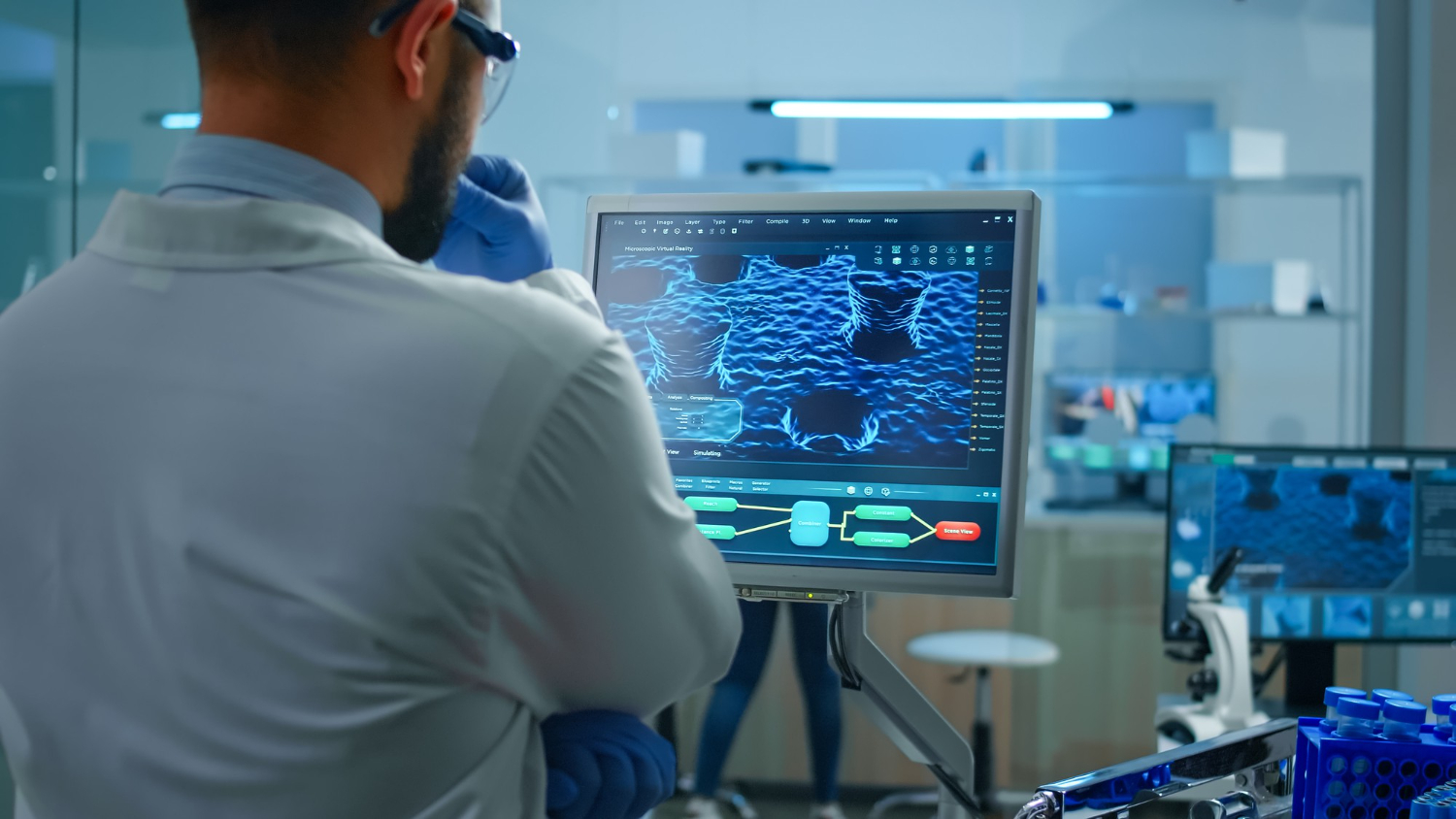
Modern automated labs generate terabytes of instrument output, yet most of it flows through brittle CSV handoffs and undocumented preprocessing scripts. The instruments are mostly the same instruments labs have had for a decade. What is different is the layer between them and the analytical decision.
A typical setup we encounter looks like this. Raw instrument output — sequencer FASTQ files, plate-reader CSVs, microscopy image stacks — lands in an object store within minutes of the run finishing. A pipeline orchestrator (Nextflow, Snakemake, or a Kubernetes-native equivalent) triggers the analytical workflow. Inside that workflow, classical bioinformatics tools handle alignment, variant calling, and quantification. AI components sit at specific QC and pattern-recognition stages: a CNN built on PyTorch or ONNX flagging anomalous plate wells, a transformer-based classifier handling sequence motif detection, a gradient-boosted model predicting whether a microscopy field is contaminated.
The AI components are not the centrepiece. They are productivity layers wrapped around the analytical steps where reviewer attention used to be the bottleneck. The pipeline writes structured metadata for every decision — model version, input hash, confidence score, reviewer override if any — into the audit log alongside the analytical result.
This is the data-engineering / AI boundary in practical terms. The data-engineering work is the orchestrator, the object store, the metadata schema, the LIMS integration. The AI work is the models themselves and the calibration regime that keeps them honest as instruments and reagents change. Conflating these two roles is a recurring source of project failure.
Why pattern recognition scales without reproducibility debt
Reproducibility determines whether a lab-AI initiative becomes infrastructure or technical debt. A pattern-recognition model that classifies a screening result becomes part of the analytical record. If the model changes — new weights, new threshold, new training data — the historical results need to either be re-callable under the model that produced them, or re-classified under the new one with a documented diff.
The labs that handle this well treat model versioning the way they treat reagent lots. Every model has a frozen version pinned to the pipeline run that used it. Re-runs against archived model versions are possible. New model versions trigger a documented re-validation against a known sample panel before they go into routine use.
The labs that handle this poorly treat the model as a black box that “improves over time.” Six months in, no one can reconstruct why a particular result was called the way it was. That is reproducibility debt, and it surfaces as a finding in any serious audit. We explore the upstream half of this problem — how pattern recognition is deployed at scale across bioinformatics pipelines — in AI for bioinformatics and modern lab automation.
Predictive analytics in pharma: earning its keep vs slide-deck claim
Predictive analytics dominates every life-sciences AI pitch deck, though implementation reality diverges sharply from the presentation. It also covers a wide range of actual capabilities, from operationally valuable to nearly meaningless.
The version that earns its keep is narrow. It uses instrument time-series data the lab already collects — pressure traces, conductivity curves, dissolved-oxygen readings, image-based plate QC scores — and predicts a specific operational event one to three shifts earlier than a human reviewer would catch it. Column fouling. Bioreactor contamination. Filter integrity drift. The success criterion is the number of avoided batch losses or the number of investigations launched before, rather than after, a deviation.
The slide-deck version forecasts trial enrolment, market uptake, or pipeline value. These forecasts can be useful for portfolio discussions but they should never be confused with operational predictive analytics. The data is too sparse, the underlying processes too socially mediated, and the feedback loops too slow. Putting both on the same dashboard tends to discredit the version that actually works.
What this means for the next platform decision
At any moment, bioinformatics leads and lab heads compare feature matrices and integration promises from two or three competing platform vendors. The vendor-neutral framing that helps most before that decision is the workflow-stage one. For every claim a vendor makes about AI capability, ask which specific analytical step it augments, what the reviewer-time saving looks like in your environment, and how the model versioning ties into your audit trail. If the answers come back at the level of “AI accelerates drug discovery,” the vendor is selling the narrative and not the workflow.
The labs that pick well are the ones that have already named the bottleneck step before the vendor conversation. That is the methodological discipline this whole space rewards. It is also the discipline behind the rest of our life-sciences AI practice.