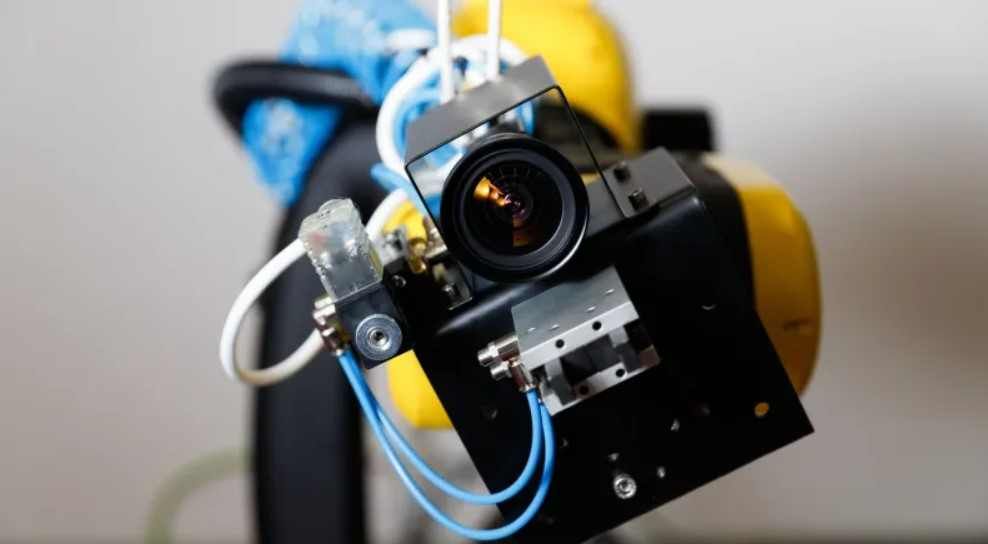
A camera looks at a part, a model decides whether it passes, an actuator pushes the failures off the line. That is automated optical inspection at its most reductive — and it is exactly the picture that gets AOI deployments into trouble. The camera-plus-model framing makes AOI sound like a procurement decision: buy the rig, train the classifier, clear an accuracy threshold on a tray of staged samples, and call it commissioned. The framing is wrong in one specific way that costs lines real money: it treats the pilot accuracy number as a release criterion, when the thing that actually determines whether an AOI line keeps working is how the model behaves against a distribution that moves the moment it goes live.
The AOI pipeline runs end to end — image capture, defect classification, reject actuation — and each stage meets the reliability conditions that arrive within weeks of go-live, not in the pilot lab. The short version: an AOI deployment that ships without drift telemetry, a rollback path, and version-pinning evidence will silently miscount its rejects long before anyone on the floor notices.
How Does Automated Optical Inspection Work, and What Does It Mean in Practice?
Manufacturing lines deploy camera-based inspection to automate defect detection, analyzing part surfaces with trained vision models instead of relying on operator scrutiny. In practice it means a fixed or line-scan camera images each part as it passes a station, a model or rule set classifies the image as pass or fail (often by defect class), and a downstream action — a reject gate, an air jet, a divert lane, an operator alert — acts on that decision in the time budget the line allows.
The “in practice” qualifier carries most of the weight. A bench demo classifies images. A production AOI station has to classify this line’s images, at this line’s cadence, under this line’s lighting, indefinitely, while the things being photographed change underneath it. The gap between those two is where the engineering lives. AOI in production is not a model; it is a model plus the instrumentation that tells you whether the model is still right.
We see the same confusion repeatedly: teams report a commissioning accuracy figure as if it were a property of the deployed system. It is a property of a snapshot — the pilot dataset, the pilot lighting, the pilot part mix — captured at one moment. The deployed system’s accuracy is a function of how far the live distribution has drifted from that snapshot, and nobody measured that because the rig didn’t ship with the means to.
What Are the Stages of an AOI Pipeline?
Each of four processing stages—acquisition, enhancement, classification, routing—introduces distinct modes of breakdown. Naming them separately matters because the reliability requirements attach to specific stages, not to “the AOI system” as an undifferentiated whole.
Image capture. Cameras, lenses, lighting, and triggering. The capture stage decides what the model ever gets to see. Lighting geometry, exposure, and focus are fixed at commissioning and then drift — bulbs age, ambient light leaks in across a shift, vibration shifts focus. A capture stage that produces subtly different images than the pilot did has already changed the model’s input distribution before the model does anything.
Preprocessing and registration. Cropping to the region of interest, normalising, aligning the part to a reference frame. On a PCB this is fiducial alignment; on a moving conveyor it is deskew and segmentation. Registration errors don’t look like defects — they look like novel parts, which the model handles unpredictably.
Defect classification. The model — increasingly a convolutional or transformer-based classifier or segmentation network trained in PyTorch or TensorFlow, exported to an inference runtime like TensorRT or ONNX Runtime for line-side latency. This is the stage everyone means when they say “the AOI model,” and it is the stage whose accuracy gets quoted. It is also the stage most sensitive to upstream drift: a classifier is only as good as the consistency of the images reaching it.
Reject actuation. Translating a classification into a physical action within the cycle-time budget. A reject decision that arrives 40 ms too late misses the gate (illustrative timing threshold). Actuation failure is rarely a model problem and almost always a systems problem — PLC integration, timing, mechanical reliability of the divert hardware.
The reason this decomposition matters: when an AOI line’s rejection rate starts wandering, the instinct is to retrain the classifier. But the cause is frequently in capture or registration, and retraining the model against drifted inputs just teaches it the drift. The four-stage view is what lets you locate the fault rather than paper over it.
Why Does Pilot Accuracy Fail as a Release Criterion for a Line-Side AOI Model?
Commissioning trials measure accuracy under controlled circumstances; production shifts lighting, fixturing, and part variation in ways that erode initial performance. Those two facts are in direct tension, and the release criterion is exactly where they collide.
A pilot accuracy figure — say, “99.2% on the validation set” — is measured against a held-out sample drawn from the same distribution the model was trained on. It tells you the model learned the pilot data. It tells you nothing about how the model performs when the part mix changes, when a packaging supplier switches to a slightly different substrate, or when the third-shift lighting differs from the day the pilot data was collected. The honest statement is that pilot accuracy bounds the best case and says nothing about the trajectory.
The expert release criterion is not a number; it is a set of artefacts. Can you detect when the live distribution has moved away from the pilot distribution? Can you roll back to a known-good model version when it has? Can you prove which model version produced which reject decisions? Those questions — drift telemetry, a rollback path, version-pinning evidence — are what separate a releasable line-side model from a pilot that happened to score well. This is the same release-criterion divergence we describe in the engineering discipline that catches AI failures before customers do: the pass/fail line is drawn against sustained behaviour, not a snapshot.
What Real-World Conditions Cause AOI Accuracy to Degrade After Go-Live?
Model drift accelerates when ambient conditions, supplier lots, or line speeds change in patterns absent from the validation dataset. In our experience commissioning industrial vision (an observed pattern across engagements, not a benchmarked rate), the first meaningful drift event lands within weeks of go-live, not quarters.
- Lighting drift. LED arrays dim non-uniformly, ambient light changes across shifts and seasons, reflective surfaces behave differently as parts get oilier or dustier. The model’s input statistics shift even though the parts are nominally identical.
- Packaging and substrate redesigns. A supplier changes a label stock, a solder mask shade, a tray colour. To the line it is the same part; to the classifier it is a new distribution.
- Conveyor variance. Speed jitter, vibration, part presentation angle. These corrupt registration before they ever reach the classifier, producing inputs the model was never trained on.
- Operator-introduced novelty. A new SKU runs without anyone retraining, a fixture gets adjusted, a manual rework station feeds reworked parts back onto the line.
None of these are exotic. They are the normal life of a production line. The point is that each of them changes the distribution the AOI model sees, and a model with no telemetry has no way to tell you it is now operating outside its training envelope. It will keep emitting confident pass/fail decisions against inputs it has no basis to judge. The structural shape of this is the compound-failure mode we cover in the CV-specific failure framing behind these reliability requirements — small upstream shifts that combine into a rejection-rate error no single stage owns.
How Is AOI Rejection-Rate Accuracy Measured and Monitored Once the Line Is Live?
Measure what escapes inspection and what gets wrongly rejected, comparing both to manual verification across production runs—these rates matter more than any lab benchmark. A line that monitors these measures its true rejection rate; a line that doesn’t is working from a drifting estimate it mistakes for a fixed fact.
You cannot measure escape rate from the AOI system alone — the whole point of an escape is that AOI passed it. So the monitoring loop needs a ground-truth source: a sampled manual audit, a downstream functional test, a customer-return signal. The drift telemetry then compares the model’s live behaviour and input statistics against the pilot baseline and raises a signal when they diverge, which is the same mechanism we detail in model drift detection signals, thresholds, and telemetry. The combination — input-distribution monitoring plus a periodic ground-truth audit — is what converts “the model works” into a number you can defend.
This is also where the production AI reliability discipline becomes concrete on a line: the telemetry, the rollback path, and the version-pinning evidence are not optional add-ons but the instruments that make the rejection rate trustworthy.
Decision Surface: What Distinguishes a Releasable AOI Line from a Pilot
| Capability | Pilot-grade (snapshot) | Production-grade (sustained) | Why it matters |
|---|---|---|---|
| Accuracy claim | Single validation-set figure | Tracked false-reject + escape rate over time | Catches drift before it becomes scrap or returns |
| Drift detection | None | Input-distribution telemetry vs. baseline | Tells you the model is outside its training envelope |
| Ground truth | Pilot labels only | Periodic manual audit / downstream test | Escapes are invisible to AOI itself |
| Rollback | Redeploy from scratch | Pinned known-good version, hours to revert | Recover from a drift incident in hours, not days |
| Version evidence | Ad hoc | Which model version produced which decision | Lets you trace a quality incident to a cause |
The right column is the difference between recovering from a drift incident in hours and reverting the whole station to manual inspection — which, without the supporting artefacts, is the typical outcome within a quarter of go-live (observed across engagements; not a published benchmark).
What Has to Be in Place for an AOI Deployment to Survive a Line Refresh?
Product redesigns, assembly changes, and component substitutions create the harshest operating conditions, revealing whether the inspection logic generalizes or breaks. Surviving it requires three things to already exist before the refresh happens:
Drift telemetry so the refresh registers as a distribution shift the moment it lands, rather than as a slow accumulation of mislabelled rejects nobody attributes to the change. A rollback path so that if the refreshed line breaks the model, you revert to the known-good version in hours and keep inspecting while you retrain. And version-pinning evidence so that when quality asks “which model judged this batch,” there is a traceable answer.
A deployment that has all three treats a line refresh as a planned event with a recovery procedure. A deployment without them treats it as an unplanned outage, and the unplanned outage is usually what triggers the reversion to manual inspection. The artefacts are cheap to build during commissioning and expensive to retrofit after the first incident.
How Does AOI Differ Across PCB, SMT, and Semiconductor Inspection?
Capture, process, infer, act—every system follows this flow, but electronics assembly and fabric inspection parameterize each step entirely differently.
PCB and SMT assembly inspection is the classic AOI case — checking component presence, placement, polarity, and solder joints against a known board layout. Registration uses fiducials; the reference is the CAD or gerber definition, which means “defect” is well-defined relative to a design. We go deeper on this in how AOI works and stays reliable on PCB lines, where the design-reference makes drift detection comparatively tractable.
Semiconductor inspection operates at far smaller scales, often catching die-level and wafer-level defects where the feature size pushes optical resolution to its limits and the defect classes are subtler. The classification stage carries more of the burden, and the line between a real defect and a nuisance variation is harder to draw.
In both, the reliability requirements are identical even though the imaging physics differs — the model still degrades against a moving distribution, and the release criterion is still telemetry plus rollback plus version evidence rather than a pilot number.
How Does AOI Compare to Automated X-ray Inspection (AXI)?
Camera-based systems inspect exposed surfaces; X-ray modalities reveal subsurface features like solder joint voids and hidden cracks. That single distinction governs when a line needs one, the other, or both.
| Dimension | Automated Optical Inspection (AOI) | Automated X-ray Inspection (AXI) |
|---|---|---|
| What it sees | Surface features — placement, polarity, visible solder, cosmetic defects | Internal and hidden features — voids, BGA joints under packages, internal cracks |
| Best for | High-volume surface defect screening, component presence | Hidden joints, multi-layer assemblies, internal structure |
| Speed / cost | Faster, lower cost per part | Slower, higher cost, radiation handling |
| Typical role | First-line screening on most lines | Targeted inspection where AOI cannot see |
A line that only needs to verify what is visible — placement, polarity, surface solder — runs AOI alone. A line with ball-grid arrays or stacked packages, where the critical joints are physically hidden, needs AXI for those features because AOI optically cannot reach them. Most assembly lines run AOI as the high-throughput screen and reserve AXI for the subset of joints that demand it. The two are complementary far more often than they are alternatives.
FAQ
How does automated optical inspection work, and what does it mean in practice?
AOI images each part with a camera, classifies it as pass or fail with a model or rule set, and acts on that decision with a downstream reject mechanism. In practice it means doing this at line cadence, under line lighting, indefinitely, while the parts being photographed change — so a production AOI system is a model plus the instrumentation that tells you whether the model is still right, not a model alone.
What are the stages of an AOI pipeline, from image capture to defect classification to reject actuation?
The pipeline has four stages: image capture (cameras, lenses, lighting, triggering), preprocessing and registration (aligning the part to a reference frame), defect classification (the model itself), and reject actuation (acting within the cycle-time budget). Each stage has its own failure surface, which is why a wandering rejection rate is often a capture or registration fault rather than a model fault.
Why does pilot accuracy fail as a release criterion for a line-side AOI model?
Pilot accuracy is measured against a held-out sample from the training distribution, so it bounds the best case and says nothing about how the model behaves as the live distribution moves. The defensible release criterion is a set of artefacts — drift telemetry, a rollback path, and version-pinning evidence — not a single accuracy number.
What real-world conditions cause AOI accuracy to degrade after go-live?
Lighting drift, packaging and substrate redesigns, conveyor variance, and operator-introduced novelty all shift the input distribution the model sees, often within weeks of go-live. A model without telemetry cannot tell you it is now operating outside its training envelope and will keep emitting confident decisions against inputs it has no basis to judge.
How is AOI rejection-rate accuracy measured and monitored once the line is live?
The relevant measures are the live false-reject rate and escape rate, tracked against a ground-truth source — a sampled manual audit, a downstream functional test, or a customer-return signal — since escapes are by definition invisible to AOI itself. Input-distribution telemetry compared against the pilot baseline raises a signal when the two diverge.
What has to be in place for an AOI deployment to survive a line refresh instead of reverting to manual inspection?
Three artefacts must already exist before the refresh: drift telemetry so the change registers as a distribution shift, a rollback path so a broken model can revert to a known-good version in hours, and version-pinning evidence so quality can trace which model judged which batch. Without them, the unplanned outage a refresh causes typically triggers reversion to manual inspection within a quarter.
How does AOI apply to specific domains like PCB and SMT assembly versus semiconductor inspection, and does the inspection pipeline differ across them?
The four-stage pipeline is the same, but each stage’s content differs: PCB and SMT inspection checks placement, polarity, and solder against a CAD reference using fiducial registration, while semiconductor inspection works at die and wafer scale where feature size pushes optical resolution to its limits. The reliability requirements are identical across both — the model still degrades against a moving distribution.
How does AOI compare to automated X-ray inspection (AXI), and when does a line need X-ray inspection alongside or instead of optical inspection?
AOI sees surface features; AXI sees internal and hidden ones like voids and joints under ball-grid arrays. A line that only verifies visible features runs AOI alone, while a line with hidden joints needs AXI for those features — most lines run AOI as the high-throughput screen and reserve AXI for the subset of joints that demand it.
Building Confidence Around Line-Specific Deployment
Operational resilience depends on embedded drift monitoring that triggers recalibration alerts and workflow designs that permit model updates during shift transitions. The failure class to name in any AOI release review is a line-side model degrading silently against a moving distribution with no telemetry to catch it — and the industrial-CV validation lens is what turns “the model works in the pilot” into “the line-side model is releasable.”