
CASE STUDY
Multi-Target Multi-Camera Tracking
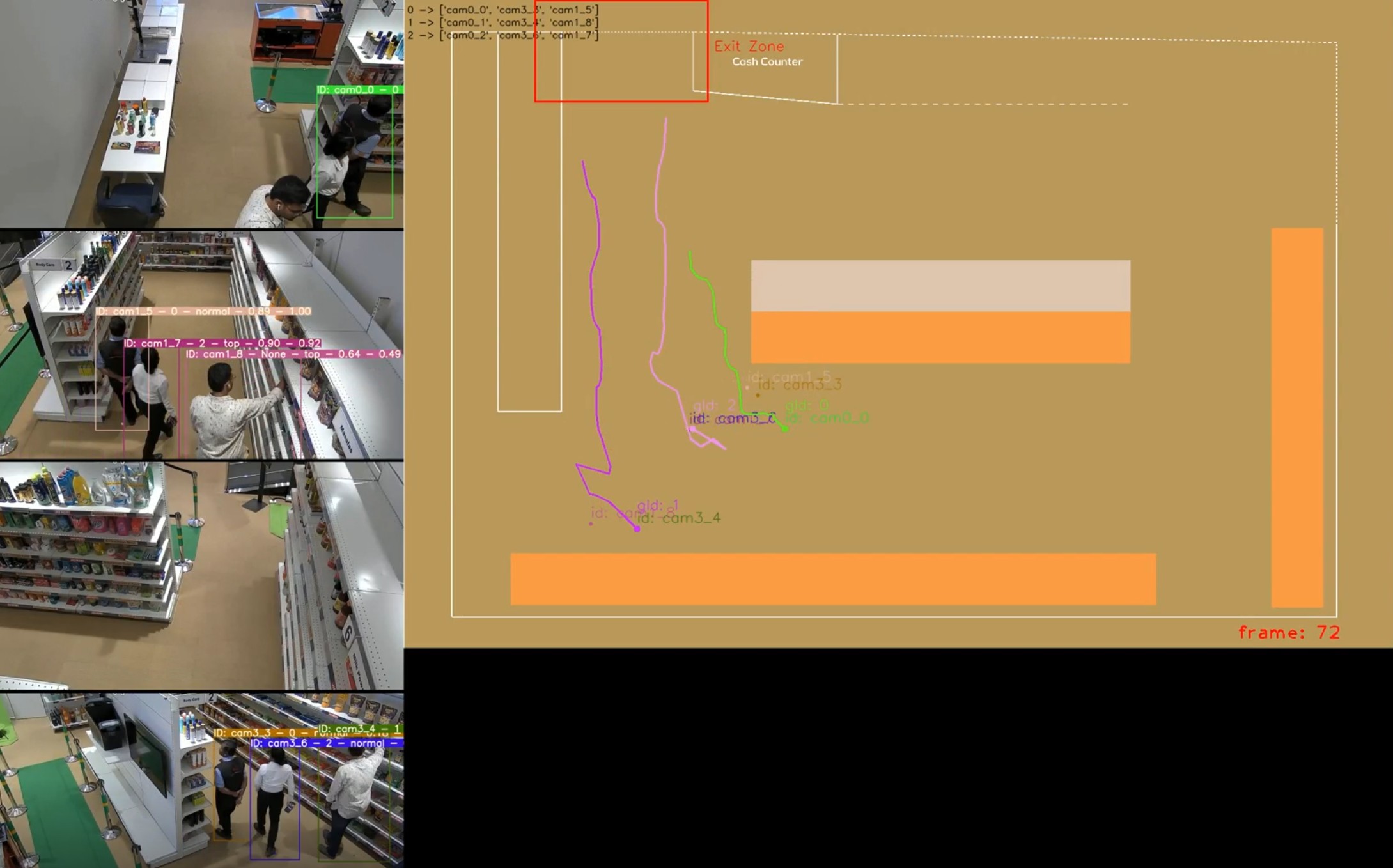
TechnoLynx built a cost-efficient, AI-powered tracking system for a multinational startup building autonomous shopping cart technology. The system used the client's existing CCTV infrastructure to track multiple targets in real time across non-overlapping cameras with consistent local and global IDs.
The Challenge
A multinational startup wanted a cost-efficient tracking system built on their existing CCTV-style camera infrastructure. The solution needed to track multiple targets (objects and people) within a monitored area, both within a single camera view and across multiple cameras. The challenge increased significantly when camera views didn’t overlap: the system had to keep tracking when a target disappeared from one camera and only reappeared later in another.
Work with existing CCTV infrastructure.
The system had to be accurate and real-world ready without relying on additional cameras. In a retail store, camera placement is constrained by store layout — blind spots in aisle coverage mean targets can pass between camera zones with no visual coverage.
Handle non-overlapping camera views.
Targets can leave one camera and remain unseen before entering another, creating gaps in continuous tracking.
Keep identity consistent across cameras.
Track many targets at once while preventing misassociation, especially during transitions between camera views.
Support low-cost edge and scalable deployments.
The client needed an edge version for low-cost hardware and a higher-performance option for store-scale operation — both had to handle the TensorRT multithreading constraints that arise when tracking many simultaneous targets across a camera network.
Project Timeline
From single-camera tracking to reliable multi-camera identity across non-overlapping views
Problem Framing
Defined the goal: track multiple targets within and across CCTV camera feeds in a cost-effective way.
Implemented real-time target detection and single-camera tracking, learning movement patterns to improve tracking.
Detection + Single-Camera Tracking
Non-Overlap Prediction
Built a probabilistic model to predict trajectories and estimate where targets are likely to appear next when cameras don’t overlap.
Introduced local IDs per camera and a global ID across the system, tuning association logic to reduce mis-matches with many simultaneous targets. The identity pipeline was hardened to survive TensorRT multithreading constraints under concurrent multi-target load.
Multi-Camera Identity
Edge + HPC Delivery & Demos
Delivered an edge version for low-cost hardware (e.g., Raspberry Pi) and an HPC-backed version for larger deployments, supporting real-world demonstrations.
The Solution
We designed an AI-powered multi-camera tracking system that works within existing CCTV infrastructure and remains cost-efficient. It detects and tracks multiple targets in real time, assigns local and global identities, and uses probabilistic prediction to bridge gaps when camera views don’t overlap.
Probabilistic Prediction
A higher-level probabilistic model predicts paths and trajectories to estimate where a target will appear next, maintaining continuity across non-overlapping views.
Detection + Tracking
Integrated object detection for real-time identification, then tracked targets through each camera’s view using learned movement patterns.
Edge + HPC Versions
Delivered both an edge deployment for low-cost devices (e.g., Raspberry Pi) and a more powerful HPC-backed version for higher resolution and larger camera fleets.
Technical Specifications
Frameworks
PyTorch, TensorRT, OpenCV, NumPy + custom code
Identity Model
Local ID per camera + global ID across the full system
Non-Overlap Handling
Probabilistic trajectory prediction to bridge gaps between cameras
Edge
Designed for low-cost hardware (e.g., Raspberry Pi)
HPC
Higher-resolution, larger-scale tracking for many-camera environments
The Outcome
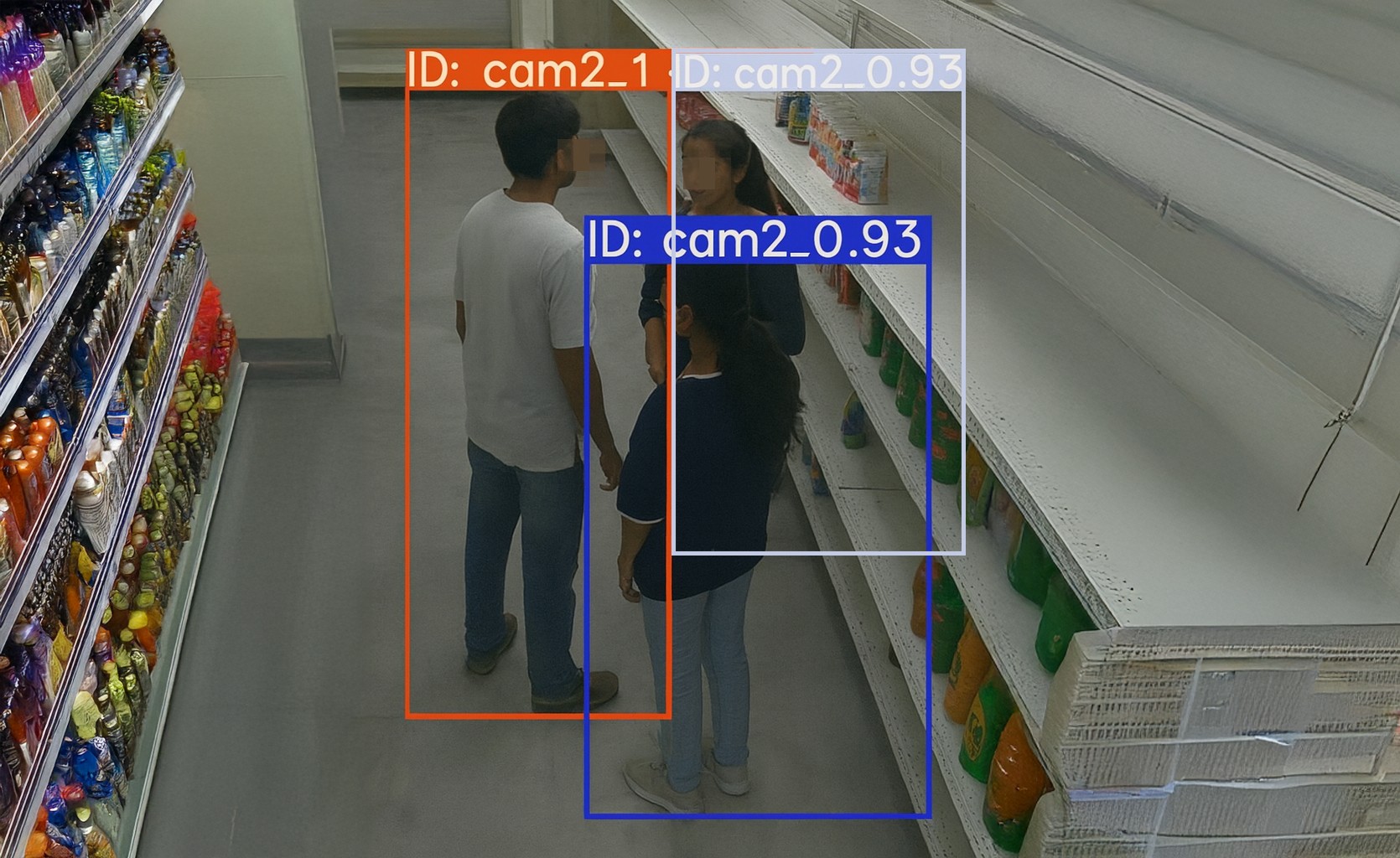
The system reached acceptable accuracy across the client's tracking objectives. The probabilistic model bridged non-overlapping camera gaps at a level sufficient for real-world use, and the local plus global ID pipeline maintained identity continuity across camera transitions. Successful real-world demonstrations helped the client showcase the technology to potential partners and customers. The system was cost-efficient: it used the client's existing CCTV infrastructure without requiring additional cameras, and could be deployed on both low-cost edge hardware (Raspberry Pi) and higher-performance environments.
Key Achievements
Multi-target tracking within and across multiple cameras in real time
Probabilistic prediction to maintain tracking across non-overlapping camera views
Local + global ID system to preserve identity across the camera network
Delivered both edge (low-cost) and HPC-backed versions for different operational scales
Supported real-world demonstrations so the client could prove the system’s functionality to potential customers, impressing stakeholders.
Part of a broader smart retail technology engagement.
Our Technological Capabilities
Computer Vision Services
Our services feature expertise in classical computer vision, human-supervised system design for legal compliance, video pipeline optimisation with tools like FFmpeg, custom adaptable models, and explainable AI for ethical transparency.


Generative AI
We are leaders in generative AI, offering optimised inference for faster deployments, ethical AI systems with bias mitigation, intelligent automation for adaptive workflows, and advanced simulation and prototyping capabilities.

GPU Performance Engineering
We deliver immersive XR solutions with cross-platform development (Unity 6), GPU performance optimisation, and expertise in NVIDIA Omniverse and CloudXR. We also use reinforcement learning for intelligent XR environments.

Building a Tracking System on Existing Cameras?
Let’s discuss how multi-camera tracking, predictive modelling, and practical CV pipelines can help you scale monitoring without expensive infrastructure changes.