
Growth in Businesses through Custom Software Development

Find out how custom development services by TechnoLynx are here to consolidate processes, optimise productivity, and propel the business growth.

Growth in Businesses through Custom Software Development
Written by TechnoLynx Published on 14 Feb 2024

Nowadays, the business world is highly dynamic. Successful companies are the winners of the implementation of custom-made solutions that are always perfectly consistent with their daily growing needs. Custom software development becomes a potent agent for business growth since custom-made systems provide an unequalled degree of flexibility, scalability, and efficiency.

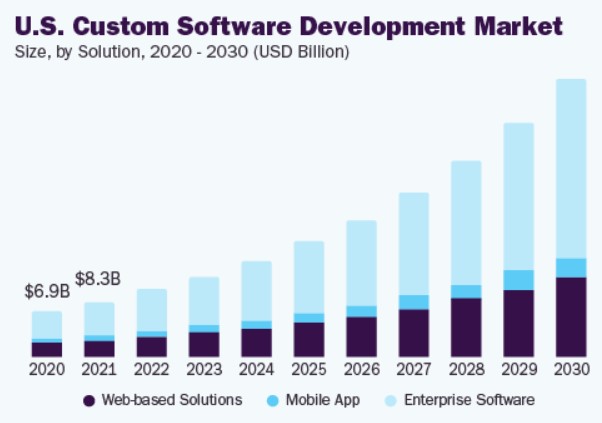
The custom software development market, valued at USD 29.29 billion in 2022, is expected to grow at a CAGR of 22.4% from 2023 to 2030 (skill-mine.com). Tailored to specific needs, it meets demands for real-time data analysis, flexible workspaces, and low code platforms.

At TechnoLynx, we build custom applications that specifically solve the issues that you face and help your business achieve greater heights. Our much-experienced developers bring the combination of technological prowess and knowledge of the industry to design high-end solutions customised to the particular needs of your business.

From streamlining internal processes to enhancing customer experiences, custom applications offer limitless possibilities. With TechnoLynx at your service, you can achieve full capacity with custom development to achieve process excellence, efficiency, and spot market trends. Collaborate with TechnoLynx on creating on-demand applications that yield measurable results and catapult your business to new levels. Join us and transform your vision into reality!

Image credit: GrandViewResearch

What Is MLOps and Why Do Organizations Need It

What Is MLOps and Why Do Organizations Need It

8/05/2026

MLOps solves the model deployment and maintenance problem. What it is, what problems it addresses, and when an organization actually needs it versus when.

MLOps Tools Stack: Experiment Tracking, Registries, Orchestration, and Serving

MLOps Tools Stack: Experiment Tracking, Registries, Orchestration, and Serving

8/05/2026

MLOps tools span experiment tracking, model registries, pipeline orchestration, and serving. How to choose what you need without over-engineering the.

MLOps Pipeline: Components, Failure Points, and CI/CD Differences

MLOps Pipeline: Components, Failure Points, and CI/CD Differences

8/05/2026

An MLOps pipeline covers data ingestion through monitoring. How each stage differs from software CI/CD, where pipelines fail, and what each stage requires.

MLOps Infrastructure: What You Actually Need and When

MLOps Infrastructure: What You Actually Need and When

8/05/2026

MLOps infrastructure spans compute, storage, orchestration, and monitoring. What each component is for and when it's necessary versus premature overhead.

MLOps Architecture: Batch Retraining vs Online Learning vs Triggered Pipelines

MLOps Architecture: Batch Retraining vs Online Learning vs Triggered Pipelines

7/05/2026

MLOps architecture choices—batch retraining, online learning, triggered pipelines—determine model freshness and operational cost. When each pattern is.

Hiring AI Talent: Role Definitions, Interview Gaps, and What Actually Predicts Success

Hiring AI Talent: Role Definitions, Interview Gaps, and What Actually Predicts Success

7/05/2026

Hiring AI talent requires distinguishing ML engineer, data scientist, AI researcher, and MLOps engineer roles. What interviews miss and what actually.

Enterprise AI Failure Rate: Why Most Projects Don't Reach Production

Enterprise AI Failure Rate: Why Most Projects Don't Reach Production

7/05/2026

Most enterprise AI projects fail before production. The causes are structural, not technical. Understanding failure patterns before starting a project.

Data Science Team Structure for AI Projects

Data Science Team Structure for AI Projects

7/05/2026

Data science team structure depends on project scale and maturity. Roles needed, common gaps, and when a team of 2 is enough vs when you need 8.

AI Strategy Consulting: What a Useful Engagement Delivers and What to Watch For

AI Strategy Consulting: What a Useful Engagement Delivers and What to Watch For

6/05/2026

AI strategy consulting ranges from genuine capability assessment to repackaged hype. What a useful engagement delivers, and the signals that distinguish.

AI POC Design: What Success Criteria to Define Before You Start

AI POC Design: What Success Criteria to Define Before You Start

6/05/2026

AI POC success requires pre-defined business criteria, not model accuracy. How to scope a 6-week AI proof of concept that produces a real go/no-go.

Talent Intelligence: What AI Actually Does Beyond Resume Screening

Talent Intelligence: What AI Actually Does Beyond Resume Screening

5/05/2026

Talent intelligence uses ML to map skills, predict attrition, and identify internal mobility — but only with sufficient longitudinal employee data.

Enterprise AI Search: Why Retrieval Architecture Matters More Than Model Choice

Enterprise AI Search: Why Retrieval Architecture Matters More Than Model Choice

5/05/2026

Enterprise AI search quality depends on chunking and retrieval design more than on the LLM. Poor retrieval with a strong LLM yields confident wrong answers.

Choosing an AI Agent Development Partner: What to Evaluate Beyond Demo Quality

5/05/2026

Most AI agent demos work on curated inputs. Production viability requires error handling, fallback chains, and observability that demos never test.

AI Consulting for Small Businesses: What's Realistic, What's Not, and Where to Start

5/05/2026

AI consulting for SMBs starts with data audit and process mapping — not model selection — because most failures stem from weak data infrastructure.

MLOps Consulting: When to Engage, What to Expect, and How to Avoid Dependency

5/05/2026

MLOps consulting should transfer capability, not create dependency. The exit criteria matter more than the entry scope.

Engineering Task vs Research Question: Why the Distinction Determines AI Project Success

27/04/2026

Engineering tasks have known solutions and predictable timelines. Research questions have uncertain outcomes. Conflating the two causes project failure.

MLOps for Organisations That Have Never Operationalised a Model

27/04/2026

MLOps keeps AI models working after deployment. Start with monitoring, versioning, and retraining pipelines — not full platform adoption.

Internal AI Team vs AI Consultants: A Decision Framework for Build or Hire

26/04/2026

Build internal teams for sustained advantage. Hire consultants for speed, specialisation, and knowledge transfer. Most organisations need both.

How to Assess Enterprise AI Readiness — and What to Do When You Are Not Ready

26/04/2026

AI readiness is about data infrastructure, organisational capability, and governance maturity — not technology. Assess all three before committing.

How a Structured AI Consulting Engagement Works

25/04/2026

A structured AI engagement moves through assessment, POC, production build, and handoff — with decision gates, not open-ended retainers.

What an AI POC Should Actually Prove — and the Four Sections Every POC Report Needs

24/04/2026

An AI POC should prove feasibility, not capability. It needs four sections: structure, success criteria, ROI measurement, and packageable value.

What to Look for When Evaluating AI Consulting Firms

23/04/2026

Evaluate AI consultancies on technical depth, delivery evidence, and knowledge transfer — not on slide decks, partnership badges, or client logo walls.

Why Most Enterprise AI Projects Fail — and How to Predict Which Ones Will

22/04/2026

Enterprise AI projects fail at 60–80% rates. Failures cluster around data readiness, unclear success criteria, and integration underestimation.

How to Evaluate GenAI Use Case Feasibility Before You Build

20/04/2026

Most GenAI use cases fail at feasibility, not implementation. Assess data, accuracy tolerance, and integration complexity before building.

CUDA vs OpenCL: Which to Use for GPU Programming

16/03/2026

CUDA and OpenCL compared for GPU programming: programming models, memory management, tooling, ecosystem fit, portability trade-offs, and a practical decision framework.

Case Study: CloudRF  Signal Propagation and Tower Optimisation

15/05/2025

See how TechnoLynx helped CloudRF speed up signal propagation and tower placement simulations with GPU acceleration, custom algorithms, and cross-platform support. Faster, smarter radio frequency planning made simple.

The Growing Need for Video Pipeline Optimisation

10/04/2025

Video pipeline optimisation: how encoding, transmission, and decoding decisions determine real-time computer vision latency and processing throughput at scale.

Smarter and More Accurate AI: Why Businesses Turn to HITL

27/03/2025

Human-in-the-loop AI: how to design review queues that maintain throughput while keeping humans in control of low-confidence and edge-case decisions.

MLOps vs LLMOps: Let’s simplify things

25/11/2024

MLOps and LLMOps compared: why LLM deployment requires different tooling for prompt management, evaluation pipelines, and model drift than classical ML workflows.

What is AI Consulting?

24/05/2024

Discover the benefits of AI Consulting and how it can transform your business strategy.

Introduction to MLOps

4/04/2024

What MLOps is, why organisations fail to move models from training to production, and the tooling and processes that close the gap between experimentation and deployed systems.

Case-Study: Text-to-Speech Inference Optimisation on Edge (Under NDA)

12/03/2024

See how our team applied a case study approach to build a real-time Kazakh text-to-speech solution using ONNX, deep learning, and different optimisation methods.

Case-Study: V-Nova - GPU Porting from OpenCL to Metal

15/12/2023

Case study on moving a GPU application from OpenCL to Metal for our client V-Nova. Boosts performance, adds support for real-time apps, VR, and machine learning on Apple M1/M2 chips.

Case-Study: Action Recognition for Security (Under NDA)

11/01/2023

How TechnoLynx built a hybrid action recognition system for a smart retail environment — detecting suspicious behaviour in real time using transfer learning and a rules-based approach on cost-effective CCTV.

Case-Study: V-Nova - Metal-Based Pixel Processing for Video Decoder

15/12/2022

TechnoLynx improved V-Nova’s video decoder with GPU-based pixel processing, Metal shaders, and efficient image handling for high-quality colour images across Apple devices.

Consulting: AI for Personal Training Case Study - Kineon

2/11/2022

TechnoLynx partnered with Kineon to design an AI-powered personal training concept, combining biosensors, machine learning, and personalised workouts to support fitness goals and personal training certification paths.

Case-Study: A Generative Approach to Anomaly Detection (Under NDA)

22/05/2022

How TechnoLynx built an unsupervised anomaly detection system using generative models — combining variational autoencoders, adversarial training, and custom diffusion models to detect data drift without labelled anomaly examples.

Case Study: Accelerating Cryptocurrency Mining (Under NDA)

29/12/2020

Our client had a vision to analyse and engage with the most disruptive ideas in the crypto-currency domain. Read more to see our solution for this mission!

Case Study - AI-Generated Dental Simulation

10/11/2020

Our client, Tasty Tech, was an organically growing start-up with a first-generation product in the dental space, and their product-market fit was validated. Read more.

Case Study - Fraud Detector Audit (Under NDA)

17/09/2020

Discover how a robust fraud detection system combines traditional methods with advanced machine learning to detect various forms of fraud!

Case Study - Accelerating Physics -Simulation Using GPUs (Under NDA)

23/01/2020

TechnoLynx used GPU acceleration to improve physics simulations for an SME, leveraging dedicated graphics cards, advanced algorithms, and real-time processing to deliver high-performance solutions, opening up new applications and future development potential.

Back See Blogs
arrow icon