Introduction
Cutting-edge AI—LLMs, multi-modal foundation models, retrieval-augmented systems, agentic stacks—encounters MLOps at the same deployment boundary as any model class, with adjustments for GPU memory, prompt versioning, corpus refresh cycles, and tool dependencies rather than fundamentally different workflows. The intersection is the engineering practice that lets cutting-edge AI ship rather than sit in a research environment. See services for the broader engagement framing this applied example lives inside.
The naive read is that cutting-edge AI requires a fundamentally different MLOps practice. The expert read is that the discipline is the same and the model-class-specific adjustments are bounded — LLM inference adds GPU memory and prompt management to the standard concerns; foundation models add weight-distribution and fine-tuning lineage; the rest is the workflow every team should already have for any production model.
What this means in practice
- The MLOps workflow is constant across model classes; the model-class adjustments are bounded.
- LLM operations adds prompt-template versioning, GPU memory management, and retrieval-corpus refresh to the standard stack.
- Foundation CV models add weight-version lineage and fine-tuning provenance to the standard stack.
- The deployment-boundary discipline is what makes cutting-edge AI ship; cutting-edge model class without the discipline stays in research.
What does MLOps actually mean for an organisation that has never operationalised a model?
First deployments of foundation models require identical core workflows with explicit model-class accommodations. The organisation needs a deployment target that supports the model class (GPU-backed serving for LLMs and foundation models, retrieval infrastructure for RAG systems, tool-execution sandboxes for agent stacks), a reproducible packaging story that includes the model weights or the API client and the prompt or pipeline artifacts that define the system’s behaviour, monitoring that captures both operational metrics and behavioural metrics (output quality, hallucination signals, tool-use patterns), and a registry that knows which model + prompt + retrieval corpus + tool set is currently serving production traffic.
The contribution to the cutting-edge AI application: without this discipline the application either uses a third-party API with no observability or runs a foundation model the team cannot reliably reproduce or roll back. With the discipline the cutting-edge AI application has the same production posture as any other system — versioned, monitored, recoverable.
Which MLOps capabilities (CI/CD for models, monitoring, retraining, registry) does a first project genuinely need, and which are overengineering?
Four standard capabilities plus class-specific extensions form the baseline. Packaging and deployment: container packaging plus a GPU-backed serving target (managed LLM serving, KServe with GPU pools, or a vendor inference API behind a stable interface). Monitoring: operational metrics plus behavioural metrics (response latency including tokens-per-second for LLMs, output quality samples evaluated against criteria, hallucination or tool-error signals where applicable). Retraining or refresh: prompt updates and retrieval-corpus refresh are the high-frequency “retraining” for LLM systems; full model fine-tuning is lower-frequency. Registry: model weights or API version plus prompt-template version plus retrieval-corpus version plus tool-set version — the registry’s identity composition is what makes rollback meaningful.
Overengineering: full agentic orchestration platforms when a single chained LLM call serves the use case; complex evaluation harnesses with multiple grader models when sampled human review serves the first deployment; multi-region GPU serving with sub-region failover when single-region serves the SLA. The pattern is unchanged: ship the smallest capability set, add when a specific deployment blocks on a missing piece.
Which MLOps tools and frameworks are realistic for a first deployment, and which assume mature data engineering already in place?
2026 timelines demand pragmatic scope definitions for initial foundation model deployments. For LLM serving: vendor APIs (OpenAI, Anthropic, Google) behind a stable interface for teams accepting third-party dependency; self-hosted serving (vLLM, TensorRT-LLM, TGI) for teams with the GPU and operations capacity. For foundation CV models: managed serving where available; self-hosted serving on Triton, KServe, or BentoML where customisation is needed. For RAG: vector databases (pgvector for teams already on Postgres, Pinecone or Weaviate for managed, Qdrant or Milvus for self-hosted). For agent stacks: LangChain or LlamaIndex for first deployments; custom orchestration when the abstractions impose a tax.
Assume mature data engineering. Production-grade evaluation pipelines for LLM output quality (LM-as-judge harnesses, automated grading with statistical confidence) assume the team can run the evaluation infrastructure. Fine-tuning at scale (preference learning, RLHF, custom training stacks) assumes ML platform capacity beyond first-deployment scope. Multi-tenant prompt management with rollback by tenant assumes a platform team. First deployments use the vendor or open-source defaults; the platform-grade tooling earns its place when the deployments grow into it.
What is the smallest viable MLOps stack that still produces a production-quality deployment?
Start with container orchestration, version control for prompts and corpora, GPU-aware monitoring, and rollback mechanisms. One serving target appropriate to the model class (vendor API or self-hosted GPU serving). One observability stack capturing operational metrics, response latency including tokens-per-second, sampled output quality, and class-specific signals (tool errors, retrieval misses, hallucination flags). One registry holding the composed identity (model + prompt + retrieval corpus + tools). One CI/CD pipeline that bundles the composed artifact, runs evaluation against a frozen test set, and promotes on pass. One rollback path that returns to the previous composed identity in seconds.
The composition is the difference from classical MLOps. A model-only registry rolls back the model; a composed-identity registry rolls back the system the user experiences. For cutting-edge AI where the user-perceived behaviour comes from the composition rather than the model alone, the registry’s composition discipline is what makes production-quality rollback possible.
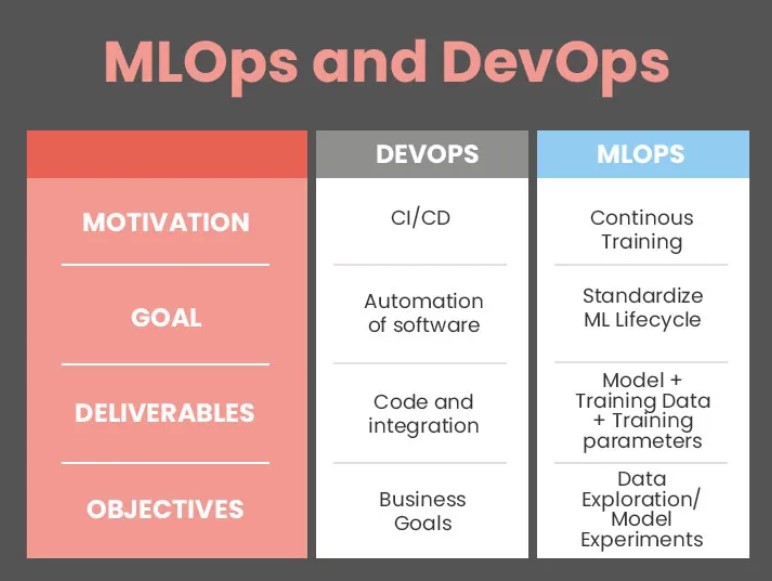
How does MLOps differ from DevOps in the data-pipeline, drift, and rollback dimensions?
Foundation models amplify every distinction between traditional DevOps and ML operations. Data-pipeline dimension: retrieval corpora and prompt templates are the cutting-edge AI analogue of the training-data dependency — the deployment’s effective behaviour depends on the retrieval corpus and prompt set in addition to the model weights, and reproducing a deployment requires reproducing all three. Drift dimension: prompt drift (a team edits a prompt template and the system’s effective behaviour shifts), retrieval-corpus drift (the corpus grows or rotates and the system retrieves different context), and upstream model-version drift (the vendor changes the model behind the API) all produce behavioural drift that DevOps does not consider.
Rollback dimension: rollback requires returning to the previous composed identity (model version + prompt version + retrieval-corpus snapshot + tool set), which means the registry must store all four with the relationships between them. DevOps’ “redeploy the previous container” does not capture this composition; MLOps for cutting-edge AI must. The three differences are amplified at the cutting edge but the structure is the same — model-specific concerns layered onto DevOps, made explicit by the workflow.
Why do most ML models never reach production, and which MLOps gaps cause that?
Underestimating operational complexity—not algorithmic difficulty—kills most foundation model deployments before launch. The demo runs against a curated prompt and a small retrieval corpus; the production system needs versioned prompts, refreshed retrieval at production scale, and monitoring that catches behavioural drift. The MLOps gaps that cause this: no composed-identity registry (the team cannot tell which prompt + model + corpus is serving), no behavioural monitoring (the team cannot detect that the system degraded), no evaluation pipeline (every change is shipped on hope), no rollback discipline (a bad change has no fast revert path).
The pattern is the same as the classical-ML case: the gap is at the boundary between the model team (or prompt engineering team, or AI team) and the application team. The MLOps discipline that bridges the boundary is the discipline that ships. Cutting-edge AI raises the visibility of the gap because the model class is high-profile; the discipline that closes the gap is the standard MLOps workflow with cutting-edge-AI-specific additions, not a fundamentally different practice.
Limitations that remained
Even mature practices in 2026 cannot eliminate certain operational trade-offs inherent to foundation models. Output-quality monitoring is harder than classical-ML accuracy monitoring — LM-as-judge graders are still maturing, automated quality metrics for open-ended outputs have known weaknesses, sampled human review remains the strongest signal but does not scale linearly. Evaluation against frozen test sets does not catch every regression in generative systems; some regressions only surface in production traffic and require fast rollback to recover.
Vendor-API dependencies add a class of risk classical-ML deployments do not have — the vendor can change the model behind the API or deprecate features, and the team’s only mitigation is multi-vendor abstraction or self-hosted serving. Cost control at scale is unsolved for LLM deployments — token economics shift the cost surface from compute-per-inference to tokens-per-request, and the controls for capping spend interact awkwardly with the system’s quality contract. The pattern: the MLOps discipline lets cutting-edge AI ship; the limits are what the team owns once it is shipping.
LLM and foundation model deployments demand new operational patterns
TechnoLynx brings transformer and agent architectures to production through prompt registries, behavioral test suites beyond latency checks, retrieval strategy experimentation frameworks, and rollback procedures that govern prompt modifications as strictly as code. If your team has a cutting-edge AI demo that should be a production system, contact us.
Image credits: Freepik