What Is MLOps and Why Do Organizations Need It

MLOps solves the model deployment and maintenance problem. What it is, what problems it addresses, and when an organization actually needs it versus when.

What Is MLOps and Why Do Organizations Need It
Written by TechnoLynx Published on 08 May 2026

MLOps is not DevOps with a different name

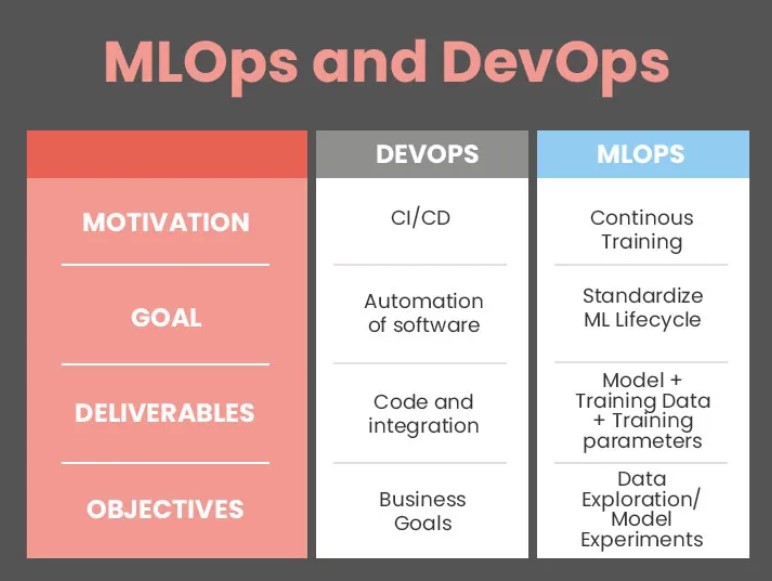
MLOps borrows concepts from DevOps — automation, reproducibility, monitoring — but applies them to a fundamentally different type of software artifact: a trained model. Models have properties that regular software does not: they degrade silently when input distributions change, their “code” (weights) cannot be version-controlled in a Git repository, and retraining requires re-running an expensive compute process rather than recompiling.

Understanding what MLOps addresses, and what it doesn’t, is prerequisite to deciding whether and how to invest in it.

Model deployment without MLOps

Without MLOps practices, ML teams face reproducible problems:

  • A model performs well in development but behaves differently in production because the training and serving environments differ (library versions, data preprocessing steps, random seeds)
  • A model degrades in production over 6 months as the input data distribution shifts, but no one notices until users complain
  • A data scientist trains a new version of a model but there is no safe way to deploy it without taking the current version offline
  • The team wants to retrain the model on new data but cannot reproduce the original training run to verify the new version is actually better

What does MLOps provide?

Problem MLOps solution
Irreproducible training Experiment tracking (MLflow, W&B), versioned data, pinned environments
Silent degradation Data drift monitoring, model performance monitoring in production
Risky deployments Canary deployments, A/B testing, rollback capabilities
Manual retraining Triggered or scheduled retraining pipelines
Model versioning Model registry with lineage tracking
Environment inconsistency Containerized training and serving environments

When you actually need MLOps

MLOps investment is appropriate when:

  • You have models in production that real business processes depend on
  • Model degradation would be noticed late (after business impact, not before)
  • Retraining is required more than once a year
  • Multiple people are working on the same models

MLOps is overhead when:

  • You are in a proof-of-concept phase with no production models
  • Models are trained once and essentially static (batch scoring that rarely changes)
  • The team is one person working alone
  • The business impact of model failure is low

In our experience, organizations adopt MLOps tooling too early (before they have production models to maintain) or too late (after a series of painful production incidents). The right time is when you are actively deploying your first model to production.

For more on how MLOps applies specifically to organizations that have never deployed a model before, MLOps for organisations that have never operationalised a model covers the starting point in detail.

What does MLOps maturity look like at different stages?

MLOps maturity progresses through four stages, and organisations benefit from understanding which stage they are at before investing in advanced tooling.

Stage 1 — Manual. Data scientists train models in notebooks, export model files manually, and hand them to engineers for deployment. Deployment is a manual process involving SSH, file copying, and service restarts. Retraining happens when someone remembers to do it. This stage works for one or two models but does not scale.

Stage 2 — Automated training. Training pipelines are automated: data is extracted, transformed, and used to train models on a schedule. Model artifacts are stored in a registry with version tracking. Deployment remains manual — an engineer reviews the trained model, approves it, and triggers a deployment script. This stage supports 5–10 models with modest operational effort.

Stage 3 — Automated deployment. The full pipeline from data ingestion through model training to model deployment is automated, with quality gates at each stage. New model versions are deployed automatically if they pass quality checks. Monitoring detects model performance degradation and triggers retraining. This stage supports 10–50 models with a small MLOps team (2–4 engineers).

Stage 4 — Self-managing. The system manages model lifecycle decisions: when to retrain, which features to include, how to allocate compute resources across models, and when to retire underperforming models. Human oversight is strategic (setting policies, reviewing aggregate metrics) rather than operational (triggering pipelines, approving deployments). Few organisations reach this stage, and it is only justified for environments with hundreds of models.

We assess clients at their current maturity stage and recommend investments that advance them one stage — not two. Jumping from Stage 1 to Stage 3 introduces tools and practices that the team is not ready to use effectively, resulting in expensive infrastructure that does not deliver its intended value.

The business case for MLOps becomes clear when you calculate the cost of operating models without it. Manual model deployment requires 2–4 hours of engineer time per deployment. If models require weekly retraining (common for models operating on changing data), that is 100–200 hours of engineering time per year per model on deployment alone — not counting monitoring, debugging, and retraining effort. At 10 models, manual operations consume 1–2 full-time engineers. MLOps automation reduces per-deployment effort to near zero (automated pipeline) plus monitoring review time (30 minutes per week), freeing those engineers for higher-value work on new model development and system improvement.

Object Detection Model Selection for Production: YOLO vs Transformers, Speed/Accuracy, and Deployment

Object Detection Model Selection for Production: YOLO vs Transformers, Speed/Accuracy, and Deployment

9/05/2026

Object detection model selection for production: YOLO variants vs detection transformers, speed/accuracy tradeoffs, edge vs cloud deployment, mAP vs.

Multi-Agent Architecture for AI Systems: When Coordination Adds Value

Multi-Agent Architecture for AI Systems: When Coordination Adds Value

8/05/2026

Multi-agent AI architectures coordinate multiple LLM agents for complex tasks. When they add value, common coordination patterns, and where they break.

Facial Detection Software: Open Source vs Commercial APIs, Accuracy, and Production Integration

Facial Detection Software: Open Source vs Commercial APIs, Accuracy, and Production Integration

8/05/2026

Facial detection software options: OpenCV, dlib, DeepFace vs commercial APIs, when to build vs buy, demographic accuracy, and production pipeline.

Multi-Agent Systems: Design Principles and Production Reliability

Multi-Agent Systems: Design Principles and Production Reliability

8/05/2026

Multi-agent systems decompose complex tasks across specialized agents. Design principles, failure modes, and when multi-agent adds value vs complexity.

H100 GPU Servers for AI: When the Hardware Investment Is Justified

H100 GPU Servers for AI: When the Hardware Investment Is Justified

8/05/2026

H100 GPU servers deliver peak AI performance but cost $200K+. When the investment is justified, what configurations to consider, and common procurement mistakes.

MLOps Tools Stack: Experiment Tracking, Registries, Orchestration, and Serving

MLOps Tools Stack: Experiment Tracking, Registries, Orchestration, and Serving

8/05/2026

MLOps tools span experiment tracking, model registries, pipeline orchestration, and serving. How to choose what you need without over-engineering the.

LLM Types: Decoder-Only, Encoder-Decoder, and Encoder-Only Models

LLM Types: Decoder-Only, Encoder-Decoder, and Encoder-Only Models

8/05/2026

LLM architecture type—decoder-only, encoder-decoder, encoder-only—determines what tasks each model handles well and what deployment constraints it carries.

Embedded Edge Devices for CV Deployment: Jetson vs Coral vs Hailo vs OAK-D

Embedded Edge Devices for CV Deployment: Jetson vs Coral vs Hailo vs OAK-D

8/05/2026

Embedded edge devices for CV: NVIDIA Jetson vs Coral TPU vs Hailo vs OAK-D — power, inference throughput, and model optimisation requirements compared.

MLOps Pipeline: Components, Failure Points, and CI/CD Differences

MLOps Pipeline: Components, Failure Points, and CI/CD Differences

8/05/2026

An MLOps pipeline covers data ingestion through monitoring. How each stage differs from software CI/CD, where pipelines fail, and what each stage requires.

LLM Orchestration Frameworks: LangChain, LlamaIndex, LangGraph Compared

LLM Orchestration Frameworks: LangChain, LlamaIndex, LangGraph Compared

8/05/2026

LangChain, LlamaIndex, and LangGraph solve different problems. Choosing the wrong framework adds abstraction without value. A practical decision framework.

MLOps Infrastructure: What You Actually Need and When

MLOps Infrastructure: What You Actually Need and When

8/05/2026

MLOps infrastructure spans compute, storage, orchestration, and monitoring. What each component is for and when it's necessary versus premature overhead.

Generative AI Architecture Patterns: Transformer, Diffusion, and When Each Applies

Generative AI Architecture Patterns: Transformer, Diffusion, and When Each Applies

8/05/2026

Transformer vs diffusion architecture determines deployment constraints. Memory footprint, latency profile, and controllability differ substantially.

MLOps Architecture: Batch Retraining vs Online Learning vs Triggered Pipelines

7/05/2026

MLOps architecture choices—batch retraining, online learning, triggered pipelines—determine model freshness and operational cost. When each pattern is.

Diffusion Models in ML Beyond Images: Audio, Protein, and Tabular Applications

7/05/2026

Diffusion extends beyond images to audio, protein structure, molecules, and tabular data. What each domain gains and loses from the diffusion approach.

Deep Learning for Image Processing in Production: Architecture Choices, Training, and Deployment

7/05/2026

Deep learning for image processing in production: CNN vs ViT tradeoffs, training data requirements, augmentation, deployment optimisation, and.

Hiring AI Talent: Role Definitions, Interview Gaps, and What Actually Predicts Success

7/05/2026

Hiring AI talent requires distinguishing ML engineer, data scientist, AI researcher, and MLOps engineer roles. What interviews miss and what actually.

Drug Manufacturing: How Pharmaceutical Production Works and Where AI Adds Value

7/05/2026

Drug manufacturing transforms APIs into finished products through formulation, processing, and packaging. AI improves process control, inspection, and.

Diffusion Models Explained: The Forward and Reverse Process

7/05/2026

Diffusion models learn to reverse a noise process. The forward (adding noise) and reverse (denoising) processes, score matching, and why this produces.

Enterprise AI Failure Rate: Why Most Projects Don't Reach Production

7/05/2026

Most enterprise AI projects fail before production. The causes are structural, not technical. Understanding failure patterns before starting a project.

Continuous Manufacturing in Pharma: How It Works and Why AI Is Essential

7/05/2026

Continuous pharma manufacturing replaces batch processing with real-time flow. AI-based process control is essential for maintaining quality in continuous.

Diffusion Models Beat GANs on Image Synthesis: What Changed and What Remains

7/05/2026

Diffusion models surpassed GANs on FID scores for image synthesis. What metrics shifted, where GANs still win, and what it means for production image generation.

What Does CUDA Stand For? Compute Unified Device Architecture Explained

7/05/2026

CUDA stands for Compute Unified Device Architecture. What it means technically, why it is NVIDIA-only, and how it relates to GPU programming for AI.

Data Science Team Structure for AI Projects

7/05/2026

Data science team structure depends on project scale and maturity. Roles needed, common gaps, and when a team of 2 is enough vs when you need 8.

The Diffusion Forward Process: How Noise Schedules Shape Generation Quality

7/05/2026

The forward process in diffusion models adds noise according to a schedule. How linear, cosine, and custom schedules affect image quality and training stability.

AI POC Requirements: What to Define Before Building a Proof of Concept

6/05/2026

AI POC requirements must be defined before development starts. Data access, success metrics, scope boundaries, and stakeholder alignment determine POC outcomes.

Autonomous AI in Software Engineering: What Agents Actually Do

6/05/2026

What autonomous AI software engineering agents can actually do today: code generation quality, context limits, test generation, and where human oversight.

How Companies Improve Workforce Engagement with AI: Training, Automation, and Change Management

6/05/2026

AI workforce engagement requires training, process redesign, and change management. How organisations build AI literacy and manage the automation transition.

AI Agent Design Patterns: ReAct, Plan-and-Execute, and Reflection Loops

6/05/2026

AI agent patterns—ReAct, Plan-and-Execute, Reflection—solve different failure modes. Choosing the right pattern determines reliability more than model.

AI Strategy Consulting: What a Useful Engagement Delivers and What to Watch For

6/05/2026

AI strategy consulting ranges from genuine capability assessment to repackaged hype. What a useful engagement delivers, and the signals that distinguish.

Agentic AI in 2025–2026: What Is Actually Shipping vs What Is Still Research

6/05/2026

Agentic AI is moving from demos to production. What's deployed today, what's still research, and how to evaluate claims about autonomous AI systems.

Cheapest GPU Cloud Options for AI Workloads: What You Actually Get

6/05/2026

Free and cheap cloud GPUs have real limits. Comparing tier costs, quota, and what to expect from spot instances for AI training and inference.

AI POC Design: What Success Criteria to Define Before You Start

6/05/2026

AI POC success requires pre-defined business criteria, not model accuracy. How to scope a 6-week AI proof of concept that produces a real go/no-go.

Agent-Based Modeling in AI: When to Use Simulation vs Reactive Agents

6/05/2026

Agent-based modeling simulates populations of interacting entities. When it's the right choice over LLM-based agents and how to combine both approaches.

Best Low-Profile GPUs for AI Inference: What Fits in Constrained Systems

6/05/2026

Low-profile GPUs for AI inference are constrained by power and cooling. Which models fit, what performance to expect, and when to choose a different form factor.

AI Orchestration: How to Coordinate Multiple Agents and Models Without Chaos

5/05/2026

AI orchestration coordinates multiple models through defined handoff protocols. Without it, multi-agent systems produce compounding inconsistencies.

Talent Intelligence: What AI Actually Does Beyond Resume Screening

5/05/2026

Talent intelligence uses ML to map skills, predict attrition, and identify internal mobility — but only with sufficient longitudinal employee data.

AI-Driven Pharma Compliance: From Manual Documentation to Continuous Validation

5/05/2026

AI shifts pharma compliance from periodic manual audits to continuous automated validation — catching deviations in hours instead of months.

Building AI Agents: A Practical Guide from Single-Tool to Multi-Step Orchestration

5/05/2026

Production agent development follows a narrow-first pattern: single tool, single goal, deterministic fallback — then widen incrementally with observability.

Enterprise AI Search: Why Retrieval Architecture Matters More Than Model Choice

5/05/2026

Enterprise AI search quality depends on chunking strategy and retrieval pipeline design more than on the LLM. Poor retrieval + powerful LLM = confident wrong answers.

Choosing an AI Agent Development Partner: What to Evaluate Beyond Demo Quality

5/05/2026

Most AI agent demos work on curated inputs. Production viability requires error handling, fallback chains, and observability that demos never test.

AI Consulting for Small Businesses: What's Realistic, What's Not, and Where to Start

5/05/2026

AI consulting for SMBs must start with data audit and process mapping — not model selection — because most failures stem from insufficient data infrastructure.

Choosing Efficient AI Inference Infrastructure: What to Measure Beyond Raw GPU Speed

5/05/2026

Inference efficiency is performance-per-watt and cost-per-inference, not raw FLOPS. Batch size, precision, and memory bandwidth determine throughput.

How to Improve GPU Performance: A Profiling-First Approach to Compute Optimization

5/05/2026

Profiling must precede GPU optimisation. Memory bandwidth fixes typically deliver 2–5× more impact than compute-bound fixes for AI workloads.

MLOps Consulting: When to Engage, What to Expect, and How to Avoid Dependency

5/05/2026

MLOps consulting should transfer capability, not create dependency. The exit criteria matter more than the entry scope.

LLM Agents Explained: What Makes an AI Agent More Than Just a Language Model

5/05/2026

An LLM agent adds tool use, memory, and planning loops to a base model. Agent reliability depends on orchestration more than model benchmark scores.

GxP Regulations Explained: What They Mean for AI and Software in Pharma

5/05/2026

GxP is a family of regulations — GMP, GLP, GCP, GDP — each applying different validation requirements to AI systems depending on lifecycle role.

Engineering Task vs Research Question: Why the Distinction Determines AI Project Success

27/04/2026

Engineering tasks have known solutions and predictable timelines. Research questions have uncertain outcomes. Conflating the two causes project failure.

MLOps for Organisations That Have Never Operationalised a Model

27/04/2026

MLOps keeps AI models working after deployment. Start with monitoring, versioning, and retraining pipelines — not full platform adoption.

Back See Blogs
arrow icon