A model that works in a notebook is not a deployed model. The notebook proves the prediction is possible; it proves nothing about whether the prediction can be served reliably, retrained when data shifts, or rolled back when it goes wrong. Most organisations that build their first machine learning model stop at the notebook — the accuracy number looks good, the demo lands, and then the model sits there. The business case it was supposed to support never materialises because nothing in the notebook turns into something the business can call.
This is the most common shape of a failed first ML project, and it is rarely a modelling failure. The model is fine. What is missing is the path from a .ipynb file on a data scientist’s laptop to a service that other systems can query, monitor, and depend on. That path is what MLOps actually covers — and for a team that has never crossed it, almost everything written about MLOps is aimed at organisations several maturity levels ahead of where they stand.
Why Do Most ML Models Never Reach Production?
Teams describe “the notebook-to-production gap” as though infrastructure alone closed it, but tooling is only half the problem. A notebook assumes the data is already loaded, cleaned, and sitting in memory. Production assumes nothing: the data arrives over a wire, in a format that drifts, at a volume the laptop never saw. A notebook runs once, interactively, with a human watching. Production runs unattended, repeatedly, and has to do something sensible when an input is malformed or the model returns nonsense.
Across the first-deployment engagements we have worked on, the model itself is almost never the thing that blocks production (observed pattern across TechnoLynx engagements; not a benchmarked rate). What blocks it is the absence of three things: a repeatable way to get the model from training into a running service, a way to know whether the deployed model is still behaving, and a way to put the previous version back when the new one misbehaves. Those three — deployment, monitoring, rollback — are the load-bearing parts of a first MLOps stack. Most of what gets sold as “MLOps” is layered on top of them and is, for a first project, optional.
Industry surveys have repeatedly put the share of ML projects that never reach production high — analyst commentary has cited figures around the majority of models for several years running (market-direction; not an operational benchmark). The exact number matters less than the mechanism: models stall not because they are wrong but because no one built the road they were supposed to drive on. The same root cause shows up in larger programmes too, which is why it features prominently in our analysis of why most enterprise AI projects fail.
What MLOps Actually Means for a First-Time Team
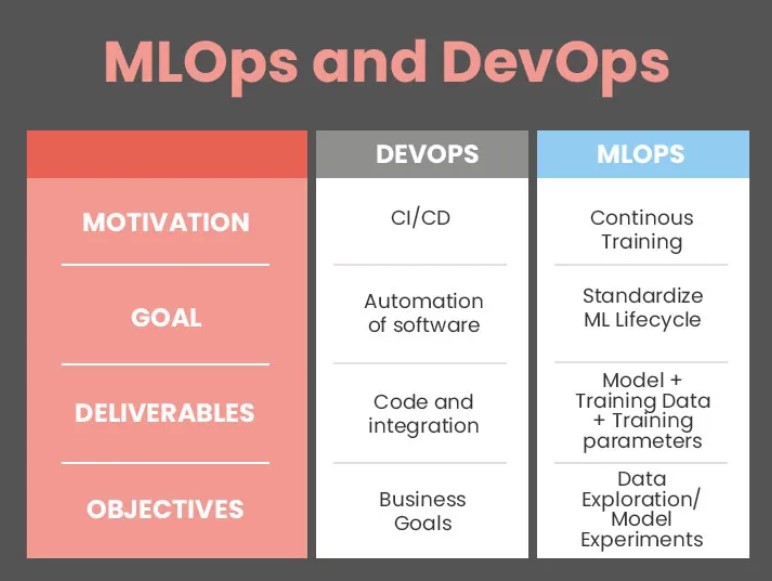
DevOps analogies help explain MLOps to executives yet obscure the data-dependency and retraining loops that distinguish model deployment from application release. The parts that carry over from DevOps — version control, CI/CD, containerisation, infrastructure as code — carry over cleanly. The parts that do not carry over are the parts that matter most for ML, and a first-time team underweights them because the DevOps analogy hides them.
Three dimensions separate MLOps from DevOps:
- The data pipeline is part of the deployable unit. In conventional software, the code is the artefact. In ML, the model is a function of code and the data it was trained on. Reproducing a deployment means reproducing the data state, not just the source.
- Drift is a runtime failure mode with no analogue in DevOps. A correctly deployed model can degrade without any code change, because the world it predicts about moves away from the world it was trained on. Nothing breaks; the predictions just get quietly worse.
- Rollback is harder because “the previous version” includes the previous model and the previous data assumptions. Reverting a code deploy is well understood. Reverting a model means having kept the prior model, its training data reference, and its serving configuration together.
The practical consequence is that a first MLOps project needs experiment tracking and model versioning earlier than a DevOps instinct would suggest, and needs full automated retraining far later. We unpack the drift dimension specifically in our note on data drift versus model drift, because the response to each is different and getting them confused leads teams to rebuild infrastructure they did not need.
Which MLOps Capabilities Does a First Project Genuinely Need?
Building Kubernetes clusters, feature stores, and experiment registries before your first model ships guarantees twelve months of infrastructure work with nothing to operationalize. A feature store, an automated retraining pipeline, multi-model A/B serving, and a governance layer are all real capabilities — and all overengineering for a team putting its first model into production. The following rubric separates what a first deployment genuinely requires from what can wait.
First-Deployment MLOps Capability Rubric
| Capability | Needed for first deployment? | Why |
|---|---|---|
| Model packaging + serving (containerised) | Yes | Without it there is no production, only a notebook. The minimum viable artefact. |
| Source + config version control | Yes | You cannot fix or roll back what you cannot reproduce. |
| Basic monitoring (latency, errors, input stats) | Yes | A silent model is a model you will discover is broken from a customer complaint. |
| Manual rollback to prior version | Yes | The cheapest insurance against a bad deploy; automate it later. |
| Experiment tracking + model registry | Soon | Useful before production for reproducibility; essential the moment you train a second version. |
| Data/model versioning (DVC-style) | Soon | Adds reproducibility of the data state; pays off when you retrain, not at first launch. |
| Drift detection | After launch | Only meaningful once the model has been live long enough for the world to move. |
| Automated retraining pipeline | Later | Premature automation of a process you have not yet done by hand once. |
| Feature store | Later / maybe never | Solves a multi-model, multi-team problem a first project does not have. |
The honest reading of this table is that the smallest viable MLOps stack is small. Containerised serving, version control, basic monitoring, and a manual rollback path produce a production-quality deployment. Everything in the “soon” and “later” rows is real value you add after the model is earning its keep — which is also the point at which you will understand your own requirements well enough to build them correctly. Our breakdown of MLOps pipeline components and how they fit together goes deeper on sequencing these.
What a First MLOps Implementation Looks Like in Practice
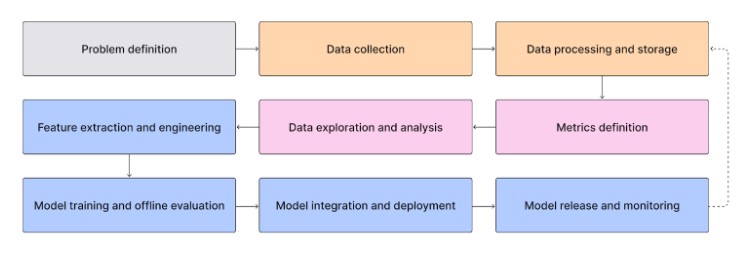
Consider a recognisable case: a team has a demand-forecasting model that works well in a Jupyter notebook, trained in scikit-learn, validated against held-out data, and approved by the business. It has never run anywhere but the laptop. The job is to get it serving predictions that the planning system can consume daily. Here is how that implementation tends to proceed, and — importantly — what each phase leaves behind as a standalone artefact.
Phase one — packaging and serving. The model is serialised and wrapped in a small service (a FastAPI app behind a container is a common, unglamorous, correct choice), then containerised with Docker. The artefact left behind is a deployment configuration that is independent of this particular model: the next model the team ships reuses it. This is where the second deployment starts costing less than the first.
Phase two — the pipeline. A CI/CD pipeline — GitHub Actions, GitLab CI, or similar — builds the container, runs validation against a reference dataset, and pushes to a registry on merge. The artefact is the pipeline itself, which has value the day it exists, before any monitoring or retraining is in place.
Phase three — monitoring. A dashboard tracks request latency, error rates, prediction distributions, and basic input statistics. Tools like Prometheus and Grafana, or a managed equivalent, do this without ceremony. The dashboard is the artefact, and it is the first time the organisation can see its model behaving rather than assume it.
Phase four — versioning and tracking. MLflow for experiment tracking and a model registry, optionally DVC for data versioning, make the next training run reproducible. This phase is frequently done after the first production deployment rather than before — which surprises teams who were told versioning is foundational. It is foundational for the second model, not the first.
The pattern worth naming is that each phase produces an intermediate artefact with value independent of the final system. The CI/CD pipeline, the monitoring dashboard, the deployment config — none of them are throwaway scaffolding. They are reusable infrastructure, and they are why the cost curve bends down on the second deployment. This is the evidence trail a buyer should expect from a competent MLOps engagement: not one big-bang go-live, but a sequence of deliverables each defensible on its own. The same architecture-level view is laid out in our discussion of MLOps architecture patterns for production.
What stayed imperfect, in the honest version of this story, is usually the retraining cadence and the drift response. A first deployment ships with manual retraining and a human deciding when to do it. That is not a failure — it is the correct amount of automation for a process the team has not yet repeated enough times to automate safely.
Which Tools Are Realistic, and Open Source Versus Cloud-Managed?
Tool selection for a first project should be governed by one question: does this tool assume mature data engineering already exists? That single criterion should drive every selection decision for an initial project. Many MLOps platforms are genuinely excellent and genuinely wrong for a first deployment, because they presume a feature store, a data warehouse, and a team fluent in the platform’s abstractions. A team operationalising its first model does not have those, and adopting the tool means building the prerequisites first.
The open-source-versus-managed choice is less about ideology than about where the team’s scarcity sits. A team without mature data engineering and without deep cloud-platform skills usually benefits from a managed stack on a single cloud — Amazon SageMaker, Google Vertex AI, or Azure ML — because the platform absorbs infrastructure work the team would otherwise have to learn. A team with strong infrastructure skills but a need to avoid lock-in benefits from an open-source stack: MLflow, DVC, BentoML or KServe for serving, Prometheus and Grafana for monitoring, stitched together on Kubernetes. The hybrid middle — open-source tracking and serving on managed compute — is where many first projects actually land.
An MLOps stack on AWS differs from an open-source or hybrid stack mainly in who owns the integration burden. SageMaker gives you packaging, serving, a registry, and monitoring as an integrated set, at the cost of coupling to AWS abstractions. An open-source stack gives you the same capabilities as separate components you integrate yourself, at the cost of more setup and more decisions — and the benefit of portability. For a first deployment the integrated route ships faster; the portability cost only bites later, if it bites at all. We compare these trade-offs in detail in our guide to selecting an MLOps tools stack, and the infrastructure side is covered in MLOps infrastructure requirements.
FAQ
What does MLOps actually mean for an organisation that has never operationalised a model?
Many organizations invest in MLOps platforms yet never successfully deploy a model that other services can query, monitor, or safely roll back. For a first-time team, the load-bearing parts are deployment (containerised serving), monitoring (knowing the model is still behaving), and rollback (putting the previous version back) — not the automated retraining and governance layers that mature organisations run.
Which MLOps capabilities does a first project genuinely need, and which are overengineering?
A first project needs containerised model serving, source and config version control, basic monitoring of latency and input statistics, and a manual rollback path. Experiment tracking and model versioning are needed soon, ideally before a second model. Drift detection, automated retraining, and feature stores are overengineering for a first deployment — they solve problems you do not yet have.
What is the smallest viable MLOps stack that still produces a production-quality deployment?
Containerised serving, version control, basic monitoring, and a manual rollback path. That combination produces a production-quality deployment without a feature store, automated retraining, or multi-model serving. Everything beyond it is value you add after the model is in production and earning, when you understand your own requirements well enough to build the rest correctly.
How does MLOps differ from DevOps in the data-pipeline, drift, and rollback dimensions?
The data pipeline is part of the deployable unit — a model is a function of code and training data, so reproducing a deployment means reproducing the data state. Drift is a runtime failure mode with no DevOps analogue: a correctly deployed model degrades as the world moves away from its training data, with nothing breaking. Rollback is harder because “the previous version” includes the prior model, its data reference, and its serving config, not just code.
Why do most ML models never reach production, and which MLOps gaps cause that?
They stall not because the model is wrong but because no one built the path from notebook to running service. The recurring gaps are the absence of a repeatable deployment route, no way to know whether the live model is still behaving, and no way to roll back a bad version. The model is usually fine; the surrounding infrastructure was never built.
Which MLOps tools are open source versus cloud-managed, and how does that choice affect a first deployment?
Open-source options like MLflow, DVC, BentoML or KServe, Prometheus and Grafana give portability at the cost of integration work. Managed stacks like SageMaker, Vertex AI, or Azure ML give an integrated set at the cost of platform coupling. A team without mature data engineering usually ships faster on a managed stack because the platform absorbs infrastructure work; the portability cost of that choice only bites later, if at all.
What does experiment tracking and data/model versioning actually add, and is it needed before or after production?
Experiment tracking and versioning (MLflow, DVC-style tooling) make training runs reproducible and let you reconstruct exactly what produced a given model. They are useful before production for reproducibility, but they become essential the moment you train a second version. Many first projects correctly defer full data versioning until just after the first deployment — it is foundational for the second model, not the first.
A first MLOps project is not the place to prove you can build the infrastructure a mature ML organisation runs. It is the place to prove that a model can leave the notebook, serve real predictions, and be put back when it misbehaves — and to leave behind a deployment config, a pipeline, and a dashboard that make the next model cheaper. If your team has models but no production path, the question to ask first is not which platform to buy; it is which of deployment, monitoring, and rollback you are currently missing. That is the gap, and closing it is what a first MLOps engagement should deliver — alongside an honest readiness assessment of whether the data foundations are there to support it.
Why most MLOps initiatives stall before deployment
Eighteen months after kickoff, the median enterprise MLOps team has operationalized zero models. MLOps Organisations Never Operationalised rewards teams that measure first and argue later — start with the smallest instrumented slice and let the numbers settle the design.