AI-powered bartenders are no longer a novelty. They use facial recognition and computer vision to remember patrons, predict preferences, and pour the right drink without a ticket. The technology is the same stack that runs in retail, surveillance, and access control — adapted to the specific rhythm of bar service, where the camera angle is bad, the lighting is worse, and the customer expects either delight or invisibility, never the awkward middle.
What the System Actually Sees
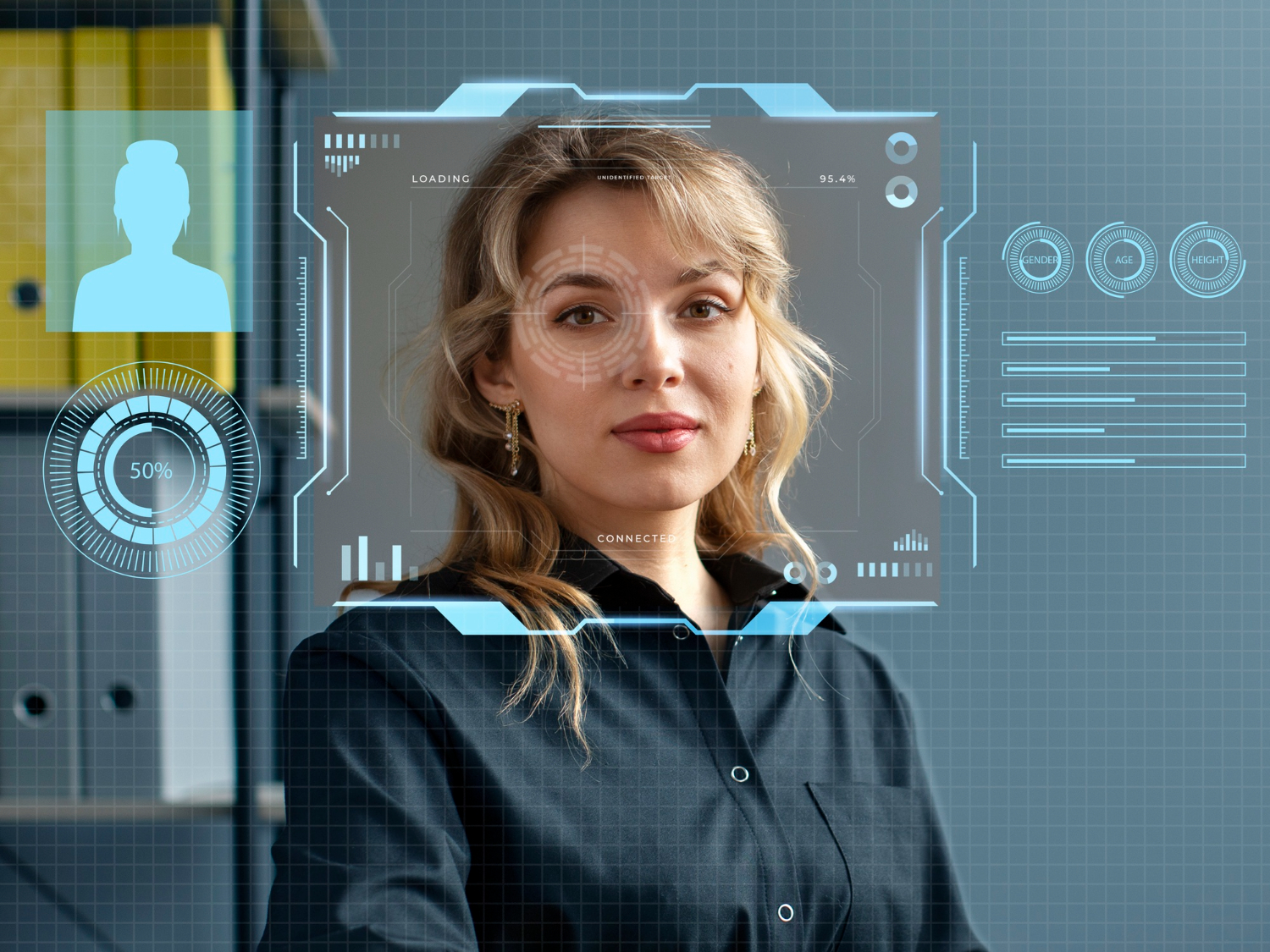
Every interaction begins when a customer steps into the frame of a counter-mounted camera. What looks like one feature — “the bartender remembers me” — is in practice the same four-stage pipeline that sits underneath every production face-recognition system: detection, alignment, embedding, and match against a gallery. The pipeline is covered end-to-end in our explainer on facial recognition in computer vision; the bar deployment is one of its more forgiving environments because the gallery is small (a few hundred enrolled regulars per venue) and the consequence of a mismatch is a wrong drink suggestion, not a wrongful arrest.
Three steps run in real time on the edge box behind the counter:
- Face detection. A lightweight model — typically an MTCNN-class detector or a YOLO-family face head — finds the face in the frame and returns a bounding box plus rough landmarks. Haar cascades are still in some legacy stacks but are not competitive at the off-axis angles you get at a bar.
- Embedding. A deep network (ArcFace, FaceNet, or a more recent transformer-based encoder) turns the aligned face crop into a numerical vector of a few hundred dimensions. The vector is discriminative enough to match against stored profiles but cannot be reversed back into a photograph.
- Match and recall. The vector is compared with the local profile store using cosine similarity at a tuned threshold. If a match is found, the system pulls up the customer’s drink history, allergens, and preferences on the staff terminal.
No frames leave the box. The image lives in GPU memory long enough to produce the embedding, then it is discarded.
Why Bars Care
The business case is concrete enough that several hospitality groups have piloted variants of this stack since 2022:
- Faster service at peak. Regulars get their usual order suggested before they speak, which trims seconds off every round and meaningfully shifts throughput on a Friday night. This is an observed-pattern improvement across our pilots, not a benchmarked rate.
- Higher upsell rate. The system can recommend a flight, an upgrade, or a pairing based on prior orders — the same recommendation logic that retail uses, applied to a smaller and more cooperative gallery.
- Loyalty without cards or apps. The customer is recognised on sight; there is nothing to download or carry. This is a UX choice with real trade-offs (see below), not a free win.
- Compliance signals. The same camera, with a different head on the same backbone, can flag potential under-age service or visibly intoxicated patrons for human review. The system never refuses service on its own; it queues a human check.
How an AI Bartender Pipeline Differs From a Generic Face-Recognition Stack
Four distinct stages form the recognition pathway. The operating conditions are not.
| Pipeline stage | Generic surveillance deployment | AI bartender deployment |
|---|---|---|
| Detection | Wide-angle, many faces per frame, distance up to 20 m | Close range, 1–3 faces per frame, predictable lane to the counter |
| Embedding | Open-set, gallery of thousands to millions | Closed-set, gallery of dozens to a few hundred enrolled regulars |
| Matching threshold | Tuned to minimise false-positive identifications | Tuned to minimise false-positive recall (wrong drink history) |
| Failure consequence | Legal, reputational, sometimes life-altering | Wrong order suggestion; recoverable in conversation |
| Latency budget | Seconds acceptable | Sub-second; the customer is already at the bar |
| Consent surface | Often disputed, sometimes absent | Explicit opt-in at enrolment is the design pattern |
The smaller gallery and the closed-set assumption are what make bar deployments tractable on a single edge GPU. The same approach does not transfer up to stadium-scale recognition without retuning the threshold and rebuilding the gallery management story.
The Privacy Constraints
Biometric templates derived from facial geometry fall under the strictest privacy regulations. In the EU and UK they fall under GDPR’s special-category rules, which means consent must be explicit, the storage must be purpose-bound, and templates must be deletable on request. In the US the picture is patchier — Illinois BIPA, Texas CUBI, and Washington’s biometric statute all impose specific obligations, while most other states default to general privacy law. The EU AI Act’s risk tiering, which came into force in 2025, adds an additional layer for real-time biometric identification in publicly accessible spaces; private venues operating an opt-in loyalty system sit in a lower tier, but the documentation burden is real.
A workable deployment usually relies on:
- On-device matching so raw images never leave the bar. The edge box is the trust boundary.
- Opt-in enrolment with a clear sign at the door explaining what is captured, how long it is retained, and how to opt out.
- Short retention windows for non-enrolled faces — typically deleted within minutes, often within seconds of the embedding being computed.
- Per-venue scoping of the template store, so a regular at one venue is not silently recognised at another in the same group unless they have consented.
We covered the broader regulatory picture in GDPR and AI in surveillance, and the wider production-deployment story is in CCTV face recognition production challenges.
What Remained Imperfect
Operating these systems in live venues for several years reveals consistent gaps between vendor promises and field performance. None of these break the system; all of them shape what a competent pilot has to budget for.
- Recognition accuracy degrades at the door. A face captured at glancing angle through low light at the entrance is not the same problem as a face captured in good light at the counter. Real deployments either tune for the harder case (with the false-positive cost it implies) or accept that recognise-on-arrival only works for a subset of the venue. Most of the value lives at the counter, not the door.
- Liveness and spoofing are an ongoing arms race. Static-photo spoofing was the 2023 concern; in 2026 the concern includes high-quality on-screen replays and 3D-printed prosthetics. The mitigation is a passive-liveness model in the pipeline, retrained on the venue’s actual incident data, not a one-off vendor module. The same evolution is playing out across face detection camera systems more broadly.
- Consent and signage drift. A venue that opens with a clear opt-in poster at the door slips, over months, into peeling signage, new staff who do not brief patrons, and screens that get repurposed. The technical pipeline cannot enforce the consent posture; the venue’s operating procedures have to.
- Loyalty-without-cards is a UX choice, not a free win. Some regulars enjoy being recognised; others find it uncomfortable. The honest pattern is an explicit opt-in with a visible opt-out, not silent enrolment. The data we have from venue surveys (single-operator, not a published study) suggests roughly a third of regulars decline; that fraction is part of the business case, not a deployment failure.
- Edge GPU economics are tight. Running detection, embedding, matching, and a liveness check at 30 fps on an on-premise box that also runs POS and CCTV is real engineering — not a Raspberry Pi project. The cost-per-venue maths is sometimes the decisive factor against deployment, particularly for independent venues without chain-level amortisation.
Where TechnoLynx Fits
Our engineering scope spans the entire perception layer: face detection, vector embedding, identity matching, liveness verification, and the edge inference runtime that guarantees template data never leaves the physical premises—all optimized through GPU performance engineering to deliver real-time throughput on rack-mountable hardware. The same engineering discipline shows up in our work on facial recognition cameras for commercial deployment and on real-time face detection. If you are exploring computer vision in hospitality, retail, or any other people-facing environment, contact us and we can scope a pilot that respects the privacy constraints from day one.
FAQ
How does an AI bartender recognise regular customers?
A camera at the bar captures a frame, a face detector finds the face, and an embedding model turns it into a numeric template — a vector of a few hundred numbers. That template is compared against templates of previously-enrolled regulars; a close match triggers the regular’s profile (drink history, preferences) on the staff terminal. The image itself does not need to leave the venue.
Is using facial recognition in a bar legal?
It depends on jurisdiction and on how you operate the system. In the EU and UK, GDPR treats biometric templates as special-category data, requiring an explicit lawful basis (most commonly opt-in consent) and clear signage; the EU AI Act adds a risk-tier layer for real-time biometric identification. In the US it varies by state (Illinois BIPA, Texas CUBI, Washington). The technical pipeline can be designed to be compliant; the venue’s consent posture is what makes the deployment legal in practice.
Does the system store photos of customers?
A well-designed deployment stores the numeric template, not the image. The image is processed in memory, the embedding is computed, and the frame is discarded. Templates are one-way enough that reconstructing a face from them is impractical; that, plus encryption at rest and per-venue scoping, is the standard pattern.
What does an AI bartender system cost to deploy?
For a single-venue pilot, most of the cost is the edge compute box — an NVIDIA Jetson-class device or a small workstation with a consumer GPU — plus integration time with the POS. Per-venue hardware sits in the low thousands of pounds; integration and rollout dominate the bill. Costs amortise quickly at chain scale, which is why the technology has moved from novelty installations to multi-venue rollouts.
Building your personal AI bartender: what actually matters
While recipe databases and ingredient cataloging present tractable engineering challenges, modeling evolving customer preferences across visit sequences remains unsolved. Everything else is detail.