Why “XR” needs unpacking before any project starts
Treating “XR” as a single technology obscures meaningful differences. It is not. Extended Reality is an umbrella for three different paradigms — Virtual Reality (VR), Augmented Reality (AR), and Mixed Reality (MR) — that have different hardware envelopes, different content pipelines, and very different failure modes in deployment. A retail try-on, a surgical training simulator, and a remote-assistance overlay are not the same project shrunk or grown. They pick different paradigms because the constraints differ, and picking wrong produces a pilot that demos well and never ships.
The point of this article is narrow: name what separates these paradigms in operational terms, and show where each fits. The companion hub piece on the integration of VR, AR, and XR develops the full decision frame; here we focus on the immersion axis and the systems engineering implications.
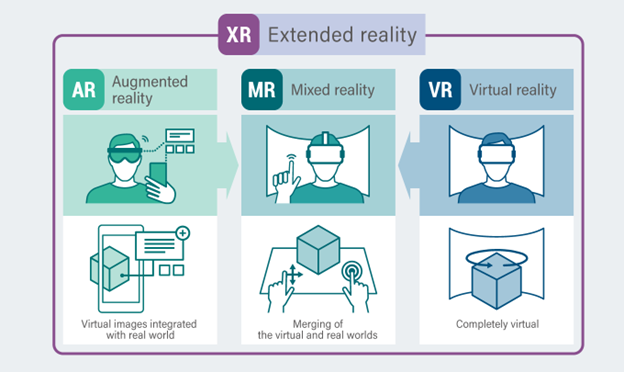
What is the practical difference between AR, VR, MR, and XR?
The textbook definitions are well known. The practical differences that matter at scoping time are not the definitions but the constraints each paradigm imposes.
VR is fully synthetic. The user is decoupled from physical surroundings, which means the rendering budget covers everything the user sees — typically 90 Hz at near-eye resolutions, with motion-to-photon latency under 20 ms to avoid simulator sickness. That is an observed pattern across the consumer headset generation from Oculus Rift through Meta Quest 3 and Apple Vision Pro: when you control the entire visual frame, you also own the entire latency budget.
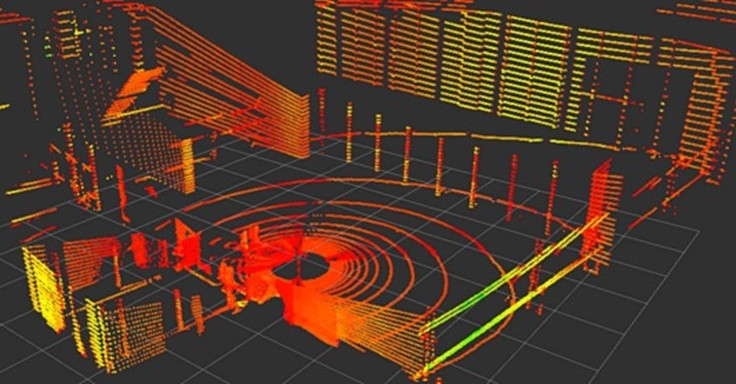
AR overlays digital content on the real world, usually through a smartphone or smart glasses. Environmental coupling becomes the binding constraint. The system has to track the real world well enough that overlays stay registered to physical objects, which means computer vision pipelines — typically simultaneous localisation and mapping (SLAM) using visual cameras, LiDAR, or sensor fusion — run continuously alongside the rendering. Failures show up as drift, jitter, or overlays that slide off the object they were anchored to.
MR sits between the two. The user sees real and virtual content simultaneously and can interact with the virtual content as if it had physical presence — grasping, pushing, occluding. Occlusion is the discriminator. In layered AR, the overlay always sits on top of the camera feed; in MR, the system has to compute depth ordering so a virtual object can disappear behind a real chair. That requires denser scene understanding and is the reason MR hardware (HoloLens, Apple Vision Pro in pass-through mode, Meta Quest 3 mixed-reality mode) costs and weighs more than AR glasses.
XR is the umbrella over all three. It is a useful term for portfolio planning. It is not a useful term inside a single project specification.
A decision frame for picking the paradigm
Most of the work in deciding which paradigm a use case actually needs gets done by four axes.
| Axis | VR fits when… | AR fits when… | MR fits when… |
|---|---|---|---|
| Environmental coupling | User must be decoupled from surroundings (training, design review, therapy) | User needs real-world context preserved (field service, navigation, retail try-on) | Virtual objects must behave as if physically present (surgical planning, industrial assembly) |
| Session duration | Short to medium (15–60 min); weight and heat dominate beyond that | Long or all-day (smart glasses, phone-based AR) | Medium (30–90 min); device weight currently limits longer sessions |
| Input modality | Controllers, hand tracking, gaze, voice — full range available | Voice, gesture, touchscreen; constrained by form factor | Hand tracking and gaze primary; precision tasks need controllers |
| Content authoring economics | High — full CG environments, asset pipelines like a game studio | Low to medium — overlays on captured reality | High — CG plus scene understanding plus interaction design |
This frame is evidence class observed-pattern — it summarises how the constraints actually bind in projects we and others have scoped, not a benchmarked decision rule. Where it is useful is at the moment before vendor RFPs go out: if the four axes don’t agree on a paradigm, the use case is probably two use cases pretending to be one.
The artifact connection matters here. Whichever paradigm the project picks, the rendering and tracking budget it implies has to be validated against the GPU envelope of the chosen hardware. That is what a GPU performance audit tests for — whether the chosen device can actually sustain the paradigm’s frame and latency requirements under realistic load, not peak burst. Sustained throughput under realistic load is the operationally relevant measure for GPU-accelerated XR, and it is what determines whether an MR demo at 60 Hz holds up when occlusion computation is also running.
Where AI and computer vision fit in each paradigm
Which capability is doing the work blurs when you conflate the differing roles AI plays by paradigm.
In VR, AI mostly shapes content. Generative AI pipelines — including Generative Adversarial Network (GAN) variants and diffusion models — produce dynamic 3D environments, NPC behaviour, and adaptive scenarios for training simulations. The user-facing constraint is rendering throughput, not perception.
In AR, AI is in the perception pipeline. SLAM, object detection, and pose estimation run continuously on captured camera streams. Tools like Google Lens illustrate the consumer end of this — real-time recognition driving an overlay — and IKEA Place shows the commerce end, where AR projects virtual furniture into physical spaces using plane detection and lighting estimation.
In MR, both halves run together. The system has to understand the scene densely enough to compute occlusion and physics-plausible interaction, and it has to generate or place virtual content with consistent lighting and shadow. The compute envelope is larger than either AR or VR alone, which is why MR-capable devices currently lag VR headsets on session-duration comfort.
Where each paradigm is actually plateauing or accelerating
XR adoption is not uniform across paradigms. Some segments are accelerating into operational use; others have demoed for years without scaling.
VR for enterprise training and design review has become routine in industries where the alternative is expensive (aviation, surgery, heavy industry) or impossible (immersive design review of buildings that don’t exist yet). Medical and nursing schools integrate VR-based simulation into their curricula, with students treating virtual patients and receiving instructor feedback in shared sessions (Pottle, 2019). VR for pain management and behavioural health is also accumulating evidence, with umbrella reviews summarising effect sizes across multiple trials (Viderman et al., 2023).
AR for field service, remote assistance, and warehouse picking has scaled where the form factor — phone or tablet — was already in the workflow. AR glasses for the same workflows have lagged because optics, weight, and battery still constrain all-day use. The 2026 hardware generation (Android XR on Samsung and Qualcomm reference designs, Meta’s Ray-Ban smart glasses, lightweight headsets like the Pimax Dream Air) is narrowing this gap, but the binding constraint remains thermal and optical, not software.
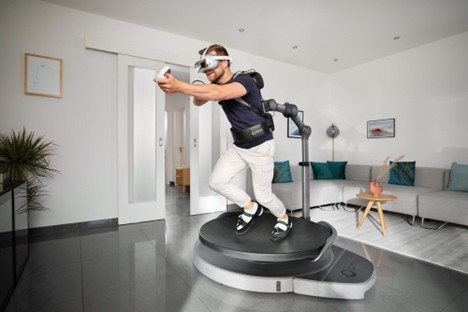
MR for surgical planning and industrial assembly is the segment where occlusion matters most and where the cost of mis-registration is highest. It is also where adoption is slowest in absolute terms, because the device cost, training cost, and integration cost are all high simultaneously. The gap between consumer entertainment use of XR — gaming on Meta Quest, omnidirectional treadmill platforms like Virtuix and Infinadeck, AR-enhanced concerts — and enterprise MR is wider than the umbrella term suggests.
A short note on entertainment
Entertainment was the first segment to embrace XR and still shapes most of the public’s mental model. VR gaming has moved from simple simulations into shared immersive worlds like Meta’s Horizon Worlds. Omnidirectional treadmills from Infinadeck and Virtuix extend the locomotion envelope. AR has appeared in live concerts (U2, Maroon 5) and through Snapchat-style filters. These are real applications, but they are not where the paradigm decision is hardest. The hard decisions are in enterprise contexts where the wrong paradigm produces an expensive pilot that never reaches production.
Closing
Naming a portfolio is the most useful function “XR” performs. The least useful thing it does is collapse three different engineering problems into one word. When scoping a new programme, separate the paradigms first, validate the rendering and tracking budget against the candidate hardware, then choose the vendor. Done in that order, the pilot has a chance of surviving deployment.
FAQ
What is the practical difference between AR, VR, MR, and XR when scoping a use case beyond the textbook definitions?
VR is fully synthetic and owns the entire latency and rendering budget. AR overlays digital content on the real world and is bound by perception accuracy (SLAM, object tracking). MR adds occlusion and physics-plausible interaction between virtual and real objects. XR is the umbrella term — useful for portfolios, not for specifications.
Which paradigm fits which workflow — industrial training, retail try-on, remote collaboration, field service?
Industrial training and design review fit VR (full decoupling from surroundings). Retail try-on and field service fit AR (real-world context preserved). Surgical planning and industrial assembly often need MR (occlusion and physical-plausible interaction). Remote collaboration straddles VR and MR depending on whether shared physical context matters.
What hardware constraints (FOV, weight, tethering, optics) drive the AR-glasses vs VR-headset choice in 2026?
VR headsets prioritise field of view and pixel density, accepting weight and limited session duration. AR glasses prioritise weight, optical clarity, and all-day battery, accepting smaller FOV and lower display brightness. The 2026 generation (Android XR, Meta Ray-Ban, Pimax Dream Air) is narrowing this gap, but thermal and optical constraints still bind.
How do enterprise VR examples (training, design review, remote ops) compare with consumer use cases for ROI?
Enterprise VR scales where the alternative is expensive or impossible — flight simulation, surgical training, immersive design review of unbuilt facilities. Consumer VR scales on entertainment value. Enterprise ROI tends to be measurable per training hour or per design-review cycle; consumer ROI is engagement-based and harder to benchmark.
What is the key feature of mixed reality that distinguishes it from layered AR, and when does that matter?
Occlusion. In layered AR, virtual content always sits on top of the camera feed. In MR, virtual objects can be occluded by real objects and vice versa, which requires dense scene understanding. This matters whenever a virtual object needs to behave as if it has physical presence — surgical overlays, industrial assembly guides, training simulators with physical props.
Where are AR/VR/XR adoption curves actually plateauing versus accelerating across industries?
VR for enterprise training and behavioural health is accelerating with accumulating clinical evidence. AR through phones and tablets has plateaued in workflows where it already fits; AR glasses are still constrained by optics and weight. MR for surgical and industrial use is growing slowly because integration cost is high. Consumer XR is dominated by gaming and social platforms.
Further Reading and Resources
Industry whitepapers, SDK documentation, and peer-reviewed studies on spatial computing offer valuable guidance for developers exploring extended reality. d.) — What is a GAN? Generative Adversarial Networks explained.
- Android (n. d.) — Learn more about Android XR.
- Dexerials (2023) — VR, AR, MR, and XR technology — the growing metaverse market.
- Gundi, J. (2023) — Extended Reality in healthcare.
- Klingler, N. (2024) — Computer vision in AR and VR — the complete 2025 guide.
- Pottle, J. (2019) — Virtual reality and the transformation of medical education. Future Healthcare Journal 6(3), 181–185. https://doi.org/10.7861/fhj.2019-0036.
- Reiners, D. et al. (2021) — The combination of artificial intelligence and extended reality: a systematic review. Frontiers in Virtual Reality 2. https://doi.org/10.3389/frvir.2021.721933.
- Viderman, D. et al. (2023) — Virtual reality for pain management: an umbrella review. Frontiers in Medicine 10. https://doi.org/10.3389/fmed.2023.1203670.
- Yarovoi, A. and Cho, Y. K. (2024) — Review of simultaneous localization and mapping (SLAM) for construction robotics applications. Automation in Construction 162, 105344. https://doi.org/10.1016/j.autcon.2024.105344.