Introduction
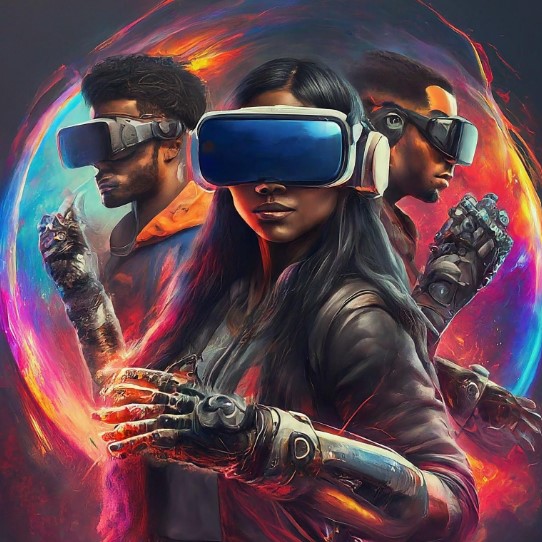
Gaming is where AR/VR/XR technology gets most of its real-world stress test — consumer expectations are higher, sessions are longer, and the failure modes are visible immediately. AI is now woven through the stack: NPC behaviour, content generation, upscaling and frame generation on the rendering side, voice and gesture as input modalities, anti-cheat and matchmaking on the service side. The combination is genuinely changing what gaming experiences are possible.
What gets in the way of clean conversations about it is the vocabulary. “AR”, “VR”, “MR”, and “XR” get used interchangeably in marketing and in product reviews, which masks the fact that the three paradigms have different hardware envelopes, different content pipelines, and different failure modes when shipped to consumers. A VR racing simulator, a mobile AR puzzle game, and a passthrough-MR fitness coach are not the same project at different scales — they pick different paradigms because the constraints differ. Picking the wrong paradigm produces a pilot that demos well at a trade show and fails at retail. The disambiguation matters before any GPU and rendering budget conversation starts.
What this means in practice
- AR overlays digital content on the real world; VR replaces the real world; MR couples digital content to the real world with tracking; XR is the umbrella term — they are not synonyms.
- The paradigm decision is upstream of the headset decision, the engine decision, and the content-budget decision.
- AI’s role in gaming is now horizontal — rendering, content, input, services — rather than a single feature.
- Enterprise XR adoption (training, design review, remote ops) is more advanced than consumer XR adoption in some categories; the directionality is workload-specific, not generation-specific.
What is the practical difference between AR, VR, MR, and XR when scoping a use case beyond the textbook definitions?
The textbook definitions are well-rehearsed: AR overlays digital content on the real world (HoloLens, Magic Leap, AR mode on a smartphone); VR replaces the real world with a fully synthetic environment (Meta Quest, Valve Index, PSVR2); MR couples digital content to the real world with persistent tracking and occlusion (Quest 3 in passthrough, Apple Vision Pro); XR is the umbrella term that covers all three plus everything along the spectrum.
The practical difference — the one that decides projects — is the environmental coupling. Does the user need to see and interact with the physical environment while engaging with digital content (AR/MR), or is the experience deliberately disconnected from the room (VR)? That single question changes the hardware (transparent vs occluded optics, world-facing cameras, depth sensors), the content pipeline (CG composed with passthrough vs entirely CG), the safe-session duration (longer for AR/MR, shorter for VR due to vestibular load), and the comfort envelope (lighter form factors viable for AR; VR headsets carry more compute on the head).
For gaming specifically, the paradigm answer follows from the gameplay loop. A flight-simulator wants total immersion → VR. A board-game digital companion wants to sit on the kitchen table → AR. A fitness coach wants the user moving safely in their living room → MR.
Which paradigm fits which workflow — industrial training, retail try-on, remote collaboration, field service?
Gameplay genre determines which modality fits, using the same logic that governs workflow selection in enterprise contexts. Industrial training: typically VR, because the goal is to put the trainee in a high-fidelity replica of an environment they cannot easily access (offshore rig, surgical suite, aircraft cockpit). Retail try-on: AR on a smartphone, because the user is in the store or at home and the digital content (a watch, a sofa, a make-up palette) must register to the real product or the real body. Remote collaboration: increasingly MR for high-end use cases (Vision Pro, Quest 3) where the participant wants to see colleagues’ faces and the digital artefact at the same time. Field service: AR glasses or smartphone AR, because the technician needs their hands free and their eyes on the equipment, with overlays guiding the procedure.
Applied back to gaming: simulation and esports sit in VR; casual mobile and location-based gaming sit in AR; living-room and exercise gaming sit in MR; cross-platform franchise gaming sits in the XR umbrella and gets a different implementation per target.
What hardware constraints (FOV, weight, tethering, optics) drive the AR-glasses vs VR-headset choice in 2026?
Form factors diverge once you map thermal envelope, weight budget, and field-of-view requirements to the target session length. AR glasses (Magic Leap 2, RayNeo, Xreal, lighter HoloLens successors): field of view typically 50-70 degrees diagonal, weight under 250 grams for all-day wear targets, transparent or semi-transparent optics, mostly untethered with the compute on the device or on a paired phone. The constraint that decides AR-glasses adoption is comfort over hours, not peak performance.
VR headsets (Quest 3/3S, Valve Index successor, PSVR2): field of view 100-110 degrees, weight 400-700 grams, occluded optics with passthrough cameras in MR-capable units, mostly untethered with on-device compute or wireless link to a PC. The constraint that decides VR headset adoption is session-comfort thresholds (typically 30-90 minutes before fatigue) and content quality at that comfort level.
For gaming specifically, the form-factor reality in 2026 is that VR/MR headsets carry most of the immersive gaming market, AR glasses carry the always-on companion and notification market, and smartphone AR carries the casual and location-based market. The lines are not blurring as fast as the marketing implies.
How do enterprise VR examples (training, design review, remote ops) compare with consumer use cases for ROI?
Surgical training, industrial maintenance simulation, automotive design review, and telecom-network operations consoles show materially stronger enterprise VR adoption in 2026 than consumer VR in most categories, driven by concrete ROI calculations. An enterprise customer can quantify the cost of training a technician on a real piece of equipment (downtime, travel, scheduling) and compare it directly to the cost of training in VR. The numbers usually favour VR for scenarios with high physical-access cost.
Consumer VR ROI is harder to pin down because the “return” is entertainment time, which competes with mobile gaming, console gaming, and streaming. The consumer story remains driven by hit content (Beat Saber, Half-Life: Alyx, Asgard’s Wrath 2 successors) rather than by category economics. The 2026 difference is that consumer VR’s installed base is now large enough — Quest 3 generation has shipped tens of millions — that studios can fund native VR games on the economics, which was not consistently true in 2021.
For gaming-adjacent enterprise applications (location-based entertainment, simulator-based driver training, esports streaming infrastructure), the ROI is somewhere in between and tends to follow the venue and operator economics rather than per-user economics.
What is the key feature of mixed reality that distinguishes it from layered AR, and when does that matter?
Persistent spatial registration with occlusion defines MR: digital content anchors to specific positions in the real environment, persists as the user moves, and correctly disappears behind real objects (a virtual character walks behind a real sofa and is occluded by it). Layered AR by contrast typically composites digital content as an overlay without genuine spatial registration — the content moves with the camera rather than with the world.
The distinction matters when the gameplay or the workflow requires the digital content to behave like a real object. A fitness coach that demonstrates an exercise from a fixed position in your room needs MR registration to stay in place. A pet-companion game where the pet walks around your living room needs occlusion to feel real. A combat training overlay that highlights threats in the user’s actual environment needs both registration and occlusion to be useful. Layered AR is sufficient when the content is informational (a navigation arrow, a translation overlay) and does not need to “live” in the environment.
For gaming, MR is where the most interesting near-term experiences sit because it unlocks gameplay that VR cannot deliver (the room stays in the experience) and that smartphone AR cannot deliver (the registration and persistence are weak).
Where are AR/VR/XR adoption curves actually plateauing versus accelerating across industries?
VR for enterprise training and design review is accelerating in 2026, with documented per-deployment ROI driving repeat purchases. MR for consumer applications is accelerating off a small base, with Quest 3 and Vision Pro generation establishing the form factor expectation. Smartphone AR for retail, navigation, and casual gaming is mature and plateauing — usage is steady but the novelty curve is past.
The categories that are not accelerating despite years of marketing: consumer AR glasses (form factor and battery life still constrain general adoption), large-scale location-based VR entertainment (operator economics are fragile), and metaverse-style persistent multi-user social platforms (the engagement numbers are not where the pitches said they would be).
For gaming specifically: VR gaming on standalone headsets is in steady growth, MR gaming on passthrough-capable headsets is the new opening category, and AR gaming on smartphones is mature with steady-state usage. AI integration (NPC behaviour, content generation, upscaling) is accelerating across all three paradigms and is the layer that most shapes the 2026 player experience.
Your Next Console Generation Starts Now
Whether you’re prototyping an AR overlay or optimizing real-time ray tracing, TechnoLynx delivers the visual-computing R&D consultancy that turns ambitious gameplay concepts into shippable features. For studios and product teams entering AR/VR/MR we run paradigm-fit assessments against the actual gameplay or workflow, design the rendering and tracking budget that the target hardware can sustain, and build the GPU-engineering layer that keeps motion-to-photon inside the comfort envelope. We work with teams that want the paradigm choice settled before the headset SKU is picked, not after. Contact us to discuss your XR product.
AI-powered NPCs and VR headsets have permanently altered what gamers consider standard features rather than luxuries.