An IoT deployment that ships every sensor reading to the cloud for analysis is not an AIoT system. It is a telemetry pipeline with a model bolted on at the far end. The distinction matters because the place where inference runs decides almost everything downstream — latency, bandwidth cost, privacy exposure, and whether the system keeps working when the network does not.
The Internet of Things and artificial intelligence solve different halves of the same problem. IoT is the sensing-and-actuation layer: temperature probes, vibration sensors, cameras, valves, the radios that connect them, and the platform that ingests their data. AI is the layer that turns those raw streams into decisions — is this bearing about to fail, is that a person or a shadow, is this traffic pattern an attack. The term Artificial Intelligence of Things (AIoT) describes the system where those two layers are designed together rather than stitched together after the fact.
What Is the Difference Between AI and IoT, and How Do They Work Together?
Instrumentation of the physical world defines IoT: it captures what is happening and transmits those readings. AI answers what to do about it — it finds the pattern in those readings and produces an action or a prediction. On their own, each is incomplete: IoT without intelligence is a firehose of data nobody reads, and AI without sensing has nothing to reason about.
AIoT is the integration of the two so the loop closes locally. A vibration sensor on a pump does not just report 4 kHz spectral energy to a dashboard; an on-device model decides the bearing signature has drifted and raises a maintenance flag before a human ever looks at the trace. The defining design question is not whether to add AI to IoT but where the model executes — and that single choice cascades into the rest of the architecture. We treat that placement decision as the first thing to settle, because retrofitting it later is expensive.
Where the Model Runs: The Edge-vs-Cloud Decision
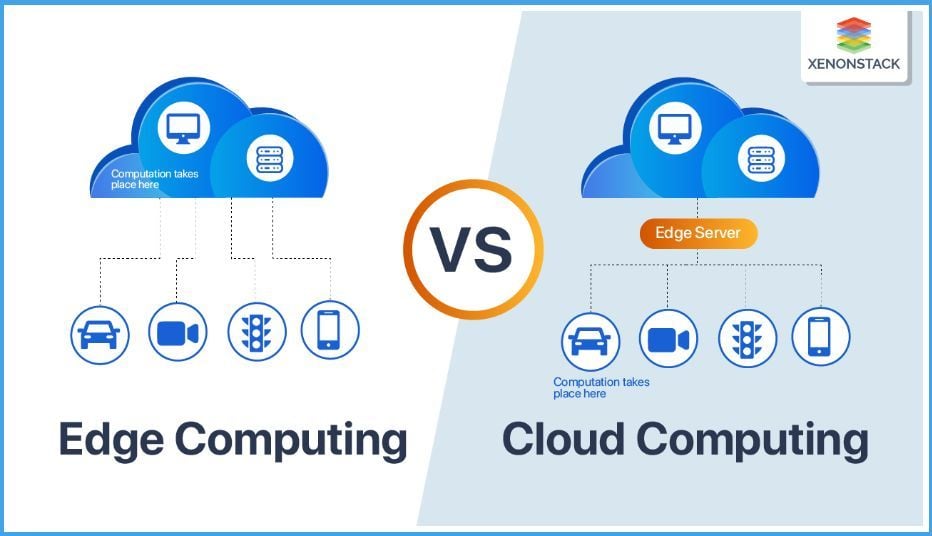
One trade-off dominates AIoT engineering complexity: should inference run on-device, at a gateway, or in the cloud? Each option moves a different cost around. The table below lays out how the choice plays out for a typical sensor-driven workload.
| Factor | On-device (edge) | Gateway / near-edge | Cloud |
|---|---|---|---|
| Inference latency | Single-digit ms | Tens of ms | 100 ms–seconds (network-bound) |
| Bandwidth cost | Minimal (decisions, not raw data) | Moderate | High (raw streams uploaded) |
| Works offline | Yes | Partially | No |
| Model size ceiling | Tight (MCU/NPU memory) | Moderate | Effectively unbounded |
| Update / retraining | Hard (OTA, fleet-wide) | Moderate | Trivial |
| Privacy exposure | Lowest (data stays local) | Medium | Highest |
The pattern we see most often: latency-sensitive or privacy-sensitive decisions belong at the edge, while heavy retraining and fleet-wide analytics belong in the cloud. The two are not competitors — a well-built AIoT system runs lightweight inference on the device and periodically ships aggregated features upstream to refine the model. If you are weighing this split in detail, our breakdown of edge computing versus cloud computing walks through where each genuinely earns its place, and the practical mechanics of getting a model onto constrained hardware are covered in our guide to deploying edge AI on IoT devices.
Edge deployment is where the abstractions stop being free. A model that runs comfortably in a PyTorch notebook on a workstation must be quantized — typically to INT8 — and compiled for the target runtime before it fits on a microcontroller-class NPU. Toolchains like TensorRT, ONNX Runtime, and TensorFlow Lite for Microcontrollers exist precisely to bridge that gap, and the conversion is rarely lossless: accuracy, latency, and memory footprint trade against each other, and the right operating point is workload-specific rather than universal.
How Is AI Used for Predictive Maintenance on IoT Devices?
Among AIoT applications, predictive maintenance offers the most transparent operational mechanism. Rotating machinery — pumps, motors, compressors, conveyor bearings — emits vibration and acoustic signatures that change in characteristic ways before a mechanical failure. IoT sensors capture those signatures continuously; a model trained on the difference between healthy and degrading signatures flags the drift early enough to schedule a repair instead of suffering an unplanned stoppage.
The reason to push that model to the edge is twofold. Vibration analysis needs high sample rates, and streaming raw high-frequency waveforms to the cloud is bandwidth-prohibitive across a large fleet. And the decision is time-sensitive — by the time a cloud round-trip completes, a fast-developing fault may already have caused damage. So the common architecture runs feature extraction and a compact anomaly model on a gateway near the machine, escalating only the interesting events upstream. Across deployments of this shape, the operationally relevant gain is not a single headline number but the shift from reactive to scheduled maintenance — the value lives in avoided unplanned downtime, which is intensely site-specific (observed pattern across industrial monitoring work; not a benchmarked rate).
How Can Edge AI Support Smart-City Environmental Monitoring?
Environmental and air-quality sensing presents a structurally different challenge, revealing why edge computing matters independent of latency concerns. A dense network of low-cost air-quality sensors generates enormous volumes of noisy data; the raw readings drift, cross-correlate with weather, and need calibration against reference stations. Running inference at the sensor or local node lets the system filter, calibrate, and aggregate locally — uploading interpreted readings instead of raw streams, which is what makes a city-scale deployment affordable to operate.
The harder modelling work is turning sparse, noisy sensor coverage into a usable pollution map. That involves spatial interpolation, sensor-fusion across heterogeneous sources, and accounting for the physical transport of pollutants. We explore the concrete version of this in using AI and IoT devices to fight air pollution, where the sensing layer and the inference layer have to be designed against each other rather than in isolation. The general lesson generalizes: when sensor data is cheap but noisy, the intelligence layer earns its keep by deciding what is worth keeping.
What Role Does AI Play in IoT Cybersecurity?
Connectivity enables IoT utility but simultaneously creates an expansive, vulnerable attack surface. Connected devices are numerous, often under-patched, and frequently deployed with default credentials — which is why they are a recurring target for botnet recruitment and lateral-movement attacks. AI’s role in IoT security is mostly anomaly detection: a model learns the normal traffic and behavioural profile of a device or fleet, then flags deviations that signature-based rules would miss.
This works because IoT devices, unlike general-purpose computers, have narrow and predictable behaviour. A smart thermostat that suddenly initiates outbound connections to an unfamiliar host is anomalous in a way a model can learn far more cleanly than it could for a laptop. The boundary condition is real, though — anomaly detection produces false positives, and a model trained on a device’s “normal” will misread legitimate firmware updates or seasonal usage shifts unless those are accounted for. Our deeper treatment of safeguarding connected devices against cyber threats covers where these defences hold and where they need human oversight. The honest framing is that AI raises the cost of an attack and shortens detection time; it does not make a connected device fundamentally trustworthy.
A Quick Read: Does the Internet of Things Use AI?
Only selectively, and never without deliberate configuration. A large share of deployed IoT is still pure telemetry — sensors reporting to dashboards, with humans or fixed rules making the decisions. AIoT is the subset where a model sits in the loop, and that subset is growing because the alternative — moving every reading to the cloud for analysis — does not scale on bandwidth, latency, or privacy once a fleet gets large. The market direction is toward more intelligence at the edge, driven by cheaper NPUs and better compression toolchains (directional industry-scale observation, not an operational benchmark). But the decision to add AI should follow a problem, not a trend: if rules-based logic answers your question reliably, a model is overhead.
FAQ
Does the internet of Things use AI?
Not universally. Much of deployed IoT is plain telemetry — sensors reporting to dashboards with humans or fixed rules deciding what to do. The subset where a trained model sits in the decision loop is what we call AIoT, and it is growing because shipping every reading to the cloud does not scale on bandwidth, latency, or privacy.
How does AI help with the internet of things?
AI turns raw sensor streams into decisions: detecting anomalies, predicting failures, classifying events, and filtering noise locally. IoT supplies the sensing and actuation; AI supplies the interpretation. Together they close the loop so a system can act on what it senses rather than just record it.
What is the difference between AI and IoT, and how do they work together as AIoT?
IoT answers what is happening by instrumenting the physical world and moving readings somewhere; AI answers what to do about it by finding the pattern and producing an action. AIoT is the integration of the two so the sensing and intelligence layers are designed together. The defining engineering question is where the model runs — on the device, on a gateway, or in the cloud.
How is AI used for predictive maintenance on IoT devices in manufacturing?
Rotating machinery emits vibration and acoustic signatures that change before failure. IoT sensors capture those signatures and a model trained on healthy-versus-degrading patterns flags the drift early enough to schedule repair. Feature extraction and the anomaly model usually run on a gateway near the machine because streaming raw high-frequency waveforms to the cloud is bandwidth-prohibitive and too slow for a time-sensitive fault.
How can edge AI on IoT devices help fight air pollution and support smart-city environmental monitoring?
Dense low-cost air-quality sensor networks generate noisy, drifting data. Running inference locally lets the system calibrate, filter, and aggregate at the node, uploading interpreted readings instead of raw streams — which is what makes city-scale operation affordable. The harder work is fusing sparse, noisy coverage into a usable pollution map through spatial interpolation and sensor fusion.
What role does AI play in IoT cybersecurity and safeguarding connected devices against threats?
AI’s main role is anomaly detection: a model learns a device’s normal traffic and behaviour, then flags deviations that signature-based rules miss. It works well because IoT devices have narrow, predictable behaviour. The limit is false positives — legitimate firmware updates or seasonal shifts can look anomalous — so AI shortens detection time and raises attack cost without making a device inherently trustworthy.
Where a project goes wrong is almost never the model itself — it is settling the edge-versus-cloud placement late, after the sensor selection, network plan, and update strategy have already hardened around the wrong assumption. Decide where inference runs first, and the rest of the AIoT architecture follows from it.