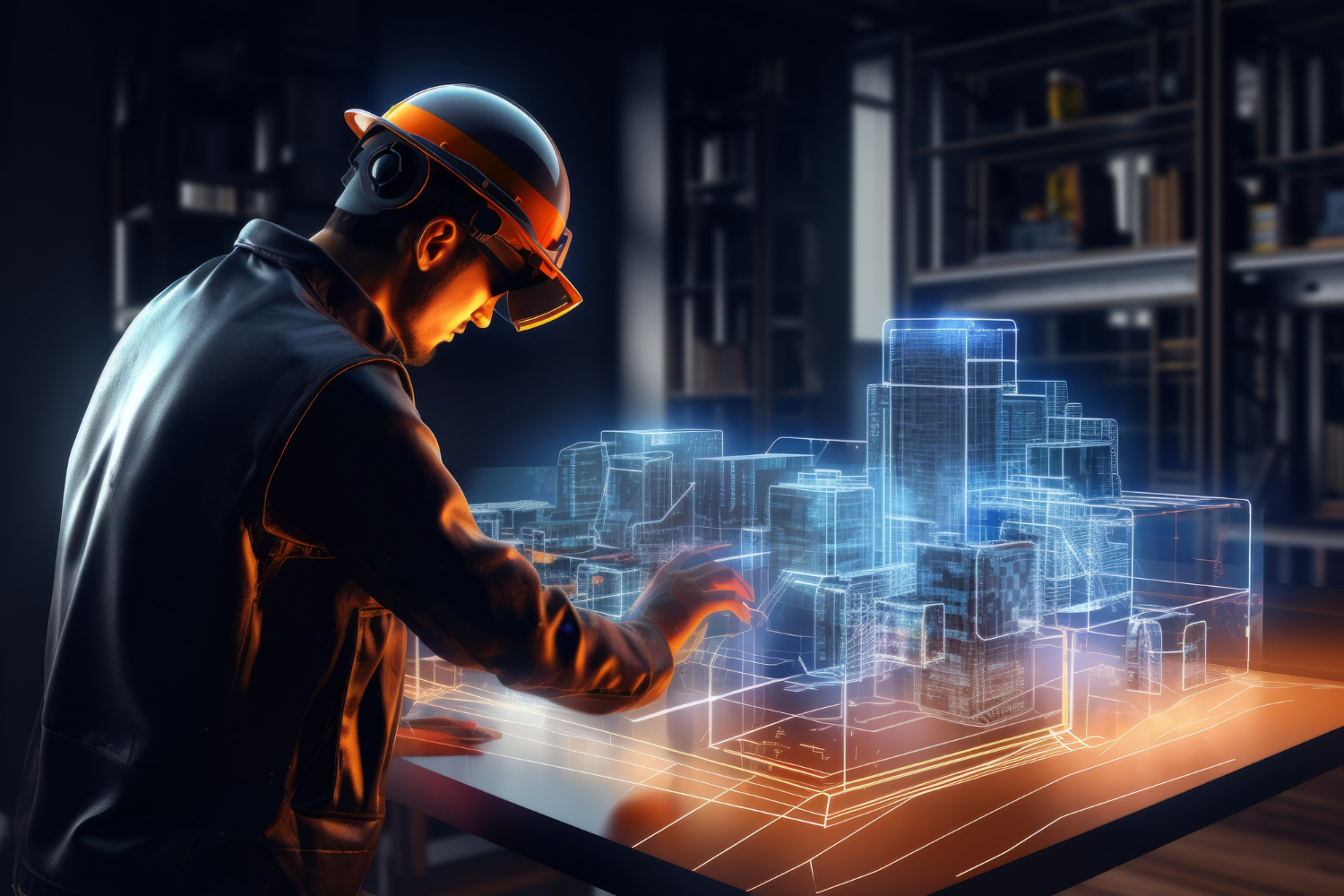
The construction industry sits on a slower automation curve than most people assume. Factories closed the loop on robotics decades ago because the work happens in a fixed environment, with parts presented at known poses, under controlled lighting. A construction site is the opposite of that: the geometry changes every shift, the materials arrive late, and the “fixture” is whatever the previous crew finished yesterday. Automation in construction is real and accelerating, but the systems that actually ship — bricklaying robots, autonomous haulers, drone-based progress capture — succeed by accepting that messiness rather than pretending it away.
What automation in construction actually means today
The phrase covers a range of technologies, and conflating them obscures where the engineering value lies. At one end sit industrial-style automation systems: feedback-controlled machinery that regulates a single process — concrete batching, rebar tying, panel fabrication — under conditions close enough to a factory that the standard control-loop tooling works. At the other end sit autonomous field systems: haul trucks, drones, and mobile robots that have to deal with unstructured outdoor environments, GNSS dropouts, dust, and humans walking through the workspace.
The hard problems differ between the two. For the first, the win comes from precision, repeatability, and integration with the rest of the site’s data flow. For the second, the win comes from perception, localisation, and safe behaviour around people. Both depend on real-time data, but the cost structure and the failure modes are not the same.
Where this fits in the broader picture
This article is the entry point to a wider thread on construction automation. We have separate pieces on robotics in the construction industry, on AI in construction, and on computer vision applied to construction sites. The piece you are reading stays at the level of what automation is, what it changes, and where the limits sit in our experience.
Productivity gains and the human-error question
Process control gains outweigh headcount savings in nearly every mature installation. A bricklaying machine that lays courses faster than a human is the headline, but the operationally relevant outcome is that the courses come out at consistent thickness and alignment, which compresses downstream rework. Rework is the dominant productivity tax on large construction projects, and any system that narrows the distribution of finished-quality outcomes pays back faster than one that only raises peak throughput.
Human error is the same story from a different angle. Automation does not eliminate human judgement — site supervisors still call the shots — but it removes the kind of fatigue-driven mistake that happens at the eleventh hour of a pour or at the end of a long shift on the slab. This is an observed pattern across our engagements with industrial clients adjacent to construction; it is not a benchmarked rate, and it depends heavily on how the work is sequenced.
Industrial robotics on site
Industrial robotics in construction has matured around tasks where the work envelope is small enough to keep the robot’s world model honest. A few examples that ship today:
- SAM100 (Construction Robotics) — a semi-automated bricklayer that pairs a robotic arm with a human operator. The robot handles placement and mortar; the human handles judgement calls on the wall geometry. It lays bricks several times faster than an unaided mason in suitable conditions.
- TyBot (Advanced Construction Robotics) — an autonomous rebar-tying machine that traverses a deck and ties intersections without a tether. Eliminates one of the most ergonomically punishing tasks on a slab pour.
- Caterpillar autonomous haul trucks — used in mining and heavy civil sites, run 24/7 along surveyed haul routes, removing operator fatigue from a high-volume repetitive cycle.
- ICON’s large-format 3D printers — extrude concrete walls in pre-programmed layers, useful for low-rise housing in geometries that would otherwise need extensive formwork.
- Drones for progress capture — survey-grade drones produce regular orthomosaics that feed into BIM-comparison pipelines, surfacing schedule slippage before it shows up in a status meeting.
What unites these is not the hardware. It is that each one has a tightly defined task envelope, a defined hand-off back to a human, and a sensor stack matched to the task — laser distance for bricklaying, vision for rebar intersections, GNSS plus inertial for haulers, photogrammetry for drones.
Real-time monitoring as the connective tissue
The least visible part of construction automation is the data plumbing. Automation systems generate telemetry continuously: machine state, position, material flow, energy draw, environmental conditions. Pulling that data into a single time-series store, where it can be cross-referenced with the project schedule, is what turns isolated automation pilots into something that affects the project as a whole.
| Layer | Typical role | Failure mode if missing |
|---|---|---|
| Sensor / telemetry | Capture state from machines, drones, site sensors | No ground truth on actual progress |
| Ingestion + storage | Aggregate streams into a time-series database | Data silos per vendor; no joining across systems |
| Analytics / control | Compute KPIs, drive feedback loops, flag anomalies | Reports lag reality by days; decisions made on stale data |
| Visualisation | Surface to supervisors, project managers, ops | Insights stay with the data team, not the site |
We see this layered view fail most often at the ingestion step. Every vendor exposes telemetry differently, and the work of normalising it is unglamorous enough to be deferred until a project is already in trouble.
Why does construction automation lag manufacturing?
Site heterogeneity will dictate whether vision systems can sustain the localization precision required for autonomous operation. That framing clarifies realistic expectations for the next five years. Clarity on that question dictates realistic timelines.
Manufacturing automation works because the environment is engineered around the robot. Construction has to do the inverse: the robot has to be engineered around an environment that nobody fully controls. That asymmetry shows up everywhere — in localisation (GNSS denied near steel structures), in perception (changing light, dust, mixed materials), in planning (sequences change daily), and in safety (humans share the workspace).
Useful systems handle this by either (a) carving out a sub-task with a stable envelope, or (b) keeping a human firmly in the loop. The systems that fail tend to over-promise full autonomy on tasks that still need judgement.
Supply chains and just-in-time delivery
Automation on site is only as good as the materials that reach it. Tracking systems that follow materials from supplier through staging to point-of-use are increasingly common, often using RFID or simple GPS-tagged shipments combined with site-level scanners. The payoff is not the tracking itself — it is the ability to align robotic and crewed work to actual material availability rather than to a paper schedule. A bricklaying robot waiting on pallets is more expensive than one that never showed up at all.
What “the future” actually looks like
Real deployment challenges surface here in full. The realistic picture is one in which more sub-tasks become automatable, more telemetry becomes available, and the integration layer becomes the differentiator. Companies that build the data backbone first and add automation incrementally tend to outperform those that buy a flagship robot and discover their data infrastructure cannot feed it.
There are also genuine open questions. Cybersecurity on connected site equipment is one — the threat surface grows with every networked machine. Workforce composition is another: automation shifts the skills mix toward operators who can supervise and diagnose machines, not replace skilled trades wholesale. These are not reasons to defer automation; they are reasons to plan for it deliberately.
How TechnoLynx fits in
At TechnoLynx we build the perception, integration, and control layers that make site automation defensible — particularly where GPU-accelerated computer vision, real-time telemetry, and edge inference have to coexist on equipment that was not designed with them in mind. Our R&D engagements with outcome ownership focus on the parts of the stack where off-the-shelf vendor software stops working: site-specific calibration, multi-sensor fusion, and the integration glue between automation islands.
If you are at the point of asking which of your processes are ready for automation and which are not, that is the conversation we have most often. The answer almost never comes from the catalogue of available robots; it comes from a careful look at where variance is killing your schedule and where a controlled sub-task can absorb a sensor-driven feedback loop.
Frequently Asked Questions
What is automation in construction?
It refers to using machines, robotics, and software systems to perform construction tasks with reduced human intervention — ranging from automated bricklaying and rebar tying to autonomous haul trucks and drone-based site monitoring. The common thread is closed-loop control over a defined sub-task.
Does construction automation replace workers?
Not in the sense of wholesale replacement. It shifts the skills mix toward operators who can supervise and troubleshoot machines, and it absorbs the most repetitive or hazardous parts of trades. Judgement-intensive work — sequencing, fault diagnosis, change orders — remains human.
What are the main barriers to adopting automation on construction sites?
The site environment is unstructured, which makes perception and localisation hard; vendor data formats are fragmented, which makes integration expensive; and the upfront capital cost is significant. Cybersecurity on networked equipment is an additional, often under-budgeted concern.
What technologies are most commonly used?
Industrial robotics for confined-envelope tasks (bricklaying, rebar tying), autonomous haulers for repetitive transport, large-format 3D printers for low-rise structures, drones for progress capture, and a real-time telemetry layer that ties them together. Computer vision and feedback-control systems sit underneath most of these.
Image by Freepik
Three priorities before investing in construction automation
Successful automation projects in construction share a disciplined sequence: establish clear performance criteria, validate results against those benchmarks, then refine efficiency. Everything else is detail.