“Quantization in machine learning” is not one technique
Practitioners often speak of “quantization in machine learning” as though it denotes one deterministic operation—enable it, gain speed, occasionally suffer quality regressions. It does not. Quantization in ML is a family of transformations, parameterized by what is being quantized, by which calibration data, by which method, and by which target format. Two models described as “quantized to INT8” can have substantially different accuracy and runtime behavior depending on which member of the family was applied and how.
Treating quantization as one thing produces a particular kind of mistake: generalizing a result obtained on one model family to another. The accuracy regression observed for INT8 on a convolutional vision model is not predictive of the regression for INT8 on a transformer language model, because the two have different activation-distribution properties that interact differently with low-precision representations. The generalization is not slightly off — it is structurally wrong. We see this pattern often enough that, in our experience, the first question to ask of any quantization result is which member of the family was actually applied.
What does the technique actually do?
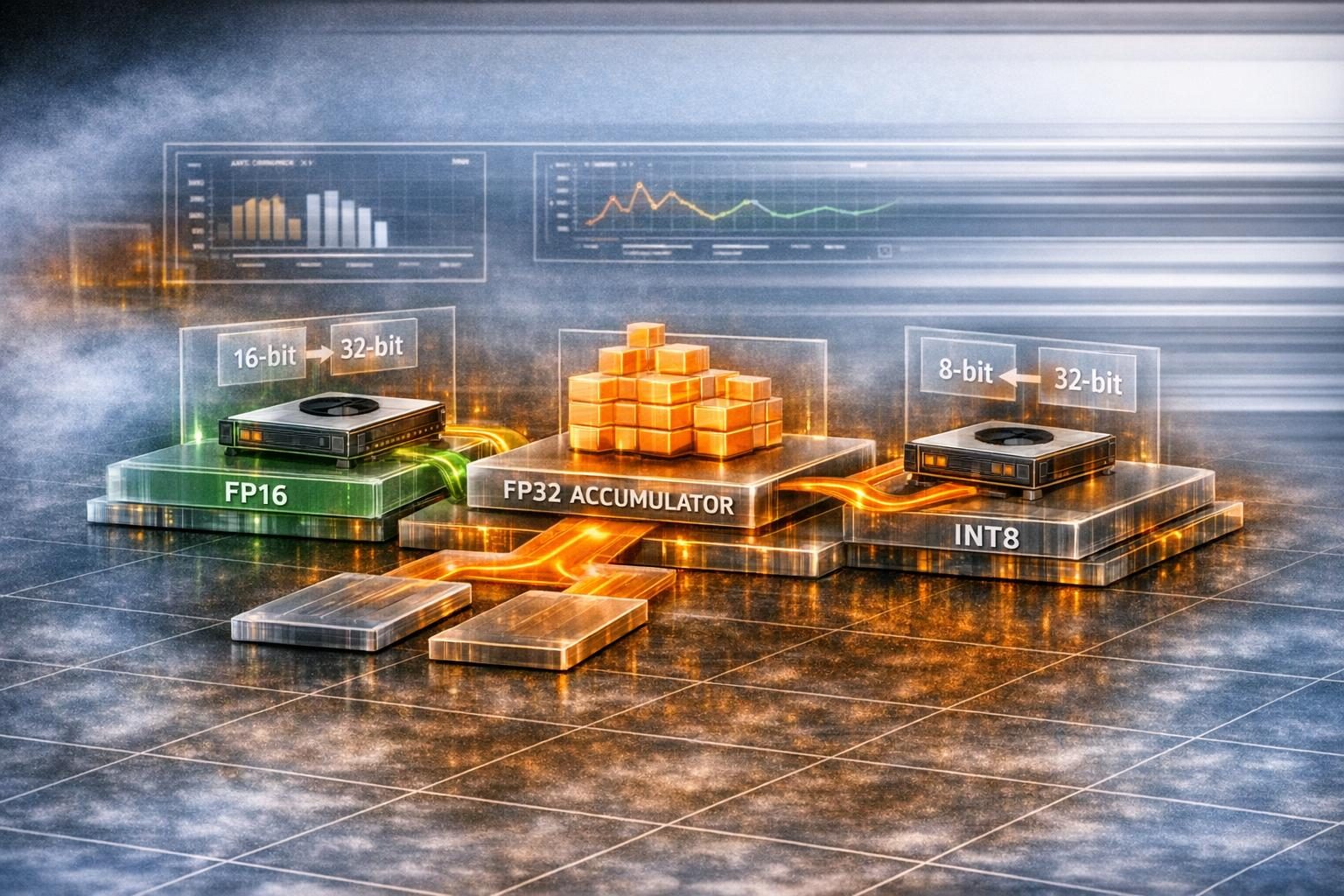
Replacing FP32 or FP16 weights and activations with INT8 or INT4 representations through a calibration procedure that bounds numerical error over representative inputs defines quantization in ML.
Three things in that sentence carry weight.
The first is replacement. The lower-precision values stand in for the original values during inference. They are not approximations layered on top of the originals; they are the numerical representation the runtime — TensorRT, ONNX Runtime’s quantization toolkit, llama.cpp’s GGUF kernels, PyTorch’s torch.ao.quantization, or a vendor-specific compiler — actually uses end-to-end.
The second is calibration. The mapping from the original value range to the discrete set of representable values in the lower-precision format is not arbitrary. It is chosen to minimize the error introduced into the model’s behavior on inputs drawn from a calibration set. The calibration set is the implicit assumption of the quantized model — it is the workload distribution the quantization is optimized for. Change the workload, and the calibration’s relevance shifts with it.
The third is family. There is no single quantization scheme. There is symmetric versus asymmetric quantization, per-tensor versus per-channel scale factors, post-training quantization versus quantization-aware training, weight-only versus weight-and-activation quantization, and outlier-aware variants like SmoothQuant, GPTQ, and AWQ that handle specific distributional pathologies. Each combination produces a different accuracy/throughput trade-off and a different runtime kernel requirement.
Bounded numerical error, not model damage
Precision about what quantization injects into your inference pipeline matters. Quantization introduces a bounded numerical error per tensor element: the difference between the original FP32 value and the nearest representable value in the target format, scaled by the quantization step. The bound is not folklore — it is a property of the chosen scale and zero-point. For symmetric per-tensor INT8 on a range [-r, r], the per-element error is bounded by roughly r / 127 in magnitude (an observed-pattern characterization that follows directly from the format definition).
This is a different kind of error from training error. Training error reflects the model’s inability to fit the data-generating distribution; it is statistical in origin and improves with more data or better optimization. Quantization error is deterministic given the scheme and calibration — the same input, twice, produces the same quantized activations and the same downstream deviation. That difference matters for evaluation: training-time noise can be averaged out, but quantization error compounds along whichever computational path the model uses, in a reproducible way.
The error is bounded, but the effect of that error on model outputs is not bounded by the same constant. A small numerical perturbation to an attention logit can change which token wins an argmax; a small perturbation to a softmax probability can shift a generation trajectory. The bound on element-wise error tells you what the format can do; the model’s structure tells you what that does to the output.
Why model family changes the risk
Activation distributions within the model determine how much accuracy risk a quantization scheme introduces. Different model families have systematically different activation behavior, which is why a “this works at INT8” generalization rarely transfers cleanly across families.
Convolutional models with bounded-range activations — for example, vision backbones with batch normalization and ReLU activations — typically have well-behaved activation distributions: most values cluster near zero, the range is bounded, and outliers are rare. INT8 quantization on this regime tends to produce negligible accuracy regression with off-the-shelf calibration, because the format’s representable range covers the activation distribution comfortably.
Attention-based models — transformers, including but not limited to LLMs — have activation distributions that include occasional large outliers, particularly in the input embeddings and attention scores. The same INT8 scheme that works cleanly on a convolutional backbone can produce substantial accuracy regression on a transformer when applied without an outlier-aware calibration scheme, because the format’s representable range either has to be set wide enough to cover the outliers — leaving the typical values represented at coarse granularity — or has to clip the outliers, which discards information the model uses. This is the distributional asymmetry that motivated work like SmoothQuant and the activation-aware variants now standard in LLM serving stacks.
LLMs amplify the transformer pattern further: their long autoregressive generation paths compound small per-token probability shifts into qualitatively different outputs many tokens downstream. A quantization scheme that produces a small per-token accuracy regression on a single-shot benchmark can produce a large generation-quality regression on long outputs. We have observed this gap in multiple engagements — the single-shot perplexity number understates what shows up at 2k+ generated tokens.
The implication is not that quantization “doesn’t work” on transformers or LLMs. It is that the quantization scheme that works on them is different from the one that works on convolutional models, and the calibration requirements are stricter.
Comparing quantization risk across model families
| Model family | Activation distribution | Typical INT8 risk | What calibration must capture |
|---|---|---|---|
| Convolutional vision models | Bounded, near-zero-centered, few outliers | Small; off-the-shelf calibration usually sufficient | Representative image distribution |
| Transformer encoders (e.g. classification) | Includes occasional outliers in embeddings and attention | Moderate; outlier-aware schemes helpful | Representative input distribution including edge cases |
| Transformer decoders (LLMs) | Outliers compound through autoregressive generation | Substantial without scheme adjustment; weight-and-activation INT8 is risky | Workload-shaped prompts including long generations |
| Recurrent models | Activation magnitudes can drift along long sequences | Variable; sequence-length-conditional | Calibration over deployment-representative sequence lengths |
Across deployment engagements, one trend holds: models whose activations produce outliers that challenge the low-precision format’s representable range demand tighter calibration and eliminate more off-the-shelf quantization options that preserve acceptable quality.
What this means for evaluating quantization claims
Without specifying the model family tested, a quantization result remains fundamentally incomplete. “Quantization works at INT8 with negligible accuracy loss” is a true statement about some models and a false one about others. The same is true of claims framed at the format level — “INT4 quantization preserves accuracy” — without naming the calibration scheme and the model family.
The right question for any quantization claim is not “is the accuracy loss small?” but “on which model family, with which scheme, with which calibration, evaluated on which workload, was the accuracy loss small?” Removing any of those four dimensions removes information the result depends on. A quantization-aware evaluation — the kind a serving team actually needs — exposes each of those dimensions and reports the workload-shaped accuracy delta, not just a headline number.### The bookkeeping comes before the numerics
Approximation discipline is procedural before it is numerical, and the released LynxBenchAI benchmark shows one form of that discipline on its own catalogue. The models are prepared once, before any target device is known, and the identical prepared artefacts are sent to every vendor’s hardware — so a difference between two devices is a difference in execution, not in how someone chose to prepare the model for that device. Where two vendors’ kernels disagree about what an approximation may do, the stricter constraint is applied to all of them rather than settled per vendor.
The second half of that bookkeeping is the threshold. Correctness criteria are enforced per test type and per precision, so an approximation that has gone too far is recorded as a zero rather than reported as a fast result. That is the property most quantization write-ups lack: a stated floor the output had to clear before its throughput number was allowed to count. None of this quantizes your model or validates your scheme — the run executes the catalogue fixed by one named release, and its GT figure is an ordinal aggregate over the three category scores, not a physical quantity or a 0–100 rating.
The framing that actually helps
Disciplined approximation through calibration characterizes quantization in ML. Its results are conditional on the calibration data, the scheme parameters, the model family’s activation distribution, and the evaluation workload. The general principle that quantization is controlled approximation rather than damage holds across the whole family — but the constants in the equation differ across model families, and reporting a result without those constants is reporting a number without its units.
LynxBenchAI treats quantization as a per-model-family, per-scheme, per-calibration evaluation regime — not as a single binary “quantized or not” axis — because the conditions of the result are what determine whether the result transfers to the workload that needs it. Stripped of the format name, on which model family, scheme, and calibration corpus did the quantization result you are about to cite establish achievable quality at this precision — and which of those constants is the deployment workload silently being asked to extrapolate across, rather than measure against?
Frequently Asked Questions
How does post-training quantization (PTQ) differ from quantization-aware training (QAT) in where the error is introduced?
PTQ applies the lower-precision mapping after training is finished, choosing scales and zero-points to minimise error on a calibration set while the weights stay fixed — so all of the approximation error enters at conversion time and is controlled only by the calibration corpus and scheme. QAT simulates quantization inside the training loop, letting the optimizer move the weights toward values that survive the coarser representation, which shifts control of the error upstream into training. PTQ is faster and needs no labelled training run; QAT is the lever you reach for when PTQ leaves regression you cannot accept on a sensitive model family.
Why does symmetric versus asymmetric quantization change the error characteristics at the same bit width?
Symmetric quantization centres the representable range on zero with a single scale, while asymmetric quantization adds a zero-point offset so the range can track a distribution that is not centred on zero. For activations like post-ReLU values that are entirely non-negative, a symmetric scheme spends half its codes on a range the data never visits, coarsening granularity where the values actually live. Asymmetric mapping reclaims that range, which is why two INT8 models can carry materially different error even though both are eight-bit.
When quantization accuracy loss looks unacceptable, how do I isolate the cause?
Separate the three candidate causes this article names: calibration corpus, scheme choice, and genuine model sensitivity. Re-run with a workload-shaped calibration set first — if the regression shrinks, the corpus was the problem. If it persists, swap to an outlier-aware scheme such as SmoothQuant or an asymmetric per-channel variant; only when both fail should you conclude the model family is genuinely sensitive at that precision and consider QAT or a higher bit width.
What does a LynxBenchAI run actually tell me about my own quantization scheme?
Nothing directly, and it is worth being blunt about that. A run executes the catalogue fixed by one named release on prepared artefacts built before any device was chosen; it does not quantize your model or validate your scheme. What it demonstrates is the bookkeeping — what was prepared, under whose constraint, and what correctness floor a result had to clear — which is the same bookkeeping your own evaluation has to state rather than assume.
Three numbers that matter more than the bit-width
Measure calibration dataset size, conduct layer-wise sensitivity analysis, and validate post-training perplexity to confirm your quantization approach survives production conditions. If any of those differ, are you still looking at a comparison, or two unrelated observations?