CUDA vs OpenCL: Picking the Right GPU Path

A clear, practical guide to cuda vs opencl for GPU programming, covering portability, performance, tooling, ecosystem fit, and how to choose for your team and workload.

CUDA vs OpenCL: Picking the Right GPU Path
Written by TechnoLynx Published on 13 Jan 2026

Introduction

When you build GPU‑accelerated software, you will likely weigh CUDA vs OPENCL. Both deliver massive parallel compute. Both can speed up maths, simulation, and AI. Yet they differ in portability, tools, and day‑to‑day developer experience. Picking the right one depends on the hardware you target, the skills in your team, and the lifetime of your product.

This article breaks down the practical differences, trade‑offs, and typical use cases. It also offers a pragmatic selection path so you can choose with confidence. Finally, we show how TechnoLynx supports teams on either path, including projects that run well across NVIDIA, AMD, Apple and more.

What CUDA is

CUDA is NVIDIA’s proprietary GPU programming model. It offers a C/C++ API, a mature compiler toolchain, and tight integration with the company’s devices. CUDA gives you access to modern features: tensor cores, warp‑level primitives, shared memory tricks, and rich libraries for linear algebra, FFT, sparse operations, and graph algorithms. If your fleet is mostly NVIDIA, CUDA is a strong default.

CUDA’s draw is the developer experience. The ecosystem includes profilers, debuggers, sanitizers, and tuned libraries. Documentation is deep, and examples are plentiful. For teams who care about peak performance on NVIDIA hardware, or who need specialised kernels, CUDA is often the fastest route from idea to real speed.

What OpenCL is

OpenCL is a vendor‑neutral standard managed by the Khronos Group. It targets heterogeneous compute: GPUs from different vendors, CPUs, FPGAs, and other accelerators. The core idea is portability. You write kernels in a C‑like language and run them on many devices, provided a driver exists. If your product needs to support multiple GPU vendors or mixed hardware, OpenCL offers a common baseline.

OpenCL’s benefit is reach. Organisations with AMD workstations, Intel integrated graphics, Apple silicon, or embedded SoCs can share one codebase. The flip side is variability. Driver quality, supported features, and performance tuning options can differ by vendor. You will often write capability checks and keep fallback code paths.


Read more: Performance Engineering for Scalable Deep Learning Systems

Portability vs Performance

A simple view of cuda vs opencl is portability vs peak performance. CUDA commits you to NVIDIA hardware yet gives you a polished, high‑speed stack. OpenCL broadens your device list at the cost of extra care for edge cases and vendor nuances.
Read more: CUDA, Frameworks, and Ecosystem Lock-In

In practice, many teams aim for both. They keep a common algorithm core, then maintain a CUDA path for NVIDIA and an OpenCL path for others. This pattern reduces lock‑in while preserving speed where it matters. TechnoLynx often implements this kind of dual‑backend design for clients who must run across platforms without sacrificing throughput.

Tooling and Developer Experience

CUDA:

  • Mature tools: Nsight Systems/Compute, sanitizers, SASS/PTX views.

  • Rich libraries: cuBLAS, cuFFT, cuSPARSE, Thrust, CUTLASS, TensorRT.

  • Strong docs and community support.

  • Rapid access to new hardware features.


OpenCL:

  • Cross‑vendor compilers and ICD loaders.

  • Portability across device families.

  • Broad but uneven library support; many teams integrate clBLAS/clFFT or write custom kernels.

  • Tooling depends on vendor; experience can vary.


Read more: Choosing TPUs or GPUs for Modern AI Workloads


If your team values polished profiling and quick iteration on NVIDIA, CUDA wins. If your priority is one codebase that reaches diverse hardware, OpenCL makes sense. TechnoLynx’s engineering practice spans CUDA, OpenCL, SYCL, Metal and more, precisely to offer that choice.

Language and API Style

CUDA feels like C/C++ with device extensions. You write kernels, launch grids/blocks, and manage memory explicitly. The model is clear for those used to C++.

OpenCL separates host and device even more strictly. You compile kernels at run‑time or ahead of time, query platforms, pick devices, and set up contexts and command queues. This extra ceremony buys portability but adds boilerplate.

If your developers prefer compact, vendor‑specific C++ that “just works” on NVIDIA, CUDA is friendly. If your priority is standardised, cross‑device API discipline, OpenCL matches that mindset.

Performance Tuning Patterns

With cuda vs opencl, tuning patterns overlap—coalesced memory access, shared memory tiling, avoiding branch divergence, and right‑sized work‑groups. CUDA offers more direct control over warp‑level behaviour and shared memory banking. OpenCL exposes similar levers but the behaviours differ by device and driver.

A common route is to build a portable baseline in OpenCL, then fine‑tune hot kernels in CUDA for NVIDIA targets. TechnoLynx has often used this layered approach, and in some cases even translated OpenCL kernels to platform‑specific backends like Metal to reach Apple silicon while keeping a single source strategy.


Read more: Energy-Efficient GPU for Machine Learning

Ecosystem Fit (AI, Vision, Scientific Computing)

If you work in AI and deep learning inference, CUDA integrates cleanly with TensorRT, cuDNN and recent model runtimes. For heavy computer vision, the CUDA ecosystem is rich and well maintained. In scientific computing, both CUDA and OpenCL appear, but specialist libraries on CUDA are often newer and faster on NVIDIA devices.

If you need to support labs with mixed GPUs or run on Apple laptops used by creative teams, OpenCL (and sometimes a path to Metal) is helpful. TechnoLynx’s case studies include moving OpenCL projects to Metal for Apple silicon and retaining high speed without splitting the codebase.

Driver Quality and Support Lifecycles

Vendor support affects day‑to‑day reliability. NVIDIA’s CUDA stack is cohesive: drivers, compiler, libraries, and tools evolve together. OpenCL support depends on each vendor’s investment. AMD, Intel and Apple have improved their stacks, but features and stability can differ.

If uptime and predictable behaviour on NVIDIA matter more than broad device reach, CUDA reduces noise. If you must deploy across different hardware generations and vendors, OpenCL is the standards‑based path.

Maintenance Over Time

Projects live for years. Team skills change. Devices get replaced. In cuda vs opencl terms, long‑term maintenance hinges on two points:

  • Portability risk: CUDA ties you to NVIDIA; OpenCL keeps doors open.

  • Complexity cost: OpenCL might mean more device handling code; CUDA simplifies on one vendor.


TechnoLynx helps organisations model these risks. Sometimes the right call is a primary CUDA path with a secondary OpenCL path for portability. Sometimes the right call is OpenCL core logic with per‑device tuning layers. We have implemented both, and even cross‑compilation/transpilation to reach Apple’s Metal while preserving a single codebase.


Read more: Case Study: GPU Porting from OpenCL to Metal - V-Nova

Security, Compliance, and Procurement

Some sectors prefer open standards for audit and long‑term support. OpenCL suits that stance. Others focus on battle‑tested drivers and support agreements; CUDA suits that stance on NVIDIA fleets. Procurement can also influence the choice: existing contracts, available hardware, and in‑house skills often decide more than benchmarks.

Typical Decision Scenarios

Pick CUDA when:

  • Your production hardware is almost entirely NVIDIA.

  • You need peak performance quickly and value polished tools.

  • Your models rely on NVIDIA‑specific libraries (cuDNN, TensorRT).

  • Your team is comfortable with C++ and device‑specific tuning.


Pick OpenCL when:

  • You must run across vendors (NVIDIA, AMD, Intel, Apple).

  • You target heterogeneous devices beyond GPUs (CPUs/FPGAs).

  • You want a standards‑based API and single codebase discipline.

  • You can invest in vendor‑specific fixes while keeping the core portable.


Pick both when:

  • You want portability and peak speed.

  • You keep a portable algorithm layer, then add CUDA kernels for NVIDIA.

  • You need to support Apple silicon via a translation path to Metal.

  • You view portability and performance as complementary, not opposites.


TechnoLynx frequently delivers these mixed strategies, backed by proven multi‑framework expertise (CUDA, OpenCL, SYCL, Metal, DirectX/Vulkan) and end‑to‑end performance audits.


Read more: Case Study: Metal-Based Pixel Processing for Video Decoder - V-Nova

A Pragmatic Selection Path

Use this short, repeatable plan to decide:

  1. List target devices: current fleet and near‑term purchases.

  2. Map ecosystem needs: libraries, toolchains, and third‑party components.

  3. Prototype both: build a minimal kernel or pipeline in CUDA and OpenCL.

  4. Measure: look at wall‑time, energy draw, and maintenance effort.

  5. Decide: pick one or use a dual path based on your findings.


Rerun this plan when hardware changes or when your application grows. Decisions that follow real measurements age better than assumptions.

Common Pitfalls (and fixes)

  • Portability without testing: OpenCL code can pass on one GPU and stall on another. Fix: add continuous tests on all supported devices.

  • Vendor lock‑in surprise: A CUDA‑only stack may block a future customer who runs AMD or Apple. Fix: keep a portable core or plan a translation route.

  • Profile blindness: Developers tune kernels without measuring end‑to‑end. Fix: use system‑level profiling from ingest to output.

  • Data movement bottlenecks: Host–device transfers erase gains. Fix: batch transfers, use pinned memory, and fuse small ops.


TechnoLynx’s practice focuses on full‑pipeline audits to catch these early, then redesigns data flow and kernels to keep devices busy and apps stable.


Read more: Accelerating Genomic Analysis with GPU Technology

Real‑World Porting Stories

We have worked on projects where a client’s OpenCL application needed strong performance on Apple silicon. Rather than branch into a separate codebase, we built a translation layer that mapped the used subset of OpenCL to Metal, achieving multi‑fold speedups while retaining single‑source maintainability. The result was faster software across Apple GPUs and sustained portability for the wider fleet.

In another stream, we helped teams decide when to keep OpenCL for portability and where to add CUDA‑specific kernels to reach peak speed on NVIDIA cards—always with a measured, documentable path your engineers can maintain.

TechnoLynx: CUDA and OpenCL, done right

TechnoLynx specialises in performance engineering on GPUs; CUDA, OpenCL, SYCL, Metal, and more. Our work spans algorithm redesign, kernel tuning, and cross‑platform porting. We optimise pipelines for training and inference, scientific computing, and real‑time vision, across NVIDIA, AMD, Intel and Apple devices. Our team has built cross‑GPU portability layers, delivered 10×–300× speed‑ups, and audited full stacks so improvements hold in production, not just in benchmarks.


Contact TechnoLynx today to discuss your CUDA vs OpenCL needs. Whether you want a single portable codebase, a CUDA fast path, or a translator to Apple’s Metal, we will design and implement a solution that fits your hardware, team skills, and long‑term roadmap; ready for scale and change!


Image credits: Freepik

Cost, Efficiency, and Value Are Not the Same Metric

Cost, Efficiency, and Value Are Not the Same Metric

17/04/2026

Performance per dollar. Tokens per watt. Cost per request. These sound like the same thing said differently, but they measure genuinely different dimensions of AI infrastructure economics. Conflating them leads to infrastructure decisions that optimize for the wrong objective.

Precision Is an Economic Lever in Inference Systems

Precision Is an Economic Lever in Inference Systems

17/04/2026

Precision isn't just a numerical setting — it's an economic one. Choosing FP8 over BF16, or INT8 over FP16, changes throughput, latency, memory footprint, and power draw simultaneously. For inference at scale, these changes compound into significant cost differences.

Precision Choices Are Constrained by Hardware Architecture

Precision Choices Are Constrained by Hardware Architecture

17/04/2026

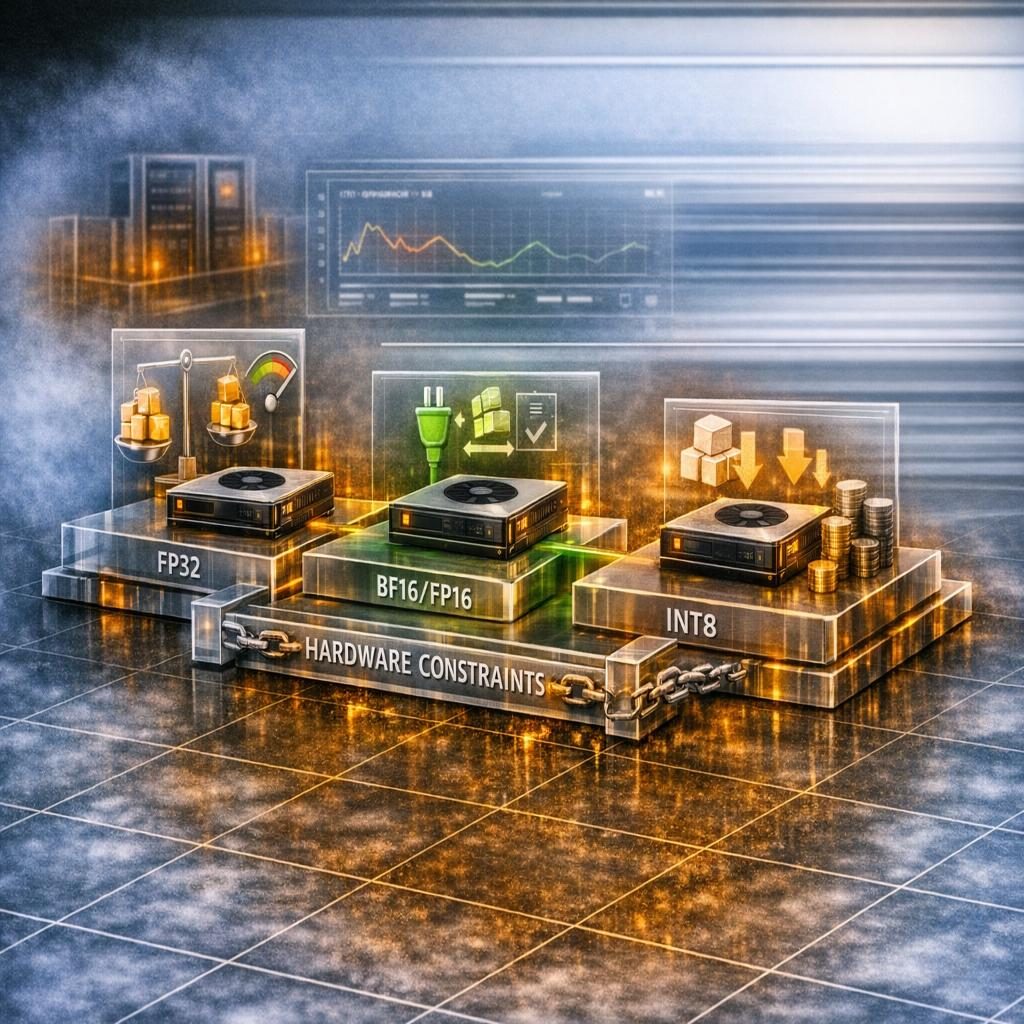
You can't run FP8 inference on hardware that doesn't have FP8 tensor cores. Precision format decisions are conditional on the accelerator's architecture — its tensor core generation, native format support, and the efficiency penalties for unsupported formats.

Steady-State Performance, Cost, and Capacity Planning

Steady-State Performance, Cost, and Capacity Planning

17/04/2026

Capacity planning built on peak performance numbers over-provisions or under-delivers. Real infrastructure sizing requires steady-state throughput — the predictable, sustained output the system actually delivers over hours and days, not the number it hit in the first five minutes.

How Benchmark Context Gets Lost in Procurement

How Benchmark Context Gets Lost in Procurement

16/04/2026

A benchmark result starts with full context — workload, software stack, measurement conditions. By the time it reaches a procurement deck, all that context is gone. The failure mode is not wrong benchmarks but context loss during propagation.

Building an Audit Trail: Benchmarks as Evidence for Governance and Risk

Building an Audit Trail: Benchmarks as Evidence for Governance and Risk

16/04/2026

High-value AI hardware decisions need traceable evidence, not slide-deck bullet points. When benchmarks are documented with methodology, assumptions, and limitations, they become auditable institutional evidence — defensible under scrutiny and revisitable when conditions change.

The Comparability Protocol: Why Benchmark Methodology Defines What You Can Compare

The Comparability Protocol: Why Benchmark Methodology Defines What You Can Compare

16/04/2026

Two benchmark scores can only be compared if they share a declared methodology — the same workload, precision, measurement protocol, and reporting conditions. Without that contract, the comparison is arithmetic on numbers of unknown provenance.

A Decision Framework for Choosing AI Hardware

A Decision Framework for Choosing AI Hardware

16/04/2026

Hardware selection is a multivariate decision under uncertainty — not a score comparison. This framework walks through the steps: defining the decision, matching evaluation to deployment, measuring what predicts production, preserving tradeoffs, and building a repeatable process.

How Benchmarks Shape Organizations Before Anyone Reads the Score

How Benchmarks Shape Organizations Before Anyone Reads the Score

16/04/2026

Before a benchmark score informs a purchase, it has already shaped what gets optimized, what gets reported, and what the organization considers important. Benchmarks function as decision infrastructure — and that influence deserves more scrutiny than the number itself.

Accuracy Loss from Lower Precision Is Task‑Dependent

Accuracy Loss from Lower Precision Is Task‑Dependent

16/04/2026

Reduced precision does not produce a uniform accuracy penalty. Sensitivity depends on the task, the metric, and the evaluation setup — and accuracy impact cannot be assumed without measurement.

Precision Is a Design Parameter, Not a Quality Compromise

Precision Is a Design Parameter, Not a Quality Compromise

16/04/2026

Numerical precision is an explicit design parameter in AI systems, not a moral downgrade in quality. This article reframes precision as a representation choice with intentional trade-offs, not a concession made reluctantly.

Mixed Precision Works by Exploiting Numerical Tolerance

Mixed Precision Works by Exploiting Numerical Tolerance

16/04/2026

Not every multiplication deserves 32 bits. Mixed precision works because neural network computations have uneven numerical sensitivity — some operations tolerate aggressive precision reduction, others don't — and the performance gains come from telling them apart.

Throughput vs Latency: Choosing the Wrong Optimization Target

16/04/2026

Throughput and latency are different objectives that often compete for the same resources. This article explains the trade-off, why batch size reshapes behavior, and why percentiles matter more than averages in latency-sensitive systems.

Quantization Is Controlled Approximation, Not Model Damage

16/04/2026

When someone says 'quantize the model,' the instinct is to hear 'degrade the model.' That framing is wrong. Quantization is controlled numerical approximation — a deliberate engineering trade-off with bounded, measurable error characteristics — not an act of destruction.

GPU Utilization Is Not Performance

15/04/2026

The utilization percentage in nvidia-smi reports kernel scheduling activity, not efficiency or throughput. This article explains the metric's exact definition, why it routinely misleads in both directions, and what to pair it with for accurate performance reads.

FP8, FP16, and BF16 Represent Different Operating Regimes

15/04/2026

FP8 is not just 'half of FP16.' Each numerical format encodes a different set of assumptions about range, precision, and risk tolerance. Choosing between them means choosing operating regimes — different trade-offs between throughput, numerical stability, and what the hardware can actually accelerate.

Peak Performance vs Steady‑State Performance in AI

15/04/2026

AI systems rarely operate at peak. This article defines the peak vs. steady-state distinction, explains when each regime applies, and shows why evaluations that capture only peak conditions mischaracterize real-world throughput.

The Software Stack Is a First‑Class Performance Component

15/04/2026

Drivers, runtimes, frameworks, and libraries define the execution path that determines GPU throughput. This article traces how each software layer introduces real performance ceilings and why version-level detail must be explicit in any credible comparison.

The Mythology of 100% GPU Utilization

15/04/2026

Is 100% GPU utilization bad? Will it damage the hardware? Should you be worried? For datacenter AI workloads, sustained high utilization is normal — and the anxiety around it usually reflects gaming-era intuitions that don't apply.

Why Benchmarks Fail to Match Real AI Workloads

15/04/2026

The word 'realistic' gets attached to benchmarks freely, but real AI workloads have properties that synthetic benchmarks structurally omit: variable request patterns, queuing dynamics, mixed operations, and workload shapes that change the hardware's operating regime.

Why Identical GPUs Often Perform Differently

15/04/2026

'Same GPU' does not imply the same performance. This article explains why system configuration, software versions, and execution context routinely outweigh nominal hardware identity.

Training and Inference Are Fundamentally Different Workloads

15/04/2026

A GPU that excels at training may disappoint at inference, and vice versa. Training and inference stress different system components, follow different scaling rules, and demand different optimization strategies. Treating them as interchangeable is a design error.

Performance Ownership Spans Hardware and Software Teams

15/04/2026

When an AI workload underperforms, attribution is the first casualty. Hardware blames software. Software blames hardware. The actual problem lives in the gap between them — and no single team owns that gap.

Performance Emerges from the Hardware × Software Stack

15/04/2026

AI performance is an emergent property of hardware, software, and workload operating together. This article explains why outcomes cannot be attributed to hardware alone and why the stack is the true unit of performance.

Power, Thermals, and the Hidden Governors of Performance

14/04/2026

Every GPU has a physical ceiling that sits below its theoretical peak. Power limits, thermal throttling, and transient boost clocks mean that the performance you read on the spec sheet is not the performance the hardware sustains. The physics always wins.

Why AI Performance Changes Over Time

14/04/2026

That impressive throughput number from the first five minutes of a training run? It probably won't hold. AI workload performance shifts over time due to warmup effects, thermal dynamics, scheduling changes, and memory pressure. Understanding why is the first step toward trustworthy measurement.

CUDA, Frameworks, and Ecosystem Lock-In

14/04/2026

Why is it so hard to switch away from CUDA? Because the lock-in isn't in the API — it's in the ecosystem. Libraries, tooling, community knowledge, and years of optimization create switching costs that no hardware swap alone can overcome.

GPUs Are Part of a Larger System

14/04/2026

CPU overhead, memory bandwidth, PCIe topology, and host-side scheduling routinely limit what a GPU can deliver — even when the accelerator itself has headroom. This article maps the non-GPU bottlenecks that determine real AI throughput.

Why AI Performance Must Be Measured Under Representative Workloads

14/04/2026

Spec sheets, leaderboards, and vendor numbers cannot substitute for empirical measurement under your own workload and stack. Defensible performance conclusions require representative execution — not estimates, not extrapolations.

Low GPU Utilization: Where the Real Bottlenecks Hide

14/04/2026

When GPU utilization drops below expectations, the cause usually isn't the GPU itself. This article traces common bottleneck patterns — host-side stalls, memory-bandwidth limits, pipeline bubbles — that create the illusion of idle hardware.

Why GPU Performance Is Not a Single Number

14/04/2026

AI GPU performance is multi-dimensional and workload-dependent. This article explains why scalar rankings collapse incompatible objectives and why 'best GPU' questions are structurally underspecified.

What a GPU Benchmark Actually Measures

14/04/2026

A benchmark result is not a hardware measurement — it is an execution measurement. The GPU, the software stack, and the workload all contribute to the number. Reading it correctly requires knowing which parts of the system shaped the outcome.

Why Spec‑Sheet Benchmarking Fails for AI

14/04/2026

GPU spec sheets describe theoretical limits. This article explains why real AI performance is an execution property shaped by workload, software, and sustained system behavior.

Visual Computing in Life Sciences: Real-Time Insights

6/11/2025

Learn how visual computing transforms life sciences with real-time analysis, improving research, diagnostics, and decision-making for faster, accurate outcomes.

AI-Driven Aseptic Operations: Eliminating Contamination

21/10/2025

Learn how AI-driven aseptic operations help pharmaceutical manufacturers reduce contamination, improve risk assessment, and meet FDA standards for safe, sterile products.

AI Visual Quality Control: Assuring Safe Pharma Packaging

20/10/2025

See how AI-powered visual quality control ensures safe, compliant, and high-quality pharmaceutical packaging across a wide range of products.

AI for Reliable and Efficient Pharmaceutical Manufacturing

15/10/2025

See how AI and generative AI help pharmaceutical companies optimise manufacturing processes, improve product quality, and ensure safety and efficacy.

Barcodes in Pharma: From DSCSA to FMD in Practice

25/09/2025

What the 2‑D barcode and seal on your medicine mean, how pharmacists scan packs, and why these checks stop fake medicines reaching you.

Pharma’s EU AI Act Playbook: GxP‑Ready Steps

24/09/2025

A clear, GxP‑ready guide to the EU AI Act for pharma and medical devices: risk tiers, GPAI, codes of practice, governance, and audit‑ready execution.

Cell Painting: Fixing Batch Effects for Reliable HCS

23/09/2025

Reduce batch effects in Cell Painting. Standardise assays, adopt OME‑Zarr, and apply robust harmonisation to make high‑content screening reproducible.

Explainable Digital Pathology: QC that Scales

22/09/2025

Raise slide quality and trust in AI for digital pathology with robust WSI validation, automated QC, and explainable outputs that fit clinical workflows.

Validation‑Ready AI for GxP Operations in Pharma

19/09/2025

Make AI systems validation‑ready across GxP. GMP, GCP and GLP. Build secure, audit‑ready workflows for data integrity, manufacturing and clinical trials.

Edge Imaging for Reliable Cell and Gene Therapy

17/09/2025

Edge imaging transforms cell & gene therapy manufacturing with real‑time monitoring, risk‑based control and Annex 1 compliance for safer, faster production.

AI in Genetic Variant Interpretation: From Data to Meaning

15/09/2025

AI enhances genetic variant interpretation by analysing DNA sequences, de novo variants, and complex patterns in the human genome for clinical precision.

AI Visual Inspection for Sterile Injectables

11/09/2025

Improve quality and safety in sterile injectable manufacturing with AI‑driven visual inspection, real‑time control and cost‑effective compliance.

Predicting Clinical Trial Risks with AI in Real Time

5/09/2025

AI helps pharma teams predict clinical trial risks, side effects, and deviations in real time, improving decisions and protecting human subjects.

Generative AI in Pharma: Compliance and Innovation

1/09/2025

Generative AI transforms pharma by streamlining compliance, drug discovery, and documentation with AI models, GANs, and synthetic training data for safer innovation.

AI for Pharma Compliance: Smarter Quality, Safer Trials

27/08/2025

AI helps pharma teams improve compliance, reduce risk, and manage quality in clinical trials and manufacturing with real-time insights.

Back See Blogs
arrow icon