Most teams discover edge machine learning the same way: a pilot works in the lab, then stutters on the live network. The bench had a 20 ms round-trip; the field has 180 ms (illustrative figures from edge deployments), and the application was specified against the wrong budget. The pattern repeats across telecom AR, factory vision, and vehicle perception, and it has the same root cause — the latency budget was set at the application layer instead of end-to-end, from sensor through edge compute, network, and back to the actuator or display. The telecom side of that pattern is exactly what our media and telecom practice tracks.
Edge machine learning is the deliberate response: run inference (and sometimes light fine-tuning) on or near the device that captures the data, rather than round-tripping every frame to a centralised cloud GPU. That sentence is doing a lot of work, so the rest of this piece unpacks where the edge actually earns its place, where the cloud still wins, and how to choose between them without confusion.
What counts as “the edge” in a real deployment
Edge infrastructure spans multiple device classes, not a single box. It is whatever sits between the sensor and the centralised data centre and is allowed to make decisions. In practice this lands in one of four places: a microcontroller-class chip co-located with a sensor; an embedded module like an NVIDIA Jetson Orin or Hailo-8 inside a camera or vehicle; a small server in a factory cell or telecom edge site; or a regional point of presence one network hop from the radio access network.
These tiers differ by orders of magnitude on memory, power, and thermals. A Jetson Orin Nano gives you roughly 40 TOPS in an 15 W envelope and runs PyTorch and TensorRT directly. A Cortex-M55 with an Ethos-U55 NPU gives you a few hundred GOPS in milliwatts and runs models exported through TensorFlow Lite Micro or ExecuTorch. The job-to-be-done determines the tier, not the other way around — and the wrong tier is the single most common reason an edge ML pilot quietly fails.
What does an “end-to-end latency budget” actually mean?
It means the clock starts when a photon hits the sensor and stops when the actuator moves or the display refreshes. For a telecom AR overlay the chain is roughly: sensor capture (8–16 ms), on-device pre-processing (2–5 ms), uplink to edge (5–30 ms depending on RAN and slicing), inference at the edge (5–20 ms), downlink (5–30 ms), and render-to-photon on the headset (16–25 ms). Add it up and the floor is around 40 ms on a clean 5G slice and 80–120 ms on a contested one. Motion-to-photon comfort thresholds for AR sit near 20 ms. That gap — the one the application layer cannot see — is where pilots break.
A practical view of the lifecycle
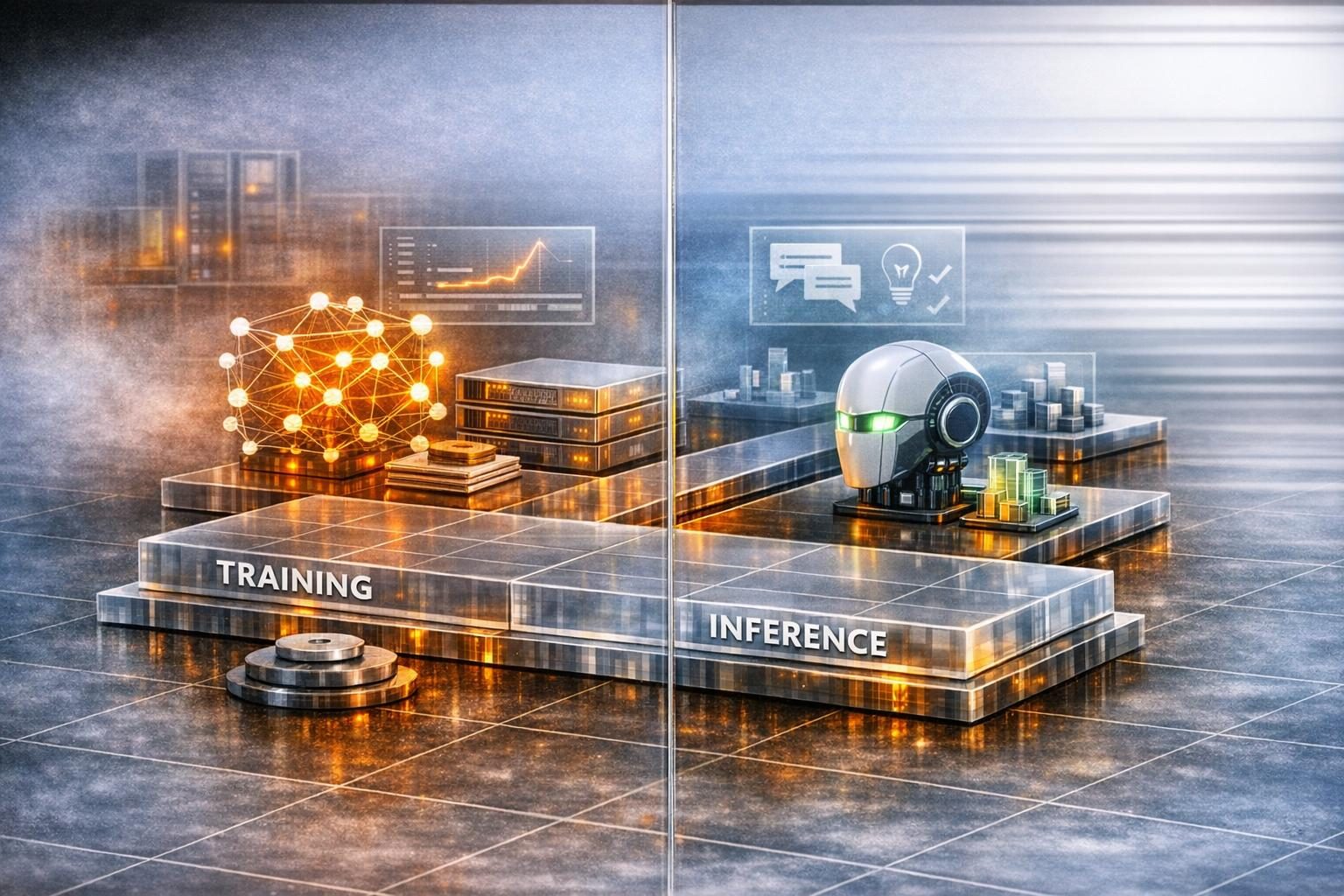
Data collection, preparation, model training, deployment, and performance monitoring form the standard machine learning loop. Training is heavy and benefits from centralised GPU clusters, mixed-precision, and NCCL-based multi-node collectives. Inference is the opposite workload — short, bursty, latency-sensitive — and is exactly what edge hardware is built for. We explored that asymmetry in Training and Inference Are Fundamentally Different Workloads, and the distinction matters because it explains why the same model can live in two places at once: trained centrally, served locally.
In our experience, the firms that ship working edge ML treat this split as architectural, not opportunistic. A distilled model — often a smaller variant produced by knowledge distillation from a larger teacher — runs on the edge for the fast path. A larger model in the cloud handles hard cases, batch re-labelling, and the next round of training. The edge node uploads selected samples (incidents, low-confidence predictions, drift signals) rather than raw streams. This is not a fashion; it is what the latency and bandwidth numbers force.
When the edge earns its place
Four conditions justify edge ML deployment. Treat this as a decision rubric:
| Condition | Why the edge wins | Typical examples |
|---|---|---|
| Latency under ~100 ms end-to-end | Round-trip to cloud exceeds the budget even on 5G | Vehicle perception, telecom AR overlays, robotic grasping |
| Bandwidth too expensive to ship | High-frame-rate video or multi-sensor fusion | 4K factory inspection, multi-camera retail, fleet dashcams |
| Privacy or regulatory constraint | Data not allowed to leave site | Clinical imaging, biometric access, industrial telemetry |
| Intermittent connectivity | Service must keep working offline | Ships, rural energy sites, vehicles in tunnels |
If none of those apply, cloud inference is usually cheaper and easier to operate. We see teams default to “put it on the edge” as a slogan; the honest call is to check the conditions first and only then commit to the engineering cost of embedded deployment, OTA updates, and on-device observability.
Which hardware actually powers edge ML in 2026?
The current lineup splits by power envelope. NVIDIA Jetson Orin and the newer Thor parts cover higher-end embedded GPUs for vehicles, robotics, and edge servers. Qualcomm AI engines dominate mobile, alongside Apple Neural Engine on iOS. Hailo-8 / Hailo-15 and Ambarella sit in the camera-class accelerator slot — high throughput per watt, tight TOPS-for-the-money on vision workloads. Coral Edge TPU still has a place for low-power inference. On laptops, NPUs are now standard in Intel Core Ultra, AMD Ryzen AI, and Apple M-series. For microcontroller-class targets, TensorFlow Lite Micro and ExecuTorch are the practical export paths.
Designing a model that survives the edge
Predictability matters more than raw speed for edge model performance. Consistent memory, deterministic execution time, and graceful behaviour on noisy inputs matter more than peak FLOPS. That pushes the design toward quantised weights (INT8 is the default; INT4 is increasingly viable for transformer blocks), operator sets that the target runtime actually supports, and explicit measurement of the 99th-percentile latency rather than the mean.
Model size is the obvious lever, but placement is the underrated one. Sometimes a gateway runs the full model and sensors stream features. Sometimes the sensor itself runs a tiny classifier and sends only events upstream. The choice changes the cost structure of the whole system: stream-of-features keeps the sensor cheap but adds gateway compute; event-only keeps the network quiet but pushes complexity onto the sensor. Both are valid; neither is universally right.
Security and update mechanics get less attention than they deserve. Edge nodes sit in physically exposed places, so signed firmware, secure key storage (TPMs or equivalent), and a fail-safe rollback path are non-negotiable. If a model update bricks the device, the device should return to the previous version without a truck roll.
Vehicles show the argument at full speed
Transport applications demonstrate edge inference at its clearest. Autonomous and driver-assist systems combine camera, radar, and lidar at frame rates of 30–60 Hz, and they have to decide on steering, braking, and throttle within tens of milliseconds. A cloud round-trip is not in the budget — not because cloud is bad, but because radio links are not reliable enough for a safety-critical loop. The model has to run inside the vehicle.
Fleets still benefit from a shared learning loop. Vehicles upload selected samples — incident clips, anonymised statistics, low-confidence detections — and engineers retrain centrally, validate against varied conditions, and package updates for staged rollout. That is the hybrid pattern in practice: local inference for the fast path, cloud for the slow, comparative work. The same shape applies to telecom AR/VR, where headsets handle motion prediction locally while the edge site renders the heavy scene.
What success looks like in measurable terms
Measurable outcome improvements justify edge ML investment. We track four metrics in our own engagements, and we recommend them as a baseline:
- End-to-end latency (P50 and P99), measured from sensor capture to actuator or display, not from API call to API return.
- Reliability through connection loss — fraction of decisions correctly produced during simulated and real link failures.
- Bandwidth saved — bytes per decision sent upstream, compared to the cloud-only baseline.
- Energy per inference — watt-seconds per decision, especially for battery-powered nodes.
Accuracy still matters, but it is a necessary, not sufficient, metric. Operators ignore noisy alert streams faster than any other failure mode, so false-positive rates and operator response time should sit alongside accuracy in the dashboard. This is the operational measurement we use when auditing edge deployments — not a benchmark of any one device, but a planning heuristic across many.
In simple terms, edge machine learning is about putting compute next to the decision, and keeping the cloud for what only the cloud can do: long histories, wide comparisons, and the next training run. The 2026 architecture is hybrid by default, and the firms that get it right are the ones that set the latency budget end-to-end on day one.
FAQ
What role does 5G actually play in unlocking bandwidth-intensive AR/VR applications versus marketing claims?
5G helps with peak throughput and slicing, but the part that matters for XR is the radio access network’s tail latency, not its nameplate bandwidth. In our experience, 5G shifts the floor of the latency budget by 20–40 ms compared to LTE on a clean slice, which is enough to make some on-edge XR pipelines viable. It does not by itself meet motion-to-photon thresholds; the end-to-end design still has to.
How does edge computing change the latency budget for XR rendering and motion-to-photon?
Edge compute removes the public-internet hop, which is the most variable segment of the chain. That lets the application architect commit to a tighter, more predictable budget — typically 40–60 ms total round-trip on a well-engineered telecom edge versus 120–200 ms cloud-only (representative figures for planning purposes). The gain is in variance reduction as much as in mean latency.
Which AR/VR use cases on telecom networks have shipped revenue versus remain in slideware?
Shipped, with revenue attached: industrial remote assistance, training simulators on private 5G campuses, and field-service AR overlays for telco line maintenance itself. Still mostly slideware: consumer cloud-rendered XR over public 5G at scale, and large-area outdoor AR. The pattern is consistent — controlled environments with private spectrum or campus edge ship; open-network consumer AR has not.
What is the architectural split between on-device, edge, and cloud rendering in 2026 5G XR pipelines?
On-device: motion prediction, re-projection, last-frame warp, and any safety-critical overlay. Edge: heavy scene rendering, multi-user state synchronisation, perception models for shared AR. Cloud: asset distribution, long-running training, and analytics across sites. The split is now standard enough that NVIDIA CloudXR, Meta’s edge pipelines, and the major telco APIs are all built around it.
How do 5G expansion plans and 6G previews reshape AR/VR product roadmaps?
6G previews mostly add deterministic latency and integrated sensing rather than raw bandwidth, which is the right direction for XR but is still 2028+ for any production deployment. Product roadmaps that depend on 6G to close the latency budget should be regarded as research projects, not shipping plans. The practical 2026 roadmap remains 5G + edge.
Where do edge-AR pilots typically fail — latency, throughput, content distribution, or device fragmentation?
In order of frequency in our engagements: end-to-end latency budgeted at the wrong layer, device fragmentation (especially on consumer headsets), and content distribution to the edge. Throughput is rarely the blocker on modern 5G; what blocks is variance and the assumption that lab numbers transfer to the live RAN.
For a deeper architectural walkthrough of where these decisions land in telecom networks specifically, see AR/VR in Telecom: Use Cases on 5G and Edge Networks. For broader programme context, explore our GPU performance engineering practice.
Why edge ML deployment stays hard
Architecture choices follow from power budgets and thermal constraints before accuracy optimization begins. Everything else is detail.
Image credits: Freepik.