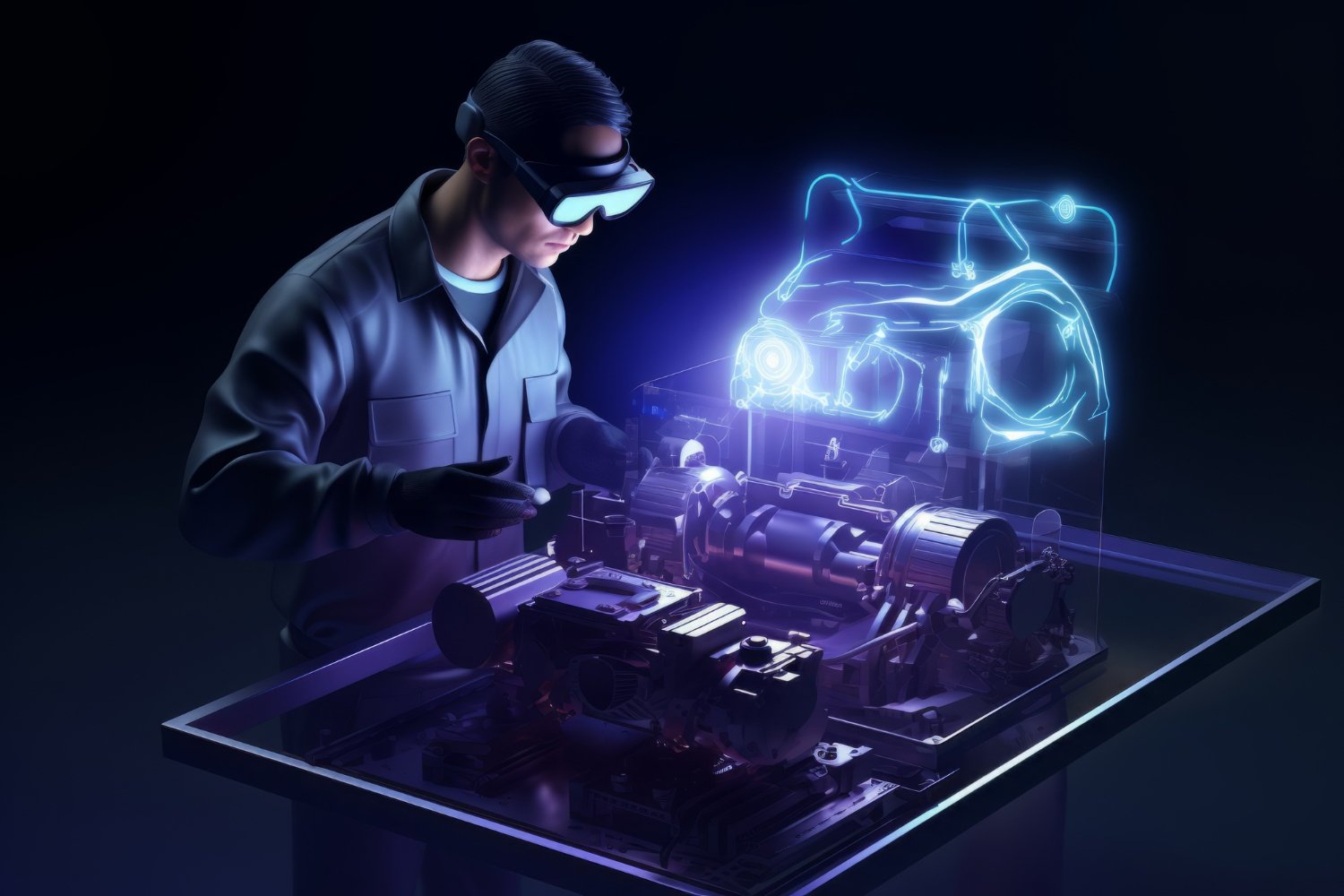
Virtual Reality Evolution: From Science Fiction to Real Life

Learn how VR evolved from science fiction concepts like Star Trek and 2001: A Space Odyssey into a modern technology shaping real life.

Virtual Reality Evolution: From Science Fiction to Real Life
Written by TechnoLynx Published on 12 Dec 2024

From Fiction to Reality

Virtual reality (VR) was once confined to science fiction. Writers like Isaac Asimov, Philip K. Dick, and Arthur C. Clarke imagined worlds where people interacted with artificial environments. Concepts like time travel, immersive simulations, and advanced human-machine interactions seemed far removed from real life. Today, these ideas are no longer purely speculative.

The evolution of this technology is rooted in the imaginative works of science fiction writers. Their ability to predict potential technological advances laid the groundwork for modern applications in fields like education, healthcare, and design.

Sci-Fi’s Early Predictions

Speculative fiction has always played a pivotal role in shaping technological ambitions. Works like Star Trek introduced the concept of the holodeck, an environment where users could fully immerse themselves in virtual simulations. Films such as 2001: A Space Odyssey portrayed intelligent systems interacting with humans, inspiring generations of innovators.

The link between virtual reality and science fiction goes deeper. Writers like Philip K. Dick questioned how humans distinguish between the real world and simulations. These ideas didn’t just entertain; they encouraged a future where technology could redefine the boundaries of real life.

Evolution Mirroring Natural Selection

Much like natural selection, the development of VR followed an adaptive process. Early systems were rudimentary, consisting of simple visual displays and clunky hardware. Over time, technology evolved in response to user needs and advancements in modern science.

This process parallels the principles of Charles Darwin’s theory of evolution. Just as species adapt to survive, technology adapts to improve functionality and accessibility. The continuous refinement of virtual environments reflects this adaptive journey, driven by both imagination and necessity.

Roots in the United States

The United States played a critical role in transforming science fiction into reality. During the mid-20th century, early experiments focused on creating immersive environments using visual displays. Though limited in scope, these projects laid the foundation for more sophisticated systems.

By the late 20th century, technological advancements enabled the development of more immersive environments. While still expensive and bulky, these systems marked a significant leap forward. They demonstrated how technology could create meaningful simulations for training, entertainment, and research.

The Role of Modern Science

In the 21st century, virtual environments became more than speculative ideas. Advances in modern science brought realism and accessibility to virtual systems. Lightweight headsets, high-resolution displays, and improved computing power allowed users to engage with simulations more seamlessly.

Today, these systems extend far beyond entertainment. Educational institutions use them for interactive learning experiences, while healthcare professionals rely on them for training and therapy. These applications underscore how far the technology has come since its speculative origins.

Real Life Meets Virtual Environments

One of the most transformative aspects of virtual environments is their ability to simulate real life while maintaining the safety and flexibility of a digital platform. Users can explore historical sites, interact with complex systems, or even experience space travel without leaving their homes.

This blending of the real world with digital environments brings science fiction scenarios closer to everyday reality. It allows people to engage with environments once thought impossible to access. For example, training simulations in fields like aviation and medicine provide practical benefits without the risks of physical scenarios.

Read more: Futuristic AR and VR Technology: Immersive Future

Science Fiction’s Continued Influence

The contributions of science fiction writers like Arthur C. Clarke and Isaac Asimov continue to influence modern applications. Their stories often explored philosophical and ethical questions about human interaction with technology.

These narratives encouraged a deeper understanding of the potential challenges and opportunities in developing virtual systems. By addressing themes of identity, memory, and perception, speculative fiction provides a framework for thinking about future applications of the technology.

Beyond Sci-Fi and Into Everyday Life

While virtual environments originated in speculative fiction, they are now integrated into many aspects of daily life. For instance, architects use simulations to design buildings and test their functionality. Automotive engineers rely on these environments to refine vehicle designs through crash simulations and performance testing.

In education, these tools help students learn in more engaging ways. Whether exploring the solar system or dissecting human anatomy, students gain hands-on experience that traditional methods cannot provide. These real-world applications highlight the transition from sci-fi dreams to tangible solutions.

The Role of Knowledge Sharing

In understanding the evolution of virtual reality, one cannot overlook the importance of knowledge-sharing platforms. Websites like Wikipedia, the free encyclopedia, play a vital role in documenting technological advancements. They serve as comprehensive resources for understanding the historical, technical, and cultural aspects of virtual reality.

For instance, a quick visit to the Wikipedia, the free encyclopedia on virtual reality provides insights into its origins, key milestones, and modern applications. This wealth of information supports education and research, making complex topics more accessible to everyone.

Interactive features such as “toggle the table of contents” enhance usability on platforms like Wikipedia. This simple yet effective design allows users to navigate vast amounts of information with ease. It helps researchers, students, and enthusiasts focus on specific sections without sifting through entire articles.

Such platforms not only chronicle past achievements but also keep track of ongoing developments. They bridge the gap between casual readers and industry professionals, making advanced technologies easier to comprehend.

Read more: Virtual Reality Experiences: A Deep Dive into VR Technology

Real-Time Access to Information

Knowledge-sharing tools like Wikipedia, the free encyclopedia, have become indispensable in the 21st century. With features such as “toggle the table of contents,” they demonstrate how user-friendly interfaces make learning more engaging. For virtual reality, these resources provide a clear roadmap of its journey from speculative fiction to real-world applications.

By offering structured content, such platforms inspire future innovations. Aspiring developers and enthusiasts can study the progression of ideas, learning from both successes and failures. These resources ensure that virtual reality remains a topic of active discussion and development.

The combination of accessible platforms and practical tools fosters a culture of curiosity and innovation. It brings virtual reality out of academic circles and into the public domain. This accessibility empowers people to understand, utilise, and contribute to its evolution.

Challenges Along the Way

Despite its advancements, creating realistic virtual environments has not been without challenges. High costs and the need for substantial computing power have limited widespread adoption. Furthermore, ensuring data security in immersive environments remains a significant concern.

As the technology evolves, addressing these issues will be critical. Continued innovation and collaboration between developers, researchers, and industries will determine how successfully these challenges are met.

TechnoLynx: Shaping the Future

TechnoLynx specialises in developing advanced virtual environments tailored to meet diverse needs. From creating interactive training simulations to designing immersive entertainment experiences, our solutions bridge the gap between imagination and practicality.

Our team combines expertise in modern science and user-focused design to deliver innovative systems. By aligning with your goals, we help bring the potential of virtual environments to your projects. Contact TechnoLynx today to learn how we can support your vision.

The evolution of virtual environments is a testament to the enduring influence of science fiction. From speculative ideas by Philip K. Dick and Arthur C. Clarke to real-world applications, the journey has been remarkable. As the 21st century unfolds, this technology will continue to reshape how people interact with both the real world and simulated spaces.

Final Thoughts

The relationship between technology and knowledge-sharing platforms highlights the importance of collective learning. Virtual reality, once confined to the pages of speculative fiction, is now accessible to all. By connecting historical context with modern innovation, these tools help shape the future of technology.

Continue reading: Top Virtual Reality Use Cases and Examples

Image credits: Freepik

Cost, Efficiency, and Value Are Not the Same Metric

Cost, Efficiency, and Value Are Not the Same Metric

17/04/2026

Performance per dollar. Tokens per watt. Cost per request. These sound like the same thing said differently, but they measure genuinely different dimensions of AI infrastructure economics. Conflating them leads to infrastructure decisions that optimize for the wrong objective.

Precision Is an Economic Lever in Inference Systems

Precision Is an Economic Lever in Inference Systems

17/04/2026

Precision isn't just a numerical setting — it's an economic one. Choosing FP8 over BF16, or INT8 over FP16, changes throughput, latency, memory footprint, and power draw simultaneously. For inference at scale, these changes compound into significant cost differences.

Precision Choices Are Constrained by Hardware Architecture

Precision Choices Are Constrained by Hardware Architecture

17/04/2026

You can't run FP8 inference on hardware that doesn't have FP8 tensor cores. Precision format decisions are conditional on the accelerator's architecture — its tensor core generation, native format support, and the efficiency penalties for unsupported formats.

Steady-State Performance, Cost, and Capacity Planning

Steady-State Performance, Cost, and Capacity Planning

17/04/2026

Capacity planning built on peak performance numbers over-provisions or under-delivers. Real infrastructure sizing requires steady-state throughput — the predictable, sustained output the system actually delivers over hours and days, not the number it hit in the first five minutes.

How Benchmark Context Gets Lost in Procurement

How Benchmark Context Gets Lost in Procurement

16/04/2026

A benchmark result starts with full context — workload, software stack, measurement conditions. By the time it reaches a procurement deck, all that context is gone. The failure mode is not wrong benchmarks but context loss during propagation.

Building an Audit Trail: Benchmarks as Evidence for Governance and Risk

Building an Audit Trail: Benchmarks as Evidence for Governance and Risk

16/04/2026

High-value AI hardware decisions need traceable evidence, not slide-deck bullet points. When benchmarks are documented with methodology, assumptions, and limitations, they become auditable institutional evidence — defensible under scrutiny and revisitable when conditions change.

The Comparability Protocol: Why Benchmark Methodology Defines What You Can Compare

The Comparability Protocol: Why Benchmark Methodology Defines What You Can Compare

16/04/2026

Two benchmark scores can only be compared if they share a declared methodology — the same workload, precision, measurement protocol, and reporting conditions. Without that contract, the comparison is arithmetic on numbers of unknown provenance.

A Decision Framework for Choosing AI Hardware

A Decision Framework for Choosing AI Hardware

16/04/2026

Hardware selection is a multivariate decision under uncertainty — not a score comparison. This framework walks through the steps: defining the decision, matching evaluation to deployment, measuring what predicts production, preserving tradeoffs, and building a repeatable process.

How Benchmarks Shape Organizations Before Anyone Reads the Score

How Benchmarks Shape Organizations Before Anyone Reads the Score

16/04/2026

Before a benchmark score informs a purchase, it has already shaped what gets optimized, what gets reported, and what the organization considers important. Benchmarks function as decision infrastructure — and that influence deserves more scrutiny than the number itself.

Accuracy Loss from Lower Precision Is Task‑Dependent

Accuracy Loss from Lower Precision Is Task‑Dependent

16/04/2026

Reduced precision does not produce a uniform accuracy penalty. Sensitivity depends on the task, the metric, and the evaluation setup — and accuracy impact cannot be assumed without measurement.

Precision Is a Design Parameter, Not a Quality Compromise

Precision Is a Design Parameter, Not a Quality Compromise

16/04/2026

Numerical precision is an explicit design parameter in AI systems, not a moral downgrade in quality. This article reframes precision as a representation choice with intentional trade-offs, not a concession made reluctantly.

Mixed Precision Works by Exploiting Numerical Tolerance

Mixed Precision Works by Exploiting Numerical Tolerance

16/04/2026

Not every multiplication deserves 32 bits. Mixed precision works because neural network computations have uneven numerical sensitivity — some operations tolerate aggressive precision reduction, others don't — and the performance gains come from telling them apart.

Throughput vs Latency: Choosing the Wrong Optimization Target

16/04/2026

Throughput and latency are different objectives that often compete for the same resources. This article explains the trade-off, why batch size reshapes behavior, and why percentiles matter more than averages in latency-sensitive systems.

Quantization Is Controlled Approximation, Not Model Damage

16/04/2026

When someone says 'quantize the model,' the instinct is to hear 'degrade the model.' That framing is wrong. Quantization is controlled numerical approximation — a deliberate engineering trade-off with bounded, measurable error characteristics — not an act of destruction.

GPU Utilization Is Not Performance

15/04/2026

The utilization percentage in nvidia-smi reports kernel scheduling activity, not efficiency or throughput. This article explains the metric's exact definition, why it routinely misleads in both directions, and what to pair it with for accurate performance reads.

FP8, FP16, and BF16 Represent Different Operating Regimes

15/04/2026

FP8 is not just 'half of FP16.' Each numerical format encodes a different set of assumptions about range, precision, and risk tolerance. Choosing between them means choosing operating regimes — different trade-offs between throughput, numerical stability, and what the hardware can actually accelerate.

Peak Performance vs Steady‑State Performance in AI

15/04/2026

AI systems rarely operate at peak. This article defines the peak vs. steady-state distinction, explains when each regime applies, and shows why evaluations that capture only peak conditions mischaracterize real-world throughput.

The Software Stack Is a First‑Class Performance Component

15/04/2026

Drivers, runtimes, frameworks, and libraries define the execution path that determines GPU throughput. This article traces how each software layer introduces real performance ceilings and why version-level detail must be explicit in any credible comparison.

The Mythology of 100% GPU Utilization

15/04/2026

Is 100% GPU utilization bad? Will it damage the hardware? Should you be worried? For datacenter AI workloads, sustained high utilization is normal — and the anxiety around it usually reflects gaming-era intuitions that don't apply.

Why Benchmarks Fail to Match Real AI Workloads

15/04/2026

The word 'realistic' gets attached to benchmarks freely, but real AI workloads have properties that synthetic benchmarks structurally omit: variable request patterns, queuing dynamics, mixed operations, and workload shapes that change the hardware's operating regime.

Why Identical GPUs Often Perform Differently

15/04/2026

'Same GPU' does not imply the same performance. This article explains why system configuration, software versions, and execution context routinely outweigh nominal hardware identity.

Training and Inference Are Fundamentally Different Workloads

15/04/2026

A GPU that excels at training may disappoint at inference, and vice versa. Training and inference stress different system components, follow different scaling rules, and demand different optimization strategies. Treating them as interchangeable is a design error.

Performance Ownership Spans Hardware and Software Teams

15/04/2026

When an AI workload underperforms, attribution is the first casualty. Hardware blames software. Software blames hardware. The actual problem lives in the gap between them — and no single team owns that gap.

Performance Emerges from the Hardware × Software Stack

15/04/2026

AI performance is an emergent property of hardware, software, and workload operating together. This article explains why outcomes cannot be attributed to hardware alone and why the stack is the true unit of performance.

Power, Thermals, and the Hidden Governors of Performance

14/04/2026

Every GPU has a physical ceiling that sits below its theoretical peak. Power limits, thermal throttling, and transient boost clocks mean that the performance you read on the spec sheet is not the performance the hardware sustains. The physics always wins.

Why AI Performance Changes Over Time

14/04/2026

That impressive throughput number from the first five minutes of a training run? It probably won't hold. AI workload performance shifts over time due to warmup effects, thermal dynamics, scheduling changes, and memory pressure. Understanding why is the first step toward trustworthy measurement.

CUDA, Frameworks, and Ecosystem Lock-In

14/04/2026

Why is it so hard to switch away from CUDA? Because the lock-in isn't in the API — it's in the ecosystem. Libraries, tooling, community knowledge, and years of optimization create switching costs that no hardware swap alone can overcome.

GPUs Are Part of a Larger System

14/04/2026

CPU overhead, memory bandwidth, PCIe topology, and host-side scheduling routinely limit what a GPU can deliver — even when the accelerator itself has headroom. This article maps the non-GPU bottlenecks that determine real AI throughput.

Why AI Performance Must Be Measured Under Representative Workloads

14/04/2026

Spec sheets, leaderboards, and vendor numbers cannot substitute for empirical measurement under your own workload and stack. Defensible performance conclusions require representative execution — not estimates, not extrapolations.

Low GPU Utilization: Where the Real Bottlenecks Hide

14/04/2026

When GPU utilization drops below expectations, the cause usually isn't the GPU itself. This article traces common bottleneck patterns — host-side stalls, memory-bandwidth limits, pipeline bubbles — that create the illusion of idle hardware.

Why GPU Performance Is Not a Single Number

14/04/2026

AI GPU performance is multi-dimensional and workload-dependent. This article explains why scalar rankings collapse incompatible objectives and why 'best GPU' questions are structurally underspecified.

What a GPU Benchmark Actually Measures

14/04/2026

A benchmark result is not a hardware measurement — it is an execution measurement. The GPU, the software stack, and the workload all contribute to the number. Reading it correctly requires knowing which parts of the system shaped the outcome.

Why Spec‑Sheet Benchmarking Fails for AI

14/04/2026

GPU spec sheets describe theoretical limits. This article explains why real AI performance is an execution property shaped by workload, software, and sustained system behavior.

Cracking the Mystery of AI’s Black Box

4/02/2026

A guide to the AI black box problem, why it matters, how it affects real-world systems, and what organisations can do to manage it.

Inside Augmented Reality: A 2026 Guide

3/02/2026

A 2026 guide explaining how augmented reality works, how AR systems blend digital elements with the real world, and how users interact with digital content through modern AR technology.

Smarter Checks for AI Detection Accuracy

2/02/2026

A clear guide to AI detectors, why they matter, how they relate to generative AI and modern writing, and how TechnoLynx supports responsible and high‑quality content practices.

Choosing Vulkan, OpenCL, SYCL or CUDA for GPU Compute

28/01/2026

A practical comparison of Vulkan, OpenCL, SYCL and CUDA, covering portability, performance, tooling, and how to pick the right path for GPU compute across different hardware vendors.

Deep Learning Models for Accurate Object Size Classification

27/01/2026

A clear and practical guide to deep learning models for object size classification, covering feature extraction, model architectures, detection pipelines, and real‑world considerations.

TPU vs GPU: Which Is Better for Deep Learning?

26/01/2026

A practical comparison of TPUs and GPUs for deep learning workloads, covering performance, architecture, cost, scalability, and real‑world training and inference considerations.

CUDA vs ROCm: Choosing for Modern AI

20/01/2026

A practical comparison of CUDA vs ROCm for GPU compute in modern AI, covering performance, developer experience, software stack maturity, cost savings, and data‑centre deployment.

Best Practices for Training Deep Learning Models

19/01/2026

A clear and practical guide to the best practices for training deep learning models, covering data preparation, architecture choices, optimisation, and strategies to prevent overfitting.

Measuring GPU Benchmarks for AI

15/01/2026

A practical guide to GPU benchmarks for AI; what to measure, how to run fair tests, and how to turn results into decisions for real‑world projects.

GPU‑Accelerated Computing for Modern Data Science

14/01/2026

Learn how GPU‑accelerated computing boosts data science workflows, improves training speed, and supports real‑time AI applications with high‑performance parallel processing.

CUDA vs OpenCL: Picking the Right GPU Path

13/01/2026

A clear, practical guide to cuda vs opencl for GPU programming, covering portability, performance, tooling, ecosystem fit, and how to choose for your team and workload.

Performance Engineering for Scalable Deep Learning Systems

12/01/2026

Learn how performance engineering optimises deep learning frameworks for large-scale distributed AI workloads using advanced compute architectures and state-of-the-art techniques.

Choosing TPUs or GPUs for Modern AI Workloads

10/01/2026

A clear, practical guide to TPU vs GPU for training and inference, covering architecture, energy efficiency, cost, and deployment at large scale across on‑prem and Google Cloud.

GPU vs TPU vs CPU: Performance and Efficiency Explained

10/01/2026

Understand GPU vs TPU vs CPU for accelerating machine learning workloads—covering architecture, energy efficiency, and performance for large-scale neural networks.

Energy-Efficient GPU for Machine Learning

9/01/2026

Learn how energy-efficient GPUs optimise AI workloads, reduce power consumption, and deliver cost-effective performance for training and inference in deep learning models.

Back See Blogs
arrow icon