How Agents Learn Through Trial and Error: Reinforcement Learning

Discover how RL is applied in various industries, from robotics and gaming to healthcare and finance. Explore the key concepts, algorithms, and real-world examples to grasp the potential of this transformative technology.

How Agents Learn Through Trial and Error: Reinforcement Learning
Written by TechnoLynx Published on 24 Feb 2025

Introduction to Reinforcement Learning

Reinforcement learning (RL) is a key area of artificial intelligence. It focuses on training agents to make decisions through interactions with their environment. Unlike supervised learning, where models learn from labelled data, RL uses a trial-and-error approach to discover the best actions. The agent’s main goal is to maximise rewards over time, which makes RL valuable in complex environments where outcomes are not immediately clear.

The reinforcement learning problem revolves around how an agent moves through different states by taking actions that affect its surroundings. The agent gets feedback from the environment through rewards or penalties, known as the reward function. The challenge is to develop strategies that maximise long-term rewards. This involves finding a balance between exploring new actions and exploiting known ones that give high rewards.

Many real-world scenarios apply reinforcement learning algorithms. They help solve problems in fields like autonomous driving, robotics, financial modelling, and healthcare. These algorithms are designed to handle situations where making a series of decisions can lead to complex and often surprising outcomes. By addressing the RL problem, these algorithms create intelligent systems that can adapt, learn, and improve behaviour over time, showing the power and flexibility of RL in modern AI.

Core Concepts in Reinforcement Learning

Markov Decision Process (MDP)

A Markov Decision Process (MDP) is a framework used to model decision-making where outcomes depend on both chance and the agent’s choices. MDPs are essential in RL because they provide a structured way to describe the environment in which an agent operates. MDPs are made up of states, actions, transition probabilities, and rewards.

  • States represent the different situations the agent can be in.

  • Actions are the choices available to the agent that affect the state.

  • Transition probabilities indicate the chance of moving from one state to another after an action.

Rewards are the gains or losses from moving between states, guiding the agent toward actions that offer the most benefit.

By modelling the environment as an MDP, RL problems can be approached systematically. This helps the agent learn optimal policies that maximise long-term rewards.

Read more: Symbolic AI vs Generative AI: How They Shape Technology

Bellman Equation

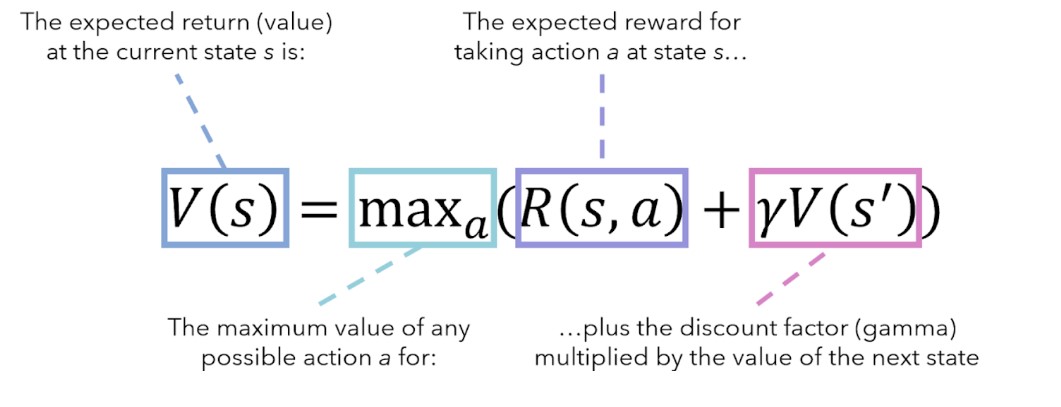
The Bellman equation is a crucial tool in RL. It calculates the value of different states or actions by estimating the expected cumulative reward an agent can achieve from that point onward. The equation is based on the idea that any optimal policy’s value function must follow a specific pattern, known as a recursive relationship.

The Bellman equation expresses the value of a state as the sum of the immediate reward from an action and the discounted value of the next state, accounting for all possible future actions. This approach helps the agent evaluate the long-term benefits of its actions, even in complex situations where outcomes are uncertain, as shown below.

The Bellman Equation. Source: Neptune.ai

In practice, the Bellman equation breaks down the RL problem into smaller parts. This makes it easier to calculate optimal strategies that maximise cumulative rewards, guiding the agent toward the best behaviour.

Methods and Techniques in Reinforcement Learning

Dynamic Programming

Dynamic programming (DP) is a method used in RL to solve MDPs by breaking down complex problems into simpler ones. DP requires a complete model of the environment, including transition probabilities and the reward function.

The main idea of DP is to use the Bellman equation repeatedly to update the value of each state until it reaches an optimal solution. This process helps the RL agent determine the best actions to take in each state.

However, dynamic programming can be computationally expensive and requires the entire state space to be known, which makes it less practical for large-scale or real-time applications.

Value Iteration

Value iteration is a key technique in value-based reinforcement learning and is one of the fundamental RL algorithms used to find optimal policies. It combines dynamic programming with an iterative approach to refine the value of states until they converge to an optimal solution.

In value iteration, the agent starts with an initial guess for the value function. It then repeatedly updates these values by selecting actions that maximise expected rewards. This method is effective when the state and action spaces are well-defined. The goal is to determine the optimal policy that guides the agent’s actions.

For instance, in a grid-world environment where an agent needs to reach a goal while avoiding obstacles, value iteration helps calculate the best path by considering the long-term rewards of each move. This process continues until the value function stabilises, ensuring that the agent’s policy is optimal.

Policy Iteration

Policy iteration is another important technique in policy-based reinforcement learning. It differs from value iteration in that it focuses directly on improving the policy rather than just refining the value function. Policy iteration alternates between two steps: policy evaluation and policy improvement.

  • Policy evaluation involves calculating the value function for a given policy. This represents the expected cumulative rewards for following that policy in every state.

  • Policy improvement then updates the policy by choosing actions that maximise the value function, leading to a new and better policy.

This cycle repeats until the policy converges to an optimal one, where no further improvements can be made.

Unlike value iteration, which works on value functions, policy iteration directly improves the policy. This makes it more suitable when the goal is to optimise specific actions rather than value estimates.

Read more: The Impact of Computer Vision on Real-Time Face Detection

Q-Learning

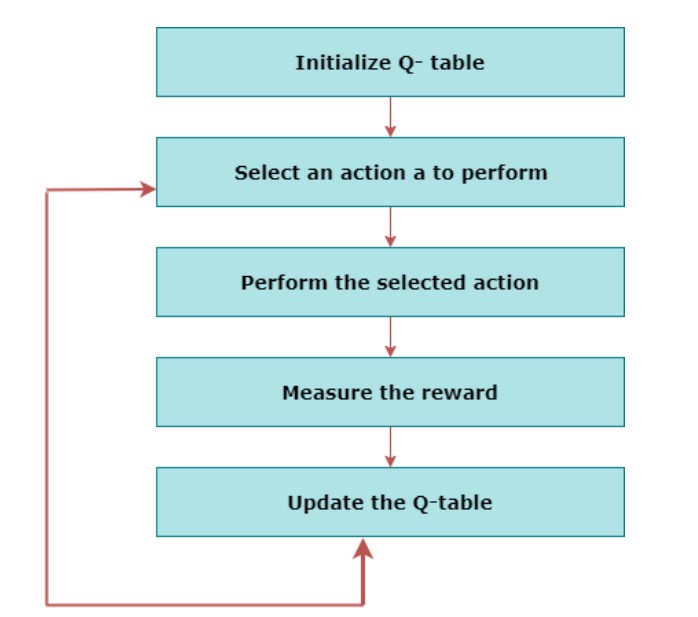
Q-learning is a popular model-free RL algorithm. It allows an agent to learn the value of taking specific actions in specific states without needing a model of the environment. Unlike dynamic programming and value iteration, which require knowledge of transition probabilities, Q-learning relies on direct interaction with the environment through trial and error. The following diagram shows the basic steps involved in Q-Learning:

Steps in Q-Learning. Source: Javatpoint

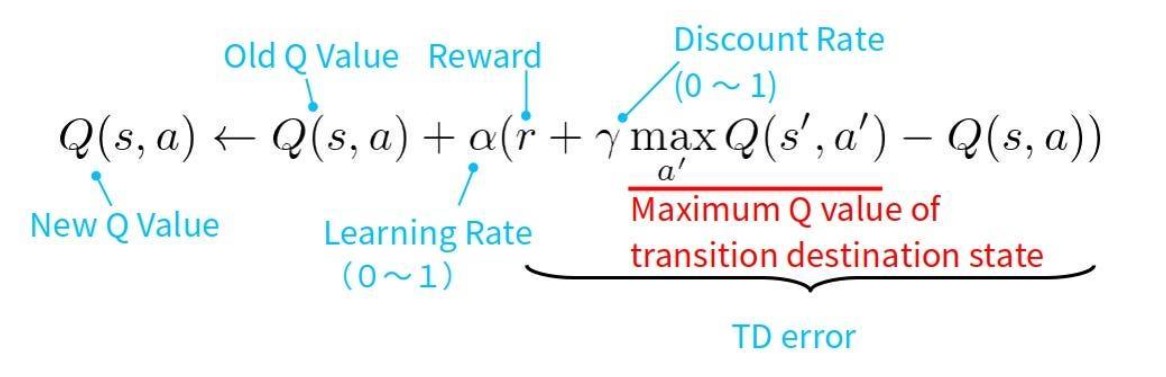
The key concept in Q-learning is the Q-function. This function represents the expected cumulative reward for taking a particular action in a given state and following the optimal policy afterwards. The Q-function is updated using the Q-learning update rule:

Q-Learning Update Rule Formula. Source: Medium

In more complex environments, deep reinforcement learning can be used, where a neural network approximates the Q-function. This allows the agent to handle high-dimensional state spaces. This combination of Q-learning with neural networks is known as deep Q-learning. It has been successfully applied in various fields, such as game playing and robotic control.

A key aspect of Q-learning is balancing the exploration-exploitation trade-off. Exploration means trying new actions to discover their rewards, while exploitation involves choosing actions known to give high rewards. This balance is often managed using strategies like the epsilon-greedy method, where the agent occasionally explores random actions while mostly exploiting known high-reward actions.

For example, in a robotic navigation task, Q-learning would enable the robot to learn the best actions to take in different parts of its environment. The robot does this by interacting with the environment and updating its Q-function based on the feedback it receives. Over time, the robot develops an optimal policy for navigating the environment efficiently, even without a predefined model of that environment.

Types of Reinforcement Learning

Value-Based Reinforcement Learning

Value-based reinforcement learning focuses on optimising value functions. These functions estimate the expected cumulative reward an agent can achieve from a particular state or state-action pair. The goal is to find the optimal policy by evaluating and maximising these value functions.

A prime example of value-based RL is Q-learning. In Q-learning, the agent updates the Q-value (or action-value) for each state-action pair based on the rewards received from the environment. By focusing on value functions, value-based RL methods are effective in environments where the goal is to maximise long-term rewards by choosing the most valuable actions at each step.

Policy-Based Reinforcement Learning

Policy-based reinforcement learning directly optimises the policy, which is a mapping from states to actions, without needing to estimate value functions. The goal is to find the optimal policy that maximises long-term rewards by improving the policy itself rather than relying on value estimates.

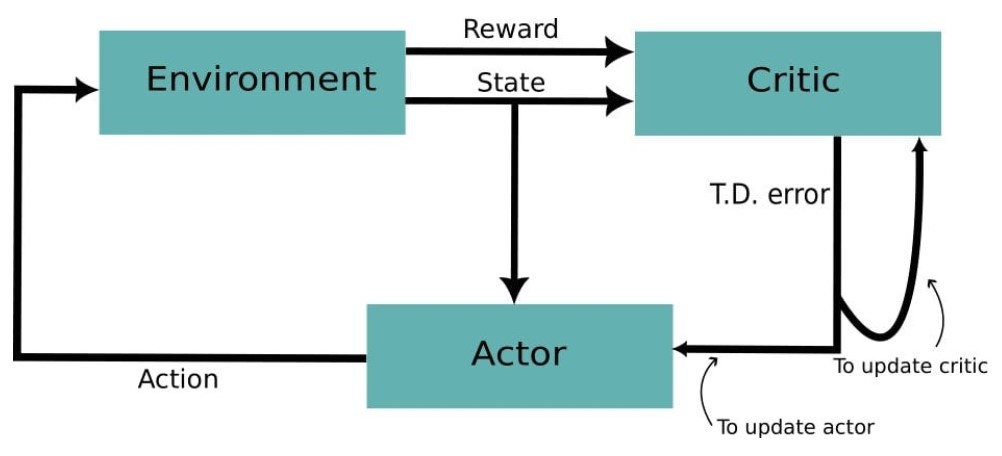
One popular method in policy-based RL is the actor-critic approach. This method combines both policy-based and value-based strategies. The actor updates the policy based on feedback from the environment, while the critic evaluates the policy by estimating value functions. This combination allows the agent to efficiently explore the action spaces and optimise its decisions for long-term rewards. The actor-critic method balances the strengths of both value-based and policy-based methods, making it a powerful tool in reinforcement learning.

Actor-Critic Approach. Source: Medium

Model-Based Reinforcement Learning

Model-based reinforcement learning uses a model of the environment to predict the outcomes of actions and make decisions. This approach contrasts with model-free methods, where the agent learns purely from experience without knowledge of the environment’s dynamics.

In model-based RL, the agent uses the model to simulate possible future states and rewards. This allows it to plan and optimise its actions more effectively. This approach can lead to faster learning and better decision-making, especially in complex environments. However, the accuracy of the model is crucial, as inaccuracies can lead to suboptimal policies.

Applications of Reinforcement Learning in Industry

Reinforcement learning has broad applications across various industries. It significantly impacts how decisions are made, and processes are optimised. In robotics, RL trains robots to perform complex tasks, such as navigating environments or manipulating objects. The robots learn from interactions with the world, allowing them to adapt to new situations and improve their performance over time.

In finance, RL algorithms help optimise trading strategies by learning from market data. This enables more effective decision-making in dynamic financial markets. The ability to learn from historical data and adjust strategies in real time makes RL a valuable tool for managing investments and reducing risks.

In healthcare, deep reinforcement learning personalised treatment plans optimise resource allocation and improve patient outcomes. For example, RL agents can help manage chronic diseases by learning the most effective interventions based on patient data. This ultimately enhances the quality of care and reduces costs.

Read more: Deep Learning in Medical Computer Vision: How It Works

The adaptability and learning capabilities of RL make it a transformative technology, driving innovation and efficiency across diverse sectors.

What We Can Offer as TechnoLynx

At TechnoLynx, we specialise in providing advanced services that seamlessly integrate with RL. Our services include Computer Vision, Generative AI, and AR/VR/XR technologies. By using these capabilities, we empower organisations to harness the full potential of deep reinforcement learning and other RL techniques.

For instance, TechnoLynx can combine Computer Vision with RL to create intelligent systems for real-time object detection and autonomous navigation in industrial settings. Similarly, by integrating NLP with RL, we can develop more interactive and responsive customer service chatbots that continuously improve based on user interactions. In IoT edge computing, our services optimise device operations and energy management through RL-driven decision-making processes. These examples show how our consultancy and services can solve complex industry challenges, offering tailored solutions that enhance efficiency and innovation.

Conclusion

In this article, we explored the main concepts, methods, and types of reinforcement learning. We covered Markov Decision Processes, the Bellman equation, and various RL techniques like value iteration, policy iteration, and Q-learning. We also discussed the differences between value-based, policy-based, and model-based reinforcement learning.

Looking ahead, the future of RL holds exciting potential, especially in the development of RL algorithms that can learn from limited data and adapt to changing environments. However, challenges such as scalability and ethical considerations remain. As RL continues to evolve, it will play a crucial role in driving innovation across industries, from robotics to healthcare, paving the way for more intelligent and autonomous systems.

Continue reading: Generative AI is Driving Smarter Business Solutions

References

  • Guide, S. (2023, January 7). The Q in Q-learning: A Comprehensive Guide to this Powerful Reinforcement Learning Algorithm. udit. Retrieved September 1, 2024.

  • Javatpoint. (2023, October). Reinforcement Learning Tutorial. Javatpoint. Retrieved August, 2024.

  • Neptune.ai. (2023, August 25). Markov Decision Process in Reinforcement Learning: Everything You Need to Know. Neptune.ai. Retrieved September 2, 2024.

  • Singh, N. (2023, July 10). The Bellman Equation: Decoding Optimal Paths with State, Action, Reward, and Discount. Medium. Retrieved September 2, 2024.

  • Thorat, R. (2023, October 29). Actor-Critic method explained. A policy-gradient method, by Rohan Thorat. Medium. Retrieved September 2, 2024.

Retail Shrinkage and Computer Vision: What CV Can and Cannot Detect

Retail Shrinkage and Computer Vision: What CV Can and Cannot Detect

9/05/2026

Retail shrinkage from theft, admin error, and vendor fraud: how CV systems address each, what they miss, and realistic shrinkage reduction numbers.

Object Detection Model Selection for Production: YOLO vs Transformers, Speed/Accuracy, and Deployment

Object Detection Model Selection for Production: YOLO vs Transformers, Speed/Accuracy, and Deployment

9/05/2026

Object detection model selection for production: YOLO variants vs detection transformers, speed/accuracy tradeoffs, edge vs cloud deployment, mAP vs.

Manufacturing Safety AI: Gun Detection and Threat Monitoring with Computer Vision

Manufacturing Safety AI: Gun Detection and Threat Monitoring with Computer Vision

9/05/2026

AI gun detection in manufacturing uses CV to identify weapons in camera feeds. What the technology detects, accuracy limits, and deployment considerations.

Machine Vision Image Sensor Selection: CCD vs CMOS, Resolution, and Illumination

Machine Vision Image Sensor Selection: CCD vs CMOS, Resolution, and Illumination

9/05/2026

How to select image sensors for machine vision: CCD vs CMOS tradeoffs, resolution, frame rate, pixel size, and illumination requirements by inspection.

Facial Recognition Cameras for Commercial Deployment: Matching, Enrollment, and Legal Framework

Facial Recognition Cameras for Commercial Deployment: Matching, Enrollment, and Legal Framework

9/05/2026

Commercial facial recognition deployments: enrollment management, 1:1 vs 1:N matching, false acceptance rates, consent requirements, and hardware.

Multi-Agent Architecture for AI Systems: When Coordination Adds Value

Multi-Agent Architecture for AI Systems: When Coordination Adds Value

8/05/2026

Multi-agent AI architectures coordinate multiple LLM agents for complex tasks. When they add value, common coordination patterns, and where they break.

Facial Detection Software: Open Source vs Commercial APIs, Accuracy, and Production Integration

Facial Detection Software: Open Source vs Commercial APIs, Accuracy, and Production Integration

8/05/2026

Facial detection software options: OpenCV, dlib, DeepFace vs commercial APIs, when to build vs buy, demographic accuracy, and production pipeline.

Multi-Agent Systems: Design Principles and Production Reliability

Multi-Agent Systems: Design Principles and Production Reliability

8/05/2026

Multi-agent systems decompose complex tasks across specialized agents. Design principles, failure modes, and when multi-agent adds value vs complexity.

Face Detection Camera Systems: Resolution, Lighting, and Real-World False Positive Rates

Face Detection Camera Systems: Resolution, Lighting, and Real-World False Positive Rates

8/05/2026

Face detection camera prerequisites: resolution minimums, angle and lighting requirements, MTCNN vs RetinaFace vs MediaPipe, and real-world false positive.

LLM Types: Decoder-Only, Encoder-Decoder, and Encoder-Only Models

LLM Types: Decoder-Only, Encoder-Decoder, and Encoder-Only Models

8/05/2026

LLM architecture type—decoder-only, encoder-decoder, encoder-only—determines what tasks each model handles well and what deployment constraints it carries.

Embedded Edge Devices for CV Deployment: Jetson vs Coral vs Hailo vs OAK-D

Embedded Edge Devices for CV Deployment: Jetson vs Coral vs Hailo vs OAK-D

8/05/2026

Embedded edge devices for CV: NVIDIA Jetson vs Coral TPU vs Hailo vs OAK-D — power, inference throughput, and model optimisation requirements compared.

LLM Orchestration Frameworks: LangChain, LlamaIndex, LangGraph Compared

LLM Orchestration Frameworks: LangChain, LlamaIndex, LangGraph Compared

8/05/2026

LangChain, LlamaIndex, and LangGraph solve different problems. Choosing the wrong framework adds abstraction without value. A practical decision framework.

Driveway CCTV Cameras with AI Detection: Vehicle Classification, Night Performance, and False Alarm Reduction

8/05/2026

Driveway CCTV AI detection: vehicle vs person classification, IR vs starlight night performance, reducing animal and shadow false alarms, home automation.

Generative AI Architecture Patterns: Transformer, Diffusion, and When Each Applies

8/05/2026

Transformer vs diffusion architecture determines deployment constraints. Memory footprint, latency profile, and controllability differ substantially.

Digital Shelf Monitoring with Computer Vision: What Retail AI Actually Detects

7/05/2026

Digital shelf monitoring uses CV to detect out-of-stocks, planogram compliance, and pricing errors. What the systems actually detect and where accuracy drops.

Diffusion Models in ML Beyond Images: Audio, Protein, and Tabular Applications

7/05/2026

Diffusion extends beyond images to audio, protein structure, molecules, and tabular data. What each domain gains and loses from the diffusion approach.

Deep Learning for Image Processing in Production: Architecture Choices, Training, and Deployment

7/05/2026

Deep learning for image processing in production: CNN vs ViT tradeoffs, training data requirements, augmentation, deployment optimisation, and.

Diffusion Models Explained: The Forward and Reverse Process

7/05/2026

Diffusion models learn to reverse a noise process. The forward (adding noise) and reverse (denoising) processes, score matching, and why this produces.

AI vs Real Face: Anti-Spoofing, Liveness Detection, and When Custom CV Models Are Necessary

7/05/2026

When synthetic faces defeat pretrained detectors: anti-spoofing challenges, liveness detection requirements, and when custom models are unavoidable.

Diffusion Models Beat GANs on Image Synthesis: What Changed and What Remains

7/05/2026

Diffusion models surpassed GANs on FID scores for image synthesis. What metrics shifted, where GANs still win, and what it means for production image generation.

AI-Based CCTV Monitoring Solutions: Automation vs Human Review and What Each Handles Well

7/05/2026

AI CCTV monitoring vs human monitoring: cost comparison, coverage capability, response time tradeoffs, and what AI handles well vs where human judgment is.

The Diffusion Forward Process: How Noise Schedules Shape Generation Quality

7/05/2026

The forward process in diffusion models adds noise according to a schedule. How linear, cosine, and custom schedules affect image quality and training stability.

CCTV Face Recognition in Production: Why It Fails More Than Demos Suggest

7/05/2026

CCTV face recognition: resolution requirements, angle and lighting challenges, false positive rates, GDPR compliance, and why production performance lags.

Autonomous AI in Software Engineering: What Agents Actually Do

6/05/2026

What autonomous AI software engineering agents can actually do today: code generation quality, context limits, test generation, and where human oversight.

AI-Enabled CCTV for Building Security: Analytics, Camera Placement, and Infrastructure

6/05/2026

AI CCTV for building security: intrusion detection, people counting, loitering analytics, camera placement strategy, and storage and bandwidth.

AI Agent Design Patterns: ReAct, Plan-and-Execute, and Reflection Loops

6/05/2026

AI agent patterns—ReAct, Plan-and-Execute, Reflection—solve different failure modes. Choosing the right pattern determines reliability more than model.

Best Wired CCTV Systems for AI Video Analytics: What Matters Beyond Resolution

6/05/2026

Wired CCTV systems for AI analytics need more than high resolution. Codec support, edge processing, and integration architecture determine analytics quality.

Automated Visual Inspection in Pharma: How CV Systems Replace Manual Quality Checks

6/05/2026

Automated visual inspection in pharma uses computer vision to detect defects in vials, syringes, and tablets — faster and more consistently than human.

Agentic AI in 2025–2026: What Is Actually Shipping vs What Is Still Research

6/05/2026

Agentic AI is moving from demos to production. What's deployed today, what's still research, and how to evaluate claims about autonomous AI systems.

Automated Visual Inspection Systems: Hardware, Model Selection, and False-Reject Rates

6/05/2026

Build automated visual inspection systems that work: hardware setup, model selection (classification vs detection vs segmentation), and managing.

Aseptic Manufacturing in Pharma: Process Control, Risks, and Where AI Fits

6/05/2026

Aseptic manufacturing prevents microbial contamination during sterile drug production. AI monitoring addresses the environmental control gaps humans miss.

Agent-Based Modeling in AI: When to Use Simulation vs Reactive Agents

6/05/2026

Agent-based modeling simulates populations of interacting entities. When it's the right choice over LLM-based agents and how to combine both approaches.

4K Security Cameras and AI Analytics: When Higher Resolution Helps and When It Doesn't

6/05/2026

4K security cameras for AI analytics: bandwidth and storage costs, where higher resolution improves results, compression artifacts and AI accuracy.

Computer Vision in Pharmacy Retail: Inventory Tracking, Planogram Compliance, and Shrinkage Reduction

5/05/2026

CV in pharmacy retail addresses unique challenges: regulated product tracking, controlled substance security, and planogram compliance across thousands of SKUs.

AI Orchestration: How to Coordinate Multiple Agents and Models Without Chaos

5/05/2026

AI orchestration coordinates multiple models through defined handoff protocols. Without it, multi-agent systems produce compounding inconsistencies.

Visual Inspection Equipment for Manufacturing QC: Where AI Adds Value and Where Rules Still Win

5/05/2026

AI-enhanced visual inspection replaces rule-based defect detection with learned representations — but requires validated training data matching production variability.

Building AI Agents: A Practical Guide from Single-Tool to Multi-Step Orchestration

5/05/2026

Production agent development follows a narrow-first pattern: single tool, single goal, deterministic fallback — then widen incrementally with observability.

Enterprise AI Search: Why Retrieval Architecture Matters More Than Model Choice

5/05/2026

Enterprise AI search quality depends on chunking strategy and retrieval pipeline design more than on the LLM. Poor retrieval + powerful LLM = confident wrong answers.

Facial Recognition in Video Surveillance: Why Lab Accuracy Doesn't Transfer to CCTV

5/05/2026

Facial recognition accuracy drops 10–40% between controlled enrollment conditions and production CCTV due to angle, lighting, and resolution.

Choosing an AI Agent Development Partner: What to Evaluate Beyond Demo Quality

5/05/2026

Most AI agent demos work on curated inputs. Production viability requires error handling, fallback chains, and observability that demos never test.

Computer Vision Store Analytics: What Cameras Can Actually Measure in Retail

5/05/2026

Store analytics CV must distinguish 'detected' from 'measured with business-decision confidence.' Most deployments conflate the two.

AI in Pharmaceutical Supply Chains: Where Computer Vision and Predictive Analytics Deliver ROI

5/05/2026

Pharma supply chain AI delivers measurable ROI in three areas: serialisation verification, cold-chain anomaly prediction, and visual inspection automation.

LLM Agents Explained: What Makes an AI Agent More Than Just a Language Model

5/05/2026

An LLM agent adds tool use, memory, and planning loops to a base model. Agent reliability depends on orchestration more than model benchmark scores.

Computer Vision for Retail Loss Prevention: What Works, What Breaks, and Why Scale Matters

5/05/2026

CV-based loss prevention must handle thousands of SKUs under variable lighting. Single-model approaches produce unactionable alert volumes at scale.

Intelligent Video Analytics: How Modern CCTV Systems Detect Behaviour Instead of Motion

4/05/2026

IVA shifts surveillance alerting from pixel-change detection to behaviour understanding. But only modular pipeline architectures deliver this in practice.

Best AI Agents in 2026: A Practitioner's Guide to What Each Actually Does Well

4/05/2026

No single AI agent excels at all task types. The best choice depends on whether your workflow is structured or unstructured.

Agent Framework Selection for Edge-Constrained Inference Targets

2/05/2026

Selecting an agent framework for partial on-device inference: four axes that decide whether a desktop-class framework survives the edge-target boundary.

Cross-Platform TTS Inference Under Real-Time Constraints: ONNX and CoreML

1/05/2026

Cross-platform TTS to iOS, Android and browser stays consistent only if compression is decided at training time — distill once, export to ONNX.

Back See Blogs
arrow icon