AI for Video: Transforming How We Make and Watch Videos

Learn how AI is changing the way we create, analyse, and share videos, bringing new levels of creativity and accessibility to the world. We’ll also explore related concerns about bias and privacy.

AI for Video: Transforming How We Make and Watch Videos
Written by TechnoLynx Published on 30 Sep 2024

Introduction

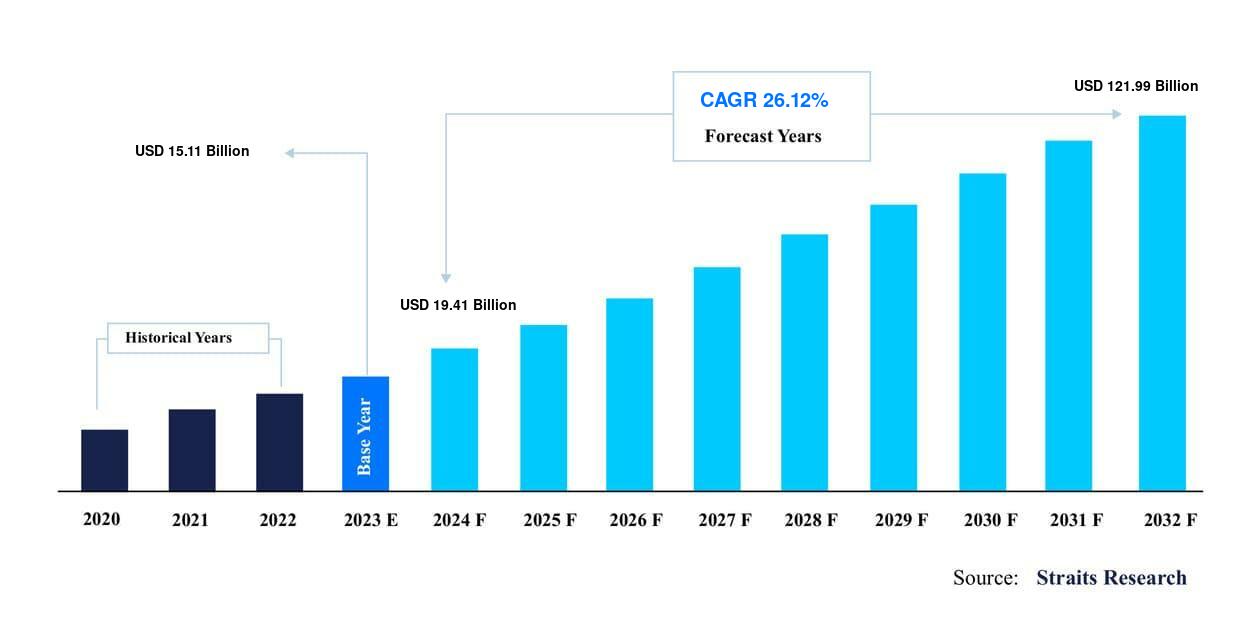
Videos play an important part in modern society and pop culture. For example, we use videos for entertainment, but we also use videos for surveillance to keep us safe. Inevitably, videos are a part of almost all aspects of our lives. Traditional methods of video creation, editing, and processing were time-consuming. Some of the methods involved filming using expensive cameras, developing the films in a darkroom, and editing by manually cutting and splicing film strips together. Even though 20th-century digital technology has made things a lot easier, the process still requires multiple teams of people working in collaboration. That was before the Artificial intelligence (AI) boom. From generating videos to personalised video recommendation systems for social media, AI is making waves in the industry, with the global market projected to reach $121.99 billion by 2032.

AI in Media & Entertainment Market Size | Source: Straits Research

In this article, we’ll dive into how AI and its different fields, like computer vision, generative AI, and natural language processing (NLP), are used to generate, edit, process video media, and more. We’ll also explore some of the many use cases of AI in video while discussing the advancements made through the integration of technologies like IoT Edge devices, GPU acceleration, and VR/AR/XR while considering the challenges involved. Let’s get started!

Understanding AI in Video Media

Before we discuss the application of AI in video media, let’s look at how AI’s use for videos has evolved over the years. The roots of artificial video generation can be traced back to the 1960s and 1970s through the use of computer-generated imagery (CGI) in movies. The turning point came with the invention of neural networks in the 1980s. Neural networks, inspired by the structure of the human brain, make it possible for computers to process and recognise patterns in visual data.

The next step in the transformation of AI for video generation came in the 2010s with the rise of advanced deep learning techniques, particularly convolutional neural networks (CNNs), that took the analysis and understanding of complex visual content a step further. It also made way for advancements in computer vision-based video processing techniques like object detection, image segmentation, and scene recognition. These innovations gave AI systems the power to analyse video frames for applications like automatic video tagging, content moderation, and video summarisation. (We’ll discuss some of these in detail in the next section.) Recently, the most remarkable AI milestones in video generation that have inspired many new models were the development of Generative Adversarial Networks (GANs) and Diffusion Models. Both of them have led the way in the production of highly realistic and compelling videos.

The Benefits of Using AI in Video

Before we dive into the applications of AI in video creation and consumption, it’s important to understand why they are so impactful. AI has completely changed the video industry and offers many benefits. Let’s look at some of these advantages:

  • Efficiency: Tasks like video editing, colour grading, and special effects can be automated using AI and save time and resources.

  • Quality: The overall quality of videos can be increased using AI by improving resolution, reducing noise, and stabilising footage. For example, AI can be used to add colour and resolution to old black-and-white video footage.

  • Accessibility: AI can be used to generate captions and subtitles to make videos more accessible to people with hearing impairments.

  • Creativity: New and innovative visual content can be generated using AI. These videos can inspire creativity and push the boundaries of storytelling.

  • Cost-effectiveness: Video and film production costs can be reduced using AI tools by automating tasks and streamlining workflows.

Applications

Now that we have a better understanding of the pros of AI for video creation and consumption, let’s take a closer look at some use cases of artificial intelligence in this field. We’ll also explore some applications of video analysis outside the media industry to better understand the underlying technologies and their versatility.

Video analysis is the use of AI and computer vision to automatically process and interpret visual data from videos. It involves techniques like object detection, facial recognition, motion tracking, and scene classification to extract valuable information from video footage. Beyond video creation and consumption, it’s good to be aware that videos are being analysed for different applications like self-driving cars and surveillance. Understanding these applications can help clarify how AI extracts valuable insights from video content for various purposes.

Video Creation Tools

A frame from an AI-generated video by Open AI’s Sora | Source: Open AI

What if you could create ultra-realistic videos without leaving your room? That’s exactly what AI can do for you. AI innovations like generative AI, GANs, and diffusion models, which we discussed earlier, led to the invention of AI tools like OpenAI’s Sora and Stability AI’s Stable Diffusion, which are some of the many tools currently used for artificial video creation. With these advancements, the AI video generation market is set to reach a staggering $1.96 billion by 2030, so many industries are looking into adopting the technology. Using the latest generative AI tools, you can create and edit video clips with prompts. Artists are also using diffusion models to create animated short films.

Social Media Content Moderation

Social media content moderation is crucial for maintaining decency and safety online. Considering billions of people are online, there is a massive amount of user-generated content that needs to be monitored for a secure online experience. Manually monitoring them is a daunting process, considering the increasing volume of content. AI tools like computer vision are great solutions for this. Computer vision systems can efficiently perform moderation tasks like automatic analysis and classification of harmful content. In real time, computer vision can be used to filter abusive, fake, and misleading content. Techniques like GPU acceleration are also used for much faster, real-time processing.

For example, YouTube, with more than 333,000 hours of video content getting uploaded in an hour, uses computer vision techniques to analyse and filter videos that violate their community guidelines. Whenever a user uploads a video, it goes through a process of analysis to see if it’s safe. By recognising patterns and features within the video frames, computer vision algorithms can detect inappropriate content, such as violence, nudity, or hate speech.

Autonomous Vehicles

Waymo’s self-driving car | Source: Waymo

Have you ever wondered how self-driving cars can always find their way, take turns, avoid obstacles, etc? It is all thanks to AI. Companies like Tesla and Waymo use computer vision models trained to recognise everything on the road, including traffic signs, other cars, and pedestrians. These models process the data locally on the vehicle’s on-board IoT Edge devices to make sure there is no delay. These features ensure safety for the driver and everyone else on the road.

While this application isn’t directly related to video creation and consumption, it gives us a good idea of how videos are processed using computer vision. In the context of self-driving cars, the AI solution analyses live video feeds from cameras to make split-second decisions. Similarly, in the video industry, computer vision is used to analyse video frames for tasks like automated editing, content moderation, and enhancing video quality. By understanding how AI processes visual data in such critical applications, we can better appreciate the underlying technology that also drives innovations in video creation and consumption.

Video Surveillance Systems

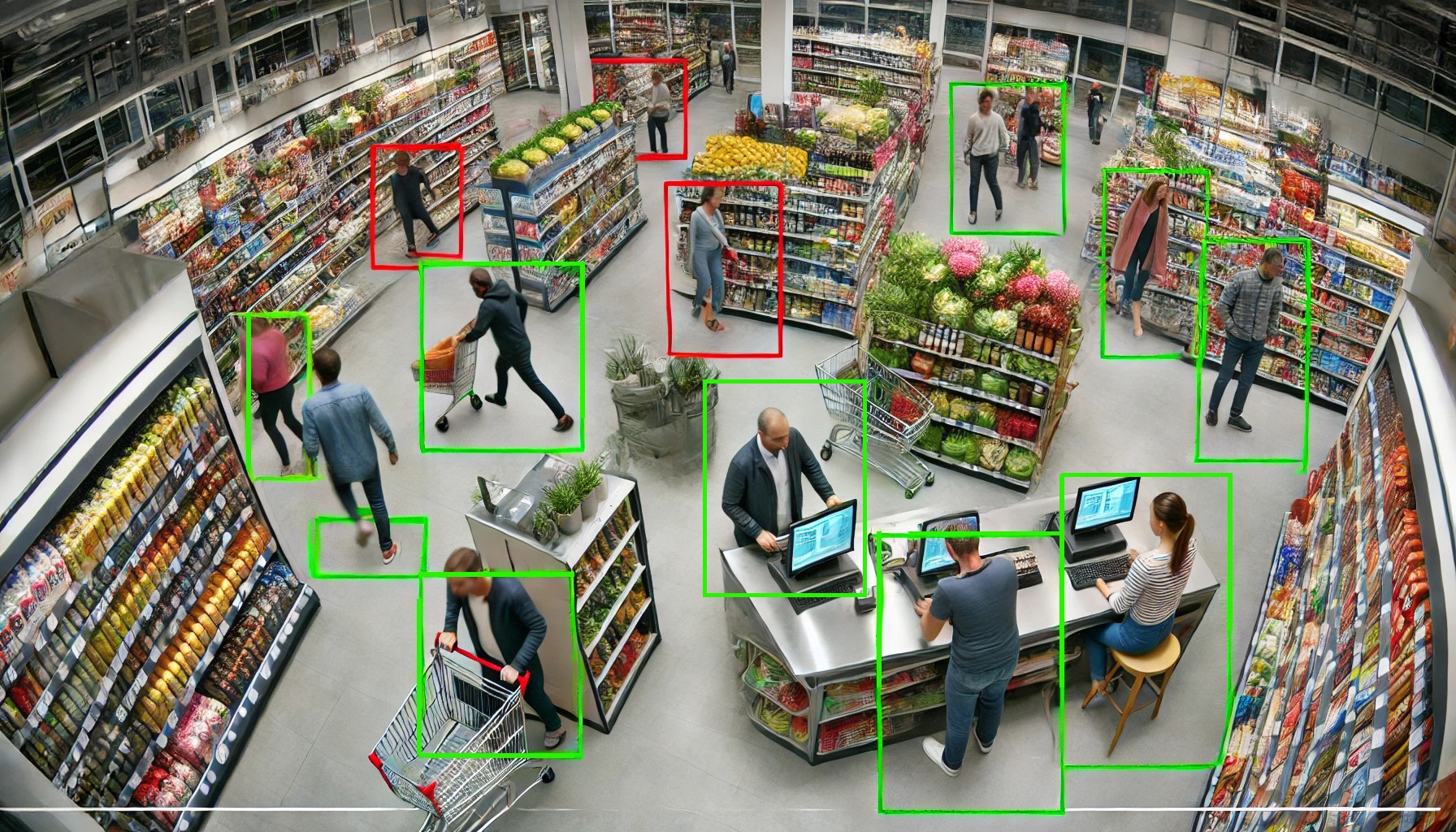
The use of AI in video surveillance systems has proven itself to be game-changing and is another great example of how videos can be analysed. It works by using computer vision techniques like object detection to process frames of surveillance video footage to identify objects. These objects include people, vehicles, animals, etc.

For added security, all the video analysis can be done locally using IoT edge computers that eliminate the need for cloud processing and storage. This can also be done by adding GPU accelerators to speed up the analysis further. Using such a system helps the user identify specific objects or anomalies in the surveillance video and can assist security guards with 24/7 automated monitoring. These systems can help in facilities like airports and railway stations where security is essential. For instance, Heathrow Airport in London saw a 30% decrease in security breaches after deploying AI video surveillance systems.

Detecting loitering using computer vision at an airport. | Source: Medium

The same AI concepts used in video surveillance, like analysing frames to detect and categorise objects, are also what makes it possible for AI to understand what a video is about. It is useful for organising videos by genre, tagging content, or improving recommendations on streaming platforms. With computer vision, AI solutions can automatically determine if a video is a drama, action, or comedy, making it easier to manage and improving the user experience. In the next section, we’ll explore this in more detail.

Enhanced User Experience for Entertainment Systems

If you’ve ever wondered how online movie streaming platforms like Netflix can accurately recommend content that you like, you’re not the only one. The technology behind it is called Natural Language Processing (NLP), which is a branch of AI. NLP can accurately process and generate textual data. Advanced NLP techniques are used by Netflix to provide their customers with personalised recommendations based on what they search. NLP is also used by video streaming platforms to generate transcripts and subtitles for video content.

Apple Vision Pro | Source: Apple

Another way AI can be used to enhance user experience is through the integration of AR/VR/XR technologies in gaming, movies, and learning. AR/VR/XR devices like the Apple Vision Pro can be used to view video content to elevate the overall movie viewing experience. Let’s say you are watching a historical documentary, you would feel transported back in time thanks to AR/VR/XR.

These devices also have computer vision features to detect and recognise hand gestures for navigation. In addition to this, Apple Vision Pro can be used to make the movie-watching experience more fun by detecting and replacing a wall or the roof of your house (if you’re indoors) with a cinema screen. In fact, according to surveys, 68% of people believe VR technology improves the video/movie-watching experience.

The Challenges

Now that we’ve explored some of the many applications of AI in video and media let’s consider some challenges. As AI continues to advance, it’s important to understand these challenges to make sure AI is used efficiently within the industry:

  • Upskilling and Reskilling: Encourage employees (video editors, digital artists, etc) to acquire new skills and knowledge related to AI and its applications in video production to stay up to date with the latest tech in the industry.

  • Bias: AI algorithms can perpetuate biases in the data they are trained on, leading to unfair or discriminatory outcomes in video production.

  • Privacy: These systems may collect and process personal data, raising concerns about privacy and data protection.

  • Cost: While the cost of implementing AI solutions can vary, it can become expensive if not managed carefully and without the right expertise.

  • Technical Limitations: AI technology is still evolving, and there may be limitations in terms of accuracy, reliability, and scalability.

  • Policy and Regulatory Frameworks: Policies and regulations need to be developed to support a fair and equitable transition to an AI-driven future.

By proactively addressing these challenges, the video industry can harness the benefits of AI while minimising its negative impacts. A strong collaborative effort is needed to involve all major stakeholders and solution providers like TechnoLynx to solve such challenges.

What We Can Offer as TechnoLynx

TechnoLynx is a software development company that helps startups and businesses upgrade their core AI technology. We aim to deliver tailor-made AI solutions to handle unique challenges. We specialise in guiding businesses through detailed research and development, from sketches to implementation. We understand your business needs and problems and deliver the best solution.

Our expertise in AI and AI-integrated solutions like computer Vision, generative AI, GPU acceleration, NLP, and VR/AR technologies covers almost all your business goals. We also care for scalability, security, and compatibility concerns for your business. Get in touch with us and see how you can elevate your business!

The Road Ahead

AI is changing the video industry in significant ways, making it easier, more creative, and more accessible. It automates tasks like video editing and even creates new types of visual content, which completely redefines how we make and watch videos. However, these advancements also bring challenges, such as bias, privacy issues, and the need for people to learn new skills. By addressing these challenges, the industry can keep innovating in a responsible way. AI will continue to play a big role in the future of video creation, consumption, and analysis, opening up new possibilities for creativity and technology.

Sources For Images:

  • Apple. (2023) Introducing Apple Vision Pro: Apple’s first spatial computer, Apple, 5 June.

  • OpenAI. (n.d.). Creating video from text, OpenAI.

  • Staqu Technologies. (2021) Role of CCTV Video Analytics Solutions in Airport Security and Operations, Medium, 25 August.

  • Straits Research. (2024). Ai In Media And Entertainment Market Size, Share & Trends Analysis Report By Solutions (AI in Media & Entertainment Hardware/Equipment, AI in Media & Entertainment AI in Media & Entertainment Services), By Application (Fake Story Detection, Plagiarism Detection, Personalization, Production Planning & Management, Sales & Marketing, Talent Identification, Content Capture, Sports Automatic Productions) and By Region(North America, Europe, APAC, Middle East and Africa, LATAM) Forecasts, 2024-2032, Straits Researc, 31 July.

  • Waymo. (n.d.). Waymo.

References:

  • Canda, J. (2024). The Role of AI in Content Moderation and Online Safety, Medium, 9 April.

  • Grand View Research, (n.d.). AI Video Generator Market Size, Share & Trends Analysis Report By Component (Solution, Services), By Application (Marketing, Education), By Organization Size, By Source, By Region, And Segment Forecasts, 2024 - 2030, Grand View Research.

  • Hayes, A. (2024). YouTube Stats: Everything You Need to Know In 2024!, Wyzowl, 32 May.

  • Straits Research. (2024). AI In Media And Entertainment Market Size, Share & Trends Analysis Report By Solutions (AI in Media & Entertainment Hardware/Equipment, AI in Media & Entertainment AI in Media & Entertainment Services), By Application (Fake Story Detection, Plagiarism Detection, Personalization, Production Planning & Management, Sales & Marketing, Talent Identification, Content Capture, Sports Automatic Productions) and By Region(North America, Europe, APAC, Middle East and Africa, LATAM) Forecasts, 2024-2032, Straits Research, 31 July.

  • VideoZen, (2023). The Evolution of AI in Video Generation: A Historical Perspective, Medium, 8 August.

Cost, Efficiency, and Value Are Not the Same Metric

Cost, Efficiency, and Value Are Not the Same Metric

17/04/2026

Performance per dollar. Tokens per watt. Cost per request. These sound like the same thing said differently, but they measure genuinely different dimensions of AI infrastructure economics. Conflating them leads to infrastructure decisions that optimize for the wrong objective.

Precision Is an Economic Lever in Inference Systems

Precision Is an Economic Lever in Inference Systems

17/04/2026

Precision isn't just a numerical setting — it's an economic one. Choosing FP8 over BF16, or INT8 over FP16, changes throughput, latency, memory footprint, and power draw simultaneously. For inference at scale, these changes compound into significant cost differences.

Precision Choices Are Constrained by Hardware Architecture

Precision Choices Are Constrained by Hardware Architecture

17/04/2026

You can't run FP8 inference on hardware that doesn't have FP8 tensor cores. Precision format decisions are conditional on the accelerator's architecture — its tensor core generation, native format support, and the efficiency penalties for unsupported formats.

Steady-State Performance, Cost, and Capacity Planning

Steady-State Performance, Cost, and Capacity Planning

17/04/2026

Capacity planning built on peak performance numbers over-provisions or under-delivers. Real infrastructure sizing requires steady-state throughput — the predictable, sustained output the system actually delivers over hours and days, not the number it hit in the first five minutes.

How Benchmark Context Gets Lost in Procurement

How Benchmark Context Gets Lost in Procurement

16/04/2026

A benchmark result starts with full context — workload, software stack, measurement conditions. By the time it reaches a procurement deck, all that context is gone. The failure mode is not wrong benchmarks but context loss during propagation.

Building an Audit Trail: Benchmarks as Evidence for Governance and Risk

Building an Audit Trail: Benchmarks as Evidence for Governance and Risk

16/04/2026

High-value AI hardware decisions need traceable evidence, not slide-deck bullet points. When benchmarks are documented with methodology, assumptions, and limitations, they become auditable institutional evidence — defensible under scrutiny and revisitable when conditions change.

The Comparability Protocol: Why Benchmark Methodology Defines What You Can Compare

The Comparability Protocol: Why Benchmark Methodology Defines What You Can Compare

16/04/2026

Two benchmark scores can only be compared if they share a declared methodology — the same workload, precision, measurement protocol, and reporting conditions. Without that contract, the comparison is arithmetic on numbers of unknown provenance.

A Decision Framework for Choosing AI Hardware

A Decision Framework for Choosing AI Hardware

16/04/2026

Hardware selection is a multivariate decision under uncertainty — not a score comparison. This framework walks through the steps: defining the decision, matching evaluation to deployment, measuring what predicts production, preserving tradeoffs, and building a repeatable process.

How Benchmarks Shape Organizations Before Anyone Reads the Score

How Benchmarks Shape Organizations Before Anyone Reads the Score

16/04/2026

Before a benchmark score informs a purchase, it has already shaped what gets optimized, what gets reported, and what the organization considers important. Benchmarks function as decision infrastructure — and that influence deserves more scrutiny than the number itself.

Accuracy Loss from Lower Precision Is Task‑Dependent

Accuracy Loss from Lower Precision Is Task‑Dependent

16/04/2026

Reduced precision does not produce a uniform accuracy penalty. Sensitivity depends on the task, the metric, and the evaluation setup — and accuracy impact cannot be assumed without measurement.

Precision Is a Design Parameter, Not a Quality Compromise

Precision Is a Design Parameter, Not a Quality Compromise

16/04/2026

Numerical precision is an explicit design parameter in AI systems, not a moral downgrade in quality. This article reframes precision as a representation choice with intentional trade-offs, not a concession made reluctantly.

Mixed Precision Works by Exploiting Numerical Tolerance

Mixed Precision Works by Exploiting Numerical Tolerance

16/04/2026

Not every multiplication deserves 32 bits. Mixed precision works because neural network computations have uneven numerical sensitivity — some operations tolerate aggressive precision reduction, others don't — and the performance gains come from telling them apart.

Throughput vs Latency: Choosing the Wrong Optimization Target

16/04/2026

Throughput and latency are different objectives that often compete for the same resources. This article explains the trade-off, why batch size reshapes behavior, and why percentiles matter more than averages in latency-sensitive systems.

Quantization Is Controlled Approximation, Not Model Damage

16/04/2026

When someone says 'quantize the model,' the instinct is to hear 'degrade the model.' That framing is wrong. Quantization is controlled numerical approximation — a deliberate engineering trade-off with bounded, measurable error characteristics — not an act of destruction.

GPU Utilization Is Not Performance

15/04/2026

The utilization percentage in nvidia-smi reports kernel scheduling activity, not efficiency or throughput. This article explains the metric's exact definition, why it routinely misleads in both directions, and what to pair it with for accurate performance reads.

FP8, FP16, and BF16 Represent Different Operating Regimes

15/04/2026

FP8 is not just 'half of FP16.' Each numerical format encodes a different set of assumptions about range, precision, and risk tolerance. Choosing between them means choosing operating regimes — different trade-offs between throughput, numerical stability, and what the hardware can actually accelerate.

Peak Performance vs Steady‑State Performance in AI

15/04/2026

AI systems rarely operate at peak. This article defines the peak vs. steady-state distinction, explains when each regime applies, and shows why evaluations that capture only peak conditions mischaracterize real-world throughput.

The Software Stack Is a First‑Class Performance Component

15/04/2026

Drivers, runtimes, frameworks, and libraries define the execution path that determines GPU throughput. This article traces how each software layer introduces real performance ceilings and why version-level detail must be explicit in any credible comparison.

The Mythology of 100% GPU Utilization

15/04/2026

Is 100% GPU utilization bad? Will it damage the hardware? Should you be worried? For datacenter AI workloads, sustained high utilization is normal — and the anxiety around it usually reflects gaming-era intuitions that don't apply.

Why Benchmarks Fail to Match Real AI Workloads

15/04/2026

The word 'realistic' gets attached to benchmarks freely, but real AI workloads have properties that synthetic benchmarks structurally omit: variable request patterns, queuing dynamics, mixed operations, and workload shapes that change the hardware's operating regime.

Why Identical GPUs Often Perform Differently

15/04/2026

'Same GPU' does not imply the same performance. This article explains why system configuration, software versions, and execution context routinely outweigh nominal hardware identity.

Training and Inference Are Fundamentally Different Workloads

15/04/2026

A GPU that excels at training may disappoint at inference, and vice versa. Training and inference stress different system components, follow different scaling rules, and demand different optimization strategies. Treating them as interchangeable is a design error.

Performance Ownership Spans Hardware and Software Teams

15/04/2026

When an AI workload underperforms, attribution is the first casualty. Hardware blames software. Software blames hardware. The actual problem lives in the gap between them — and no single team owns that gap.

Performance Emerges from the Hardware × Software Stack

15/04/2026

AI performance is an emergent property of hardware, software, and workload operating together. This article explains why outcomes cannot be attributed to hardware alone and why the stack is the true unit of performance.

Power, Thermals, and the Hidden Governors of Performance

14/04/2026

Every GPU has a physical ceiling that sits below its theoretical peak. Power limits, thermal throttling, and transient boost clocks mean that the performance you read on the spec sheet is not the performance the hardware sustains. The physics always wins.

Why AI Performance Changes Over Time

14/04/2026

That impressive throughput number from the first five minutes of a training run? It probably won't hold. AI workload performance shifts over time due to warmup effects, thermal dynamics, scheduling changes, and memory pressure. Understanding why is the first step toward trustworthy measurement.

CUDA, Frameworks, and Ecosystem Lock-In

14/04/2026

Why is it so hard to switch away from CUDA? Because the lock-in isn't in the API — it's in the ecosystem. Libraries, tooling, community knowledge, and years of optimization create switching costs that no hardware swap alone can overcome.

GPUs Are Part of a Larger System

14/04/2026

CPU overhead, memory bandwidth, PCIe topology, and host-side scheduling routinely limit what a GPU can deliver — even when the accelerator itself has headroom. This article maps the non-GPU bottlenecks that determine real AI throughput.

Why AI Performance Must Be Measured Under Representative Workloads

14/04/2026

Spec sheets, leaderboards, and vendor numbers cannot substitute for empirical measurement under your own workload and stack. Defensible performance conclusions require representative execution — not estimates, not extrapolations.

Low GPU Utilization: Where the Real Bottlenecks Hide

14/04/2026

When GPU utilization drops below expectations, the cause usually isn't the GPU itself. This article traces common bottleneck patterns — host-side stalls, memory-bandwidth limits, pipeline bubbles — that create the illusion of idle hardware.

Why GPU Performance Is Not a Single Number

14/04/2026

AI GPU performance is multi-dimensional and workload-dependent. This article explains why scalar rankings collapse incompatible objectives and why 'best GPU' questions are structurally underspecified.

What a GPU Benchmark Actually Measures

14/04/2026

A benchmark result is not a hardware measurement — it is an execution measurement. The GPU, the software stack, and the workload all contribute to the number. Reading it correctly requires knowing which parts of the system shaped the outcome.

Why Spec‑Sheet Benchmarking Fails for AI

14/04/2026

GPU spec sheets describe theoretical limits. This article explains why real AI performance is an execution property shaped by workload, software, and sustained system behavior.

Cracking the Mystery of AI’s Black Box

4/02/2026

A guide to the AI black box problem, why it matters, how it affects real-world systems, and what organisations can do to manage it.

Inside Augmented Reality: A 2026 Guide

3/02/2026

A 2026 guide explaining how augmented reality works, how AR systems blend digital elements with the real world, and how users interact with digital content through modern AR technology.

Smarter Checks for AI Detection Accuracy

2/02/2026

A clear guide to AI detectors, why they matter, how they relate to generative AI and modern writing, and how TechnoLynx supports responsible and high‑quality content practices.

Choosing Vulkan, OpenCL, SYCL or CUDA for GPU Compute

28/01/2026

A practical comparison of Vulkan, OpenCL, SYCL and CUDA, covering portability, performance, tooling, and how to pick the right path for GPU compute across different hardware vendors.

Deep Learning Models for Accurate Object Size Classification

27/01/2026

A clear and practical guide to deep learning models for object size classification, covering feature extraction, model architectures, detection pipelines, and real‑world considerations.

TPU vs GPU: Which Is Better for Deep Learning?

26/01/2026

A practical comparison of TPUs and GPUs for deep learning workloads, covering performance, architecture, cost, scalability, and real‑world training and inference considerations.

CUDA vs ROCm: Choosing for Modern AI

20/01/2026

A practical comparison of CUDA vs ROCm for GPU compute in modern AI, covering performance, developer experience, software stack maturity, cost savings, and data‑centre deployment.

Best Practices for Training Deep Learning Models

19/01/2026

A clear and practical guide to the best practices for training deep learning models, covering data preparation, architecture choices, optimisation, and strategies to prevent overfitting.

Measuring GPU Benchmarks for AI

15/01/2026

A practical guide to GPU benchmarks for AI; what to measure, how to run fair tests, and how to turn results into decisions for real‑world projects.

GPU‑Accelerated Computing for Modern Data Science

14/01/2026

Learn how GPU‑accelerated computing boosts data science workflows, improves training speed, and supports real‑time AI applications with high‑performance parallel processing.

CUDA vs OpenCL: Picking the Right GPU Path

13/01/2026

A clear, practical guide to cuda vs opencl for GPU programming, covering portability, performance, tooling, ecosystem fit, and how to choose for your team and workload.

Performance Engineering for Scalable Deep Learning Systems

12/01/2026

Learn how performance engineering optimises deep learning frameworks for large-scale distributed AI workloads using advanced compute architectures and state-of-the-art techniques.

Choosing TPUs or GPUs for Modern AI Workloads

10/01/2026

A clear, practical guide to TPU vs GPU for training and inference, covering architecture, energy efficiency, cost, and deployment at large scale across on‑prem and Google Cloud.

GPU vs TPU vs CPU: Performance and Efficiency Explained

10/01/2026

Understand GPU vs TPU vs CPU for accelerating machine learning workloads—covering architecture, energy efficiency, and performance for large-scale neural networks.

Energy-Efficient GPU for Machine Learning

9/01/2026

Learn how energy-efficient GPUs optimise AI workloads, reduce power consumption, and deliver cost-effective performance for training and inference in deep learning models.

Back See Blogs
arrow icon